
By BEST Childcare Consulting
In early childhood education and care, nothing matters more than the safety and wellbeing of the children entrusted to us. When a child lives with asthma, anaphylaxis, diabetes, epilepsy, or another diagnosed medical condition, families place an even deeper level of trust in educators and service leaders. They trust that every risk has been anticipated. They trust that every educator knows what to do. They trust that systems are strong, clear, and consistently followed.
On 27 January 2026, ACECQA released an updated template that strengthens how services plan, communicate and manage medical conditions. Medical Conditions Risk Management and Communication Plan. While this update does not change the law itself, it significantly improves how services demonstrate compliance, governance, and Exceeding-level practice.
This article explains what changed, what stayed the same, and what BEST recommends services do next.
Access the Templates
New ACECQA Template (2026 version):
https://www.acecqa.gov.au/media/47351
Older ACECQA Template (previous version):
https://www.acecqa.gov.au/media/32166
Key Differences Between the OLD and NEW ACECQA Templates
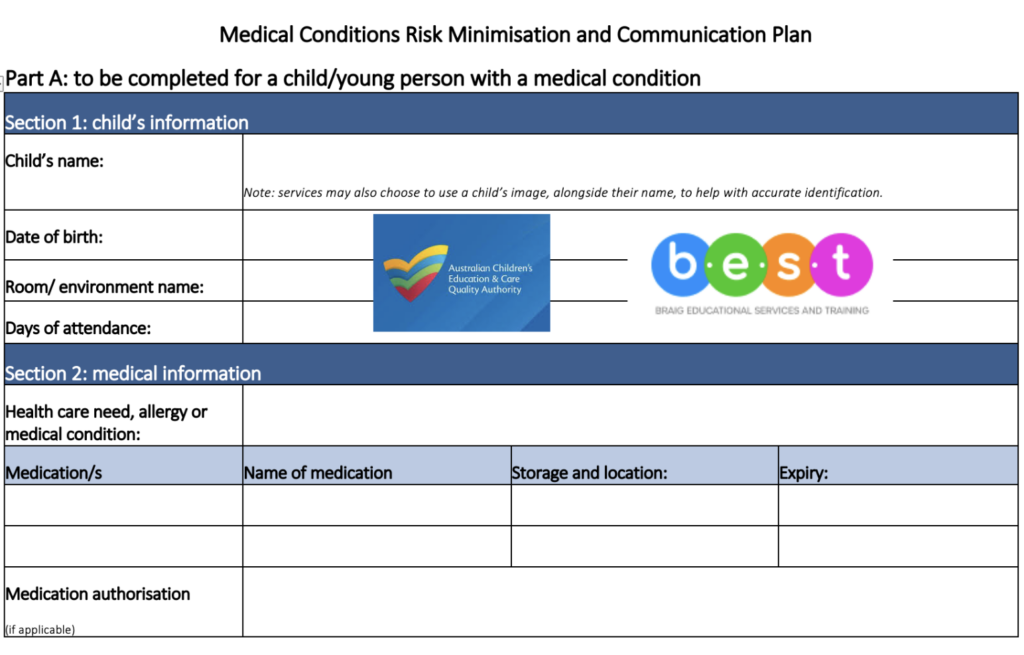
1. Important Name Change – From “Minimisation” to “Management”
OLD name:
Medical Conditions Risk Minimisation and Communication Plan
NEW name (2026):
Medical Conditions Risk Management and Communication Plan
This is a significant compliance shift.
The focus has moved from simply minimising risk to actively managing risk. This language aligns more closely with:
- National Quality Standard Quality Area 2 – Children’s Health and Safety
- Governance and risk management systems
- Modern safety and compliance frameworks
This reflects what assessors already expect: active, ongoing risk management.
2. Stronger Link to the Child’s Medical Management Plan
The new template now clearly requires services to:
- Attach the child’s medical management plan
- Cross-reference medical instructions directly
ACECQA guidance states services must:
“attach the medical management plan to this risk minimisation and communication plan.”
The previous version included this requirement, but the new template makes it much clearer and easier to demonstrate compliance.
3. Clearer Communication Procedures
The new template strengthens requirements around communication, including:
- How permanent staff are informed
- How relief and casual staff are informed
- How families provide updates
This aligns directly with Regulation 90 – Medical Conditions Policy and Communication Plan requirements.
Assessors are increasingly focused on how services ensure every educator knows exactly what to do.
4. Improved Risk Management Detail
The new template includes more structured sections covering:
- Hazard identification
- Risk control measures
- Environmental safety considerations
This reflects modern risk management practices and strengthens services’ ability to demonstrate proactive planning.
5. Better Alignment with Assessment and Rating Expectations
The new template makes it easier to demonstrate Exceeding practice because it clearly shows:
- Embedded systems
- Communication processes
- Ongoing review and monitoring
This is particularly relevant to:
- QA2 – Children’s Health and Safety
- QA7 – Governance and Leadership
6. Clearer Review and Monitoring Systems
The updated template now includes stronger sections for:
- Review dates
- Monitoring processes
- Ongoing evaluation
This supports regulatory requirements that medical risk plans are regularly reviewed and kept current.
What Did NOT Change
It is important to understand that the legal requirements themselves have not changed.
Services were already legally required to have:
- A medical management plan
- A risk minimisation plan
- A communication plan
The new template simply improves how services document and demonstrate these requirements.
Do Services Need to Redo Existing Plans?
Short answer: No — it is not legally required.
Older versions remain compliant if they are:
- Accurate
- Current
- Actively implemented
However, there is an important compliance reality.
What ACECQA and ECRU Assessors Expect in 2026
Assessors will accept older templates if they meet requirements.
However, the new template demonstrates stronger governance and best practice.
Services using current ACECQA templates show assessors:
- Current compliance knowledge
- Strong leadership
- Embedded systems
- Commitment to continuous improvement
This can support Exceeding ratings, particularly in:
- QA2 – Children’s Health and Safety
- QA7 – Governance
BEST Compliance Recommendation
BEST strongly recommends services transition to the new template.
Update the template:
• When a new child with a medical condition enrols
• When a child’s medical management plan is updated
• At the child’s annual medical plan review
• As part of your service’s ongoing compliance improvements
This ensures your service demonstrates current, best-practice compliance.
Why This Matters
Medical condition planning is not paperwork. It is protection. It is preparation. It is the difference between uncertainty and confident, immediate action. Strong systems protect children. Strong systems protect educators. Strong systems protect your service. Most importantly — strong systems protect trust.
BEST Childcare Consulting
At BEST, we help services move beyond minimum compliance and into confident, Exceeding-level practice. Updates like this are not just administrative — they are opportunities to strengthen systems, improve safety, and demonstrate leadership.
As always, use these updates to strengthen your everyday practices, embed robust systems, and demonstrate the quality and professionalism your families deserve.
Contact us TODAY.
See this BEST article “More Than Compliance: Embedding ASCIA Action Plans to Achieve Exceeding Practice and Protect Every Child (2026 Update)” for more information