
By BEST Childcare Consultancy
This is a legal requirement from 27 February 2026
There are moments in our profession where reform reminds us why our work matters so deeply.
Every day, families entrust services with what matters most in their lives — their children. They trust that the adults working with their children are safe, suitable, qualified, and supported. They trust that the systems behind the service are strong.
From 27 February 2026, one of the most significant national child safety reforms in early childhood education and care will take effect — the National Early Childhood Worker Register
The National Early Childhood Worker Register, developed by ACECQA, represents one of the most significant child safety reforms in early childhood education and care in recent years. It is designed to support regulatory authorities to monitor the workforce, identify risks earlier, and ensure safer environments for children across Australia.
This reform is not simply about administration. It is about visibility, accountability, and protection.
It recognises that safeguarding children is not just about policies — it is about knowing who is working with children, ensuring their suitability, and maintaining accurate records that follow
What is the National Early Childhood Worker Register?
The National Early Childhood Worker Register is a national database built within the existing National Quality Agenda IT System (NQA ITS) — the same system already used by approved providers and regulators.
For the first time, it creates a national workforce record of all people working in education and care services across Australia.
Importantly:
Educators themselves do NOT register.
Approved Providers are legally responsible for entering and maintaining all worker information.
This Register becomes the official electronic mechanism for workforce records that services are already required to collect and maintain under National Law.
How Services Can Prepare NOW
Services should begin preparing immediately by:
- Reviewing current staff records
- Ensuring all workforce details are accurate
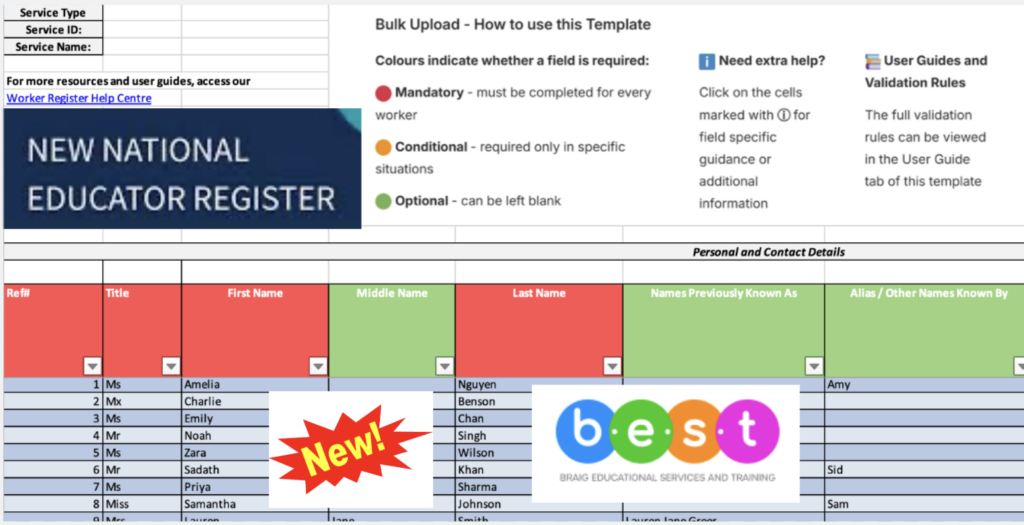
- Downloading the ACECQA Excel bulk upload template
- Planning who will manage the upload process
- Allowing sufficient time before the deadline
Do not wait until the last minute.
This is a legal requirement.
Who MUST Be Included in the Register?
The Register includes ALL workers, not just educators:
- Educators
- Teachers
- Nominated Supervisors
- Coordinators
- Family Day Care educators and assistants
- Students
- Volunteers
- Administration staff
- Cooks and drivers
- Agency and labour hire staff
- Any person working at the service
This ensures complete visibility of everyone working with children.
When Does This Become Mandatory?
Commencement Date: 27 February 2026
Approved Providers must: Within ONE month: Enter all current workforce information into the Register.
Ongoing Legal Requirement: Update worker information within 14 days when:
- A worker starts
- A worker leaves
- Worker details change
This requirement is mandated through changes to the Education and Care Services National Law and Regulations
What information needs to be recorded?
Keep information accurate and current. This becomes an ongoing compliance obligation.
For approved providers, the foundational educator register will be an electronic mechanism to enter information they must currently collect and maintain about their staff. This includes the following information about their staff:
- identity (name, date of birth, any alias and/or former names)
- contact information (address, telephone number and email)
- role at the service
- date of commencement / date of employment cessation
- service approval number of the service they are engaged with
- if they are employed directly or indirectly (e.g. through a recruitment agency or labour hire) at the service
- if they are employed on a three-month probationary basis (for centre-based services only) (not applicable
- in NSW)
- relevant qualifications held (and if applicable, that the staff member is ‘actively working towards’ that
- qualification, or is counted in ratios by virtue of a probationary period)
- evidence of having completed the following training and qualifications including:
- required child protection training, and the expiry date (if applicable)
- required child safety training, and the expiry date (if applicable)
- approved first aid qualification
- approved anaphylaxis management training
- approved emergency asthma management training.
- current Working With Children Check (WWCC) or Vulnerable People Check (WWVP) (or state equivalent) identifying number and expiry date OR teacher registration number and expiry date (if applicable).
How Providers Can Upload Workforce Information
There are three approved methods:
1. Direct Manual Entry
Entering staff one at a time via the NQA ITS portal.
2. Bulk Excel Upload
Using ACECQA’s official Excel template to upload multiple staff at once.
3. JSON Upload
Uploading data exported directly from your service software. This option is particularly useful for larger services.
There are guides on the following website for all three approved methods
Why This Reform Matters So Much
This reform strengthens child safety by:
- Supporting regulators to identify risks earlier
- Ensuring unsuitable individuals cannot move undetected between services
- Improving national workforce oversight
- Strengthening governance and accountability
- Supporting safer recruitment practices
This aligns directly with:
- National child safety reforms
- Royal Commission recommendations
- Stronger safeguarding expectations across the sector
Most importantly, it strengthens protection for children.
Future Stages – What Comes Next
Education Ministers have also asked ACECQA to explore expanding the Register in future phases.
Possible future developments include:
- Identity verification processes
- Integration with Working With Children Check systems
- Enhanced screening tools
- Potential national educator registration scheme
This represents a long-term transformation of workforce regulation.
National Quality Standard – Exceeding Practice Write-Ups
Quality Area 1 – Educational Program and Practice
Exceeding Theme 1 – Practice Embedded in Service Operations
The service embedded strong governance systems, including maintaining accurate Worker Register records, ensuring continuity of educators and stability for children. Consistent staffing supported secure relationships, predictable routines, and high-quality program delivery, which positively impacted children’s engagement and wellbeing.
Exceeding Theme 2 – Practice Informed by Critical Reflection
Through critical reflection, educators and leaders recognised that workforce stability directly impacts children’s sense of belonging and learning outcomes. The service strengthened recruitment and retention processes to ensure consistency of educators, supporting deeper relationships and intentional teaching.
Exceeding Theme 3 – Practice Shaped by Meaningful Engagement
Families were reassured through open communication about staffing stability, qualifications, and workforce governance systems. This strengthened family confidence in the educational program and in the suitability of those working with their children.
Quality Area 2 – Children’s Health and Safety
Exceeding Theme 1 – Practice Embedded in Service Operations
The service embedded the Worker Register into its child safety systems, ensuring all workers were verified, documented, and appropriately approved before working with children. This demonstrated a proactive approach to safeguarding.
Exceeding Theme 2 – Practice Informed by Critical Reflection
Leadership critically reflected on child protection responsibilities and strengthened workforce monitoring practices to ensure ongoing compliance with national child safety reforms.
Exceeding Theme 3 – Practice Shaped by Meaningful Engagement
Families were informed about national workforce reforms and reassured that strong systems were in place to ensure children’s safety and wellbeing at all times.
Quality Area 3 – Physical Environment
Exceeding Theme 1 – Practice Embedded in Service Operations
Strong workforce governance ensured that only authorised and verified staff accessed service environments, maintaining safe and secure spaces for children.
Exceeding Theme 2 – Practice Informed by Critical Reflection
The service reflected on supervision, access and environmental safety practices, ensuring workforce verification processes strengthened overall safety systems.
Exceeding Theme 3 – Practice Shaped by Meaningful Engagement
Educators, families and visitors were supported to understand the importance of workforce verification in maintaining safe environments.
Quality Area 4 – Staffing Arrangements
Exceeding Theme 1 – Practice Embedded in Service Operations
The service maintained accurate Worker Register records for all staff, ensuring staffing arrangements were safe, compliant and effectively managed.
Exceeding Theme 2 – Practice Informed by Critical Reflection
Leaders critically reflected on recruitment, onboarding and workforce documentation processes to ensure alignment with national reforms and best practice.
Exceeding Theme 3 – Practice Shaped by Meaningful Engagement
Educators were supported to understand how workforce monitoring contributes to professionalism, safety and sector integrity.
Quality Area 5 – Relationships with Children
Exceeding Theme 1 – Practice Embedded in Service Operations
Consistent and stable staffing supported secure, trusting relationships between educators and children, promoting emotional safety and wellbeing.
Exceeding Theme 2 – Practice Informed by Critical Reflection
Educators reflected on the importance of workforce stability in supporting children’s attachment, emotional regulation and sense of security.
Exceeding Theme 3 – Practice Shaped by Meaningful Engagement
Families shared feedback highlighting the importance of consistent educators in building trusting relationships with their children.
Quality Area 6 – Collaborative Partnerships with Families and Communities
Exceeding Theme 1 – Practice Embedded in Service Operations
The service maintained transparent workforce governance systems, strengthening family trust and confidence.
Exceeding Theme 2 – Practice Informed by Critical Reflection
Leadership reflected on how workforce transparency strengthens family partnerships and supports open communication.
Exceeding Theme 3 – Practice Shaped by Meaningful Engagement
Families were informed and reassured about national workforce reforms and how they protect children.
Quality Area 7 – Governance and Leadership
Exceeding Theme 1 – Practice Embedded in Service Operations
The service embedded the Worker Register requirements into governance systems, ensuring workforce records were accurate and maintained.
Exceeding Theme 2 – Practice Informed by Critical Reflection
Leaders critically reflected on workforce governance practices and strengthened systems to ensure compliance and accountability.
Exceeding Theme 3 – Practice Shaped by Meaningful Engagement
Leadership engaged with educators to build understanding of national workforce reforms and their importance.
Links and Resources
National Early Childhood Worker Register resources:
ACECQA Worker Register Overview:
https://www.acecqa.gov.au
Worker Register Fact Sheet:
https://www.acecqa.gov.au
Bulk Upload Excel Template:
https://www.acecqa.gov.au
Worker Register Approved Provider Checklist:
https://www.acecqa.gov.au
Support Contact:
Phone: 1300 422 327
Email: WorkerRegister@acecqa.gov.au
BEST Childcare Consultancy
The National Early Childhood Worker Register represents more than a database. It represents a commitment.
A commitment that every person working with children is known.
A commitment that safety is not assumed — it is verified.
A commitment that the systems behind our services are as strong as the educators within them.
Strong governance protects children. Strong leadership protects educators. Strong systems protect the profession.
As always, use these reforms to strengthen your service not just for compliance — but for culture, safety, and excellence.
As always, use these inspirations to lead your service throughout the whole year in your everyday practices to truly earn an exceeding rating.
Contact us TODAY.