Perfect for: A practical workforce pathway for childcare Directors to meet educator qualification and ratio requirements while recruiting, retaining and developing staff
By BEST Childcare Consulting
Struggling to find enough qualified educators? There may be another option, grow your own. Our latest BEST article explains how childcare services can use the Certificate III to Diploma to a University Degree as an Early Childhood Teacher pathway facilitates a practical workforce and qualification compliance strategy.
We cover Fee Free Cert III and Diploma training in WA, traineeships and employer incentives, “actively working towards” qualification rules, Diploma ratio requirements, online/flexible study, Diploma-to-university advanced standing, recent pay improvements and the Worker Retention Payment (WRP).
Importantly, we look at this from a Director and Approved Provider perspective. How supporting staff to gain their next qualification can help meet qualification requirements, retain good educators, develop Room Leaders and build your future ECT workforce. Instead of continually asking “Where will we find qualified educators?”, consider who you can help become one. Certificate III to Diploma qualified and becoming a Room Leader, to enrolling in a university degree to become a qualified Early Childhood Teacher.
Read the full article for the pathway, compliance information and links to government resources.
Workforce challenges
Finding enough qualified educators continues to be one of the biggest workforce challenges facing early childhood education and care services.
For childcare Directors and Approved Providers, however, the challenge is not simply finding enough people to fill the roster. Services must also ensure they continue to meet the National Quality Framework (NQF) educator qualification and educator-to-child ratio requirements.
Under Regulation 126 of the Education and Care Services National Regulations, in centre-based services educating and caring for children preschool age or under, at least 50% of the educators required to meet educator-to-child ratios must hold, or be actively working towards, an approved Diploma-level education and care qualification or higher. Other educators required to meet ratios must hold, or be actively working towards, at least an approved Certificate III-level qualification.
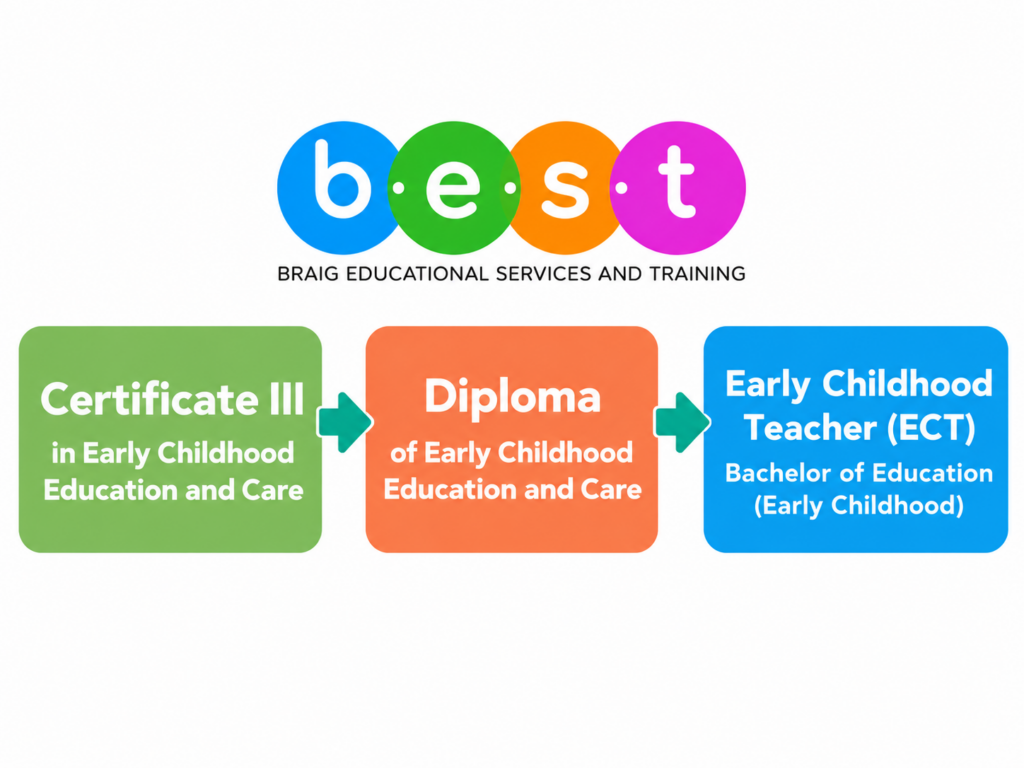
For services struggling to recruit qualified educators, there is another way to approach the problem. Instead of continually asking: “Where are we going to find another qualified educator?” consider: “Who can we help become one?” Early childhood education offers a particularly useful qualification pathway because an educator can progress through: Certificate III to Diploma qualified and becoming a Room Leader, to enrolling in a university degree to become a qualified Early Childhood Teacher
At each stage, the person gains a recognised qualification rather than having to commit to a four-year university degree from the beginning. Even better, much of this journey can occur while the educator remains employed in an early childhood service. For a service, supporting educators to study is therefore much more than professional development. It can form part of a deliberate strategy for qualification compliance, recruitment, retention, succession planning and developing future Early Childhood Teachers.
For childcare Directors: stop only recruiting qualifications and start developing them
There will always be times when a service needs to recruit an already-qualified Diploma educator, Room Leader or Early Childhood Teacher. But external recruitment does not have to be your only workforce strategy. Look around your service. Who is your enthusiastic trainee? Which Certificate III educator could become an excellent Diploma-qualified Room Leader? Which Diploma educator has the ability and interest to become an Early Childhood Teacher? Which employee has leadership potential but has never considered university because they assume it means giving up work and studying for another four years?
Supporting employees through Certificate III, Diploma and university study can help services develop a workforce that already understands their children, families, philosophy, policies and practices. It can support educator qualification compliance, recruitment, retention, succession planning, leadership development and future ECT workforce planning. Early childhood education now provides a particularly accessible progression pathway: Start with a traineeship. Gain a Certificate III. Continue to Diploma. Use that qualification and experience towards university. Keep working. Keep earning. Keep progressing.
For an individual, that can mean entering the sector without a university qualification and progressively building a professional career. For an early childhood service, it can mean turning a workforce shortage into a workforce-development strategy.
Five benefits for your childcare service
1. Help meet qualification requirements
Supporting Certificate III educators to progress towards an approved Diploma can help services develop the Diploma-level workforce required to meet Regulation 126 qualification requirements.
2. Recruit differently
Rather than competing only for educators who are already qualified, services can recruit suitable people through traineeships and support them to gain their Certificate III while employed. This allows a service to recruit for qualities such as attitude, reliability, relationships with children, willingness to learn and alignment with the service philosophy — and then help the person gain the qualification.
3. Use the “actively working towards” provisions
Where all regulatory requirements are satisfied, educators studying an approved Certificate III, Diploma or ECT qualification may be able to count towards the service’s qualification requirements while completing their studies. This can make educator study directly relevant to workforce and roster planning.
4. Retain and develop good educators
Providing a visible career pathway from Certificate III to Diploma becoming a Room Leader, enrol in university degree to become a qualified Early Childhood Teacher. This gives employees opportunities to progress professionally without necessarily leaving your service.
5. Build your future workforce
Developing existing staff creates a pipeline of Diploma-qualified educators, Room Leaders, educational leaders, future service leaders and potentially Early Childhood Teachers who already understand your children, families, philosophy, policies and practices. The result can be a much more sustainable workforce strategy: recruit, train, qualify, retain and progress.
DIRECTOR COMPLIANCE TIP: “Enrolled” does not automatically mean “actively working towards”
Do not assume that simply enrolling an educator in a course means they can immediately be counted as actively working towards a qualification. Directors should keep appropriate evidence demonstrating that the educator meets the applicable ACECQA requirements, including evidence of enrolment, commencement of the course and satisfactory progress. Additional requirements apply in some circumstances, particularly when an educator is being counted as actively working towards a Diploma-level qualification. Before including a studying educator within your service’s qualification calculations, check the current ACECQA requirements and retain appropriate evidence at the service.
ACECQA – Actively working towards a qualification:
https://www.acecqa.gov.au/qualifications-0/qualification-requirements/actively-working-towards-qualification
You don’t necessarily need to finish Year 12 or have an ATAR to get started on this career path
A career in early childhood education does not have to begin after completing Year 12 or achieving an ATAR. There are vocational pathways that allow young people to begin working towards a Certificate III in Early Childhood Education and Care while they are still at school, including school-based training and traineeship options where available. For someone who has already left school, whether they completed Year 12 or not, the Certificate III can also provide an entry point into the sector without requiring an ATAR or university entrance. This makes early childhood a particularly accessible career pathway: start with a Certificate III, gain a nationally recognised qualification, progress to the Diploma and, if you choose, use your vocational qualifications and experience as a pathway towards university and becoming an Early Childhood Teacher. Entry requirements and school-based options vary between training providers and individual circumstances, so prospective students should check eligibility with their school, Jobs and Skills WA and their chosen RTO.
Step 1: Start with the Certificate III
The CHC30121 Certificate III in Early Childhood Education and Care is the entry-level qualification for many people beginning a career in early childhood education. In Western Australia, CHC30121 is included on the 2026 Fee Free course list, subject to eligibility and availability through participating training providers. This removes one of the significant barriers for someone considering entering the profession. Rather than paying substantial course fees before they can begin a career, an eligible person can potentially undertake their Certificate III through government-funded training. For employers, however, the opportunity goes further.
Consider a traineeship
The Certificate III can be undertaken through a traineeship, allowing a person to be employed within an early childhood service while completing their qualification. In other words: They work. They earn. They study. They become qualified. This gives services another way to approach recruitment. Instead of advertising repeatedly for an already-qualified Certificate III educator, consider whether you could recruit someone who demonstrates the qualities you are looking for and support them to become qualified.
Government financial incentives may also be available to eligible employers taking on trainees. The Jobs and Skills WA Employer Incentive provides financial assistance to eligible WA businesses employing apprentices and new entrant trainees. Australian Government apprenticeship incentives may also apply depending on the trainee, occupation, qualification and current incentive arrangements. Services should check eligibility before assuming an incentive will apply.
WA Government – Employer incentives for apprentices and trainees:
https://www.wa.gov.au/service/education-and-training/vocational-education/state-government-incentives-employers-of-apprentices-and-trainees
Australian Government – Financial support for employers:
https://www.apprenticeships.gov.au/support-and-resources/financial-support-employers
“Actively working towards”
Another important advantage for services is the NQF provision allowing some educators who are studying to be considered actively working towards an approved qualification. For Certificate III-level qualification requirements and for Diploma level, an educator may be considered actively working towards the qualification where they meet the applicable requirements, including being enrolled, having commenced the course and making satisfactory progress. This means services do not necessarily have to wait until the educator graduates before their study becomes relevant to qualification planning. Again, however, Directors should check each educator individually against the current ACECQA requirements.
ACECQA – Qualification requirements for centre-based services:
https://www.acecqa.gov.au/qualifications-0/qualification-requirements/qualifications-centre-based-services-children-preschool-age-or-under
Step 2: Don’t stop at Certificate III — progress to the Diploma
Once an educator has completed their Certificate III, the next step can be the CHC50125 Diploma of Early Childhood Education and Care. The Diploma is also included on Western Australia’s 2026 Fee Free course list, subject to eligibility and provider availability. This creates an excellent opportunity for services. You may already have capable Certificate III educators who understand your service, have excellent relationships with children and families and show leadership potential. Instead of waiting until you need another Diploma-qualified educator and then advertising externally, start the conversation earlier: “Would you like to do your Diploma?” This can give the educator a clear next career step while simultaneously developing the service’s future Diploma-level workforce.
Why Diploma study matters for qualification compliance
This is where the pathway becomes particularly valuable for Directors managing Regulation 126.
At least 50% of the educators required to meet the educator-to-child ratios in the relevant centre-based services must hold, or be actively working towards, an approved Diploma-level qualification or higher.
A Certificate III-qualified educator who progresses into an approved Diploma and satisfies the applicable requirements may therefore be considered actively working towards a Diploma-level qualification.
This creates a logical workforce pathway: from Certificate III qualified, enrol in approved Diploma, meet ACECQA “actively working towards” requirements to then Completing Diploma and becoming a Diploma-qualified educator
For Directors, this is not simply about helping someone obtain another qualification. It can directly support qualification planning, roster planning and succession planning.
A practical training example: AIWT
There are many Registered Training Organisations offering early childhood qualifications, including TAFE and private providers. One WA example is the Australian Institute of Workplace Training (AIWT). AIWT offers early childhood Certificate III and Diploma qualifications and flexible learning arrangements. Flexible study can be particularly valuable to both educators and employers because it can allow study to be fitted around employment rather than requiring an employee to attend a campus several days every week. That matters to a childcare service. If an educator can continue working their normal or near-normal employment pattern while completing much of their theoretical learning flexibly, the service can continue to benefit from their availability while they progress towards the next qualification.
AIWT is simply one example. Services should compare RTOs, delivery methods, student support, traineeship arrangements, Fee Free eligibility, workplace requirements and course duration before recommending a provider.
AIWT:
https://aiwt.edu.au/
Jobs and Skills WA – Fee Free training:
https://www.jobsandskills.wa.gov.au/skillsready
Have an older Certificate III? You may still be able to progress to the new Diploma
There is also good news for experienced educators who completed an older Certificate III in Children’s Services or Early Childhood Education and Care. Changes to the entry requirements for the new CHC50125 Diploma of Early Childhood Education and Care mean that eligible superseded Certificate III qualificationscan now provide entry to the Diploma — educators do not necessarily need to complete the current CHC30121 Certificate III first. This can provide an important pathway for long-term educators who may have assumed their older qualification prevented them from progressing. Where an educator cannot demonstrate the required recent early childhood employment associated with their older qualification, additional entry requirements may apply, so the individual should check their eligibility with their chosen RTO. For Directors, this is worth discussing with existing staff: an educator with an older Certificate III may now have a much easier pathway to upgrade to the current Diploma, become Diploma-qualified and support the service’s qualification requirements.
Step 3: Diploma doesn’t have to be the end — progress to university
This is perhaps one of the least understood parts of the early childhood qualification pathway. A Diploma-qualified educator who wants to become an Early Childhood Teacher does not necessarily have to start a four-year university degree from the beginning. Some universities recognise previous early childhood qualifications and experience and provide advanced standing. This means the Certificate III and Diploma haven’t been wasted when someone decides they want to go further. They can become part of the pathway towards the degree.
UNE: a particularly useful Diploma-to-degree pathway
A very good example is the University of New England (UNE) Bachelor of Education (Early Childhood Education and Care). UNE offers the degree through online study, which makes it particularly attractive to educators who want to continue working while completing university.
More importantly, UNE has a published pathway for eligible Diploma-qualified educators. Eligible applicants entering through the relevant Diploma pathway can receive 96 credit points of block of advanced standing towards the 192-credit-point degree. In simple terms: Half of the four-year degree can already be credited. An eligible Diploma-qualified educator with the required workplace experience may therefore effectively enter at approximately third-year level, rather than beginning again in Year 1. The standard block advanced standing associated with this entry pathway is assessed as part of admission. An eligible Diploma applicant does not have to construct a separate subject-by-subject RPL portfolio simply to obtain the standard 96-credit-point block credit attached to that pathway.
Another significant advantage for working educators is professional placement. UNE states that students already working in the early childhood sector can complete most professional experience placements in the early learning service where they work, provided the service and placement meet UNE’s requirements. Some placements must still be completed outside the educator’s workplace, but this can substantially reduce the disruption associated with completing a teaching degree. For childcare Directors, it creates the possibility of retaining an experienced Diploma educator while they study online and complete much of their professional experience within the service — developing a future ECT without necessarily losing that employee from the workforce for extended periods.
There are eligibility and workplace-experience requirements, so applicants should always check UNE’s current rules when applying. But from a career-planning perspective, this makes the pathway extremely attractive. Certificate III to Diploma becoming a Room Leader, enrol in university degree to become a qualified Early Childhood Teacher.
UNE – Bachelor of Education (Early Childhood Education and Care):
https://www.une.edu.au/study/courses/bachelor-of-education-early-childhood-education-and-care
What if someone wants to go from Certificate III to university?
A Certificate III can also provide a pathway towards university admission in some circumstances. UNE, for example, recognises eligible early childhood Certificate III study within its admission arrangements and currently provides a smaller amount of advanced standing. However, for many educators the Certificate III to Diploma to Degree pathway may make considerably more sense. Why? Because the person gains another recognised vocational qualification before university. They can become a Diploma-qualified educator, access Diploma-level employment and leadership opportunities, and potentially receive substantially greater university advanced standing. Rather than asking someone beginning their career to commit immediately to a four-year university degree, the pathway can be broken into achievable stages. Get qualified. Work. Gain experience. Take the next step when you’re ready.
Other universities are available too
UNE is not the only university offering an early childhood teaching pathway. ECU also offers a Diploma-to-degree pathway. Eligible graduates of the Diploma of Early Childhood Education and Care may receive up to eight units (120 credit points) of credit towards ECU’s four-year Bachelor of Education (Early Childhood Studies), potentially reducing the remaining university study to approximately three years full-time. Unlike UNE’s published 96-credit-point block advanced-standing pathway, ECU describes its credit as “up to” 120 credit points, with the final amount determined through ECU’s Credit and Recognition of Prior Learning process.
ECU – Bachelor of Education (Early Childhood Studies):
https://www.ecu.edu.au/degrees/courses/bachelor-of-education-early-childhood-studies
The financial advantage: study, work and save
There can also be a significant financial advantage to progressing through the Certificate III, Diploma and onto a university pathway. In WA in 2026, both the CHC30121 Certificate III in Early Childhood Education and Care and CHC50125 Diploma of Early Childhood Education and Care are Fee Free for eligible students through participating providers. This means an educator may be able to gain their first two nationally recognised early childhood qualifications without paying the usual tuition fees. But the financial benefit is not just about course fees.
Through a traineeship and flexible study arrangements, educators can continue working and earning while they study, rather than leaving employment to become a full-time student. During this time, they can continue earning wages and superannuation while also building the workplace experience that becomes valuable when progressing to the next qualification.
The savings can continue at university. Under UNE’s current pathway, eligible Diploma-qualified educators with the required workplace experience receive 96 credit points of block advanced standing towards the 192-credit-point Bachelor of Education (Early Childhood Education and Care) — effectively recognising half of the four-year degree. That potentially means approximately two years of university study instead of four. At the Australian Government’s 2027 maximum student contribution for Education of $4,908 per equivalent full-time year, two years of advanced standing could represent approximately $9,800 in university student contributions that do not need to be incurred, depending on the units studied and applicable university fees.
There is another important saving for working educators: professional experience placements. UNE states that educators already working in early childhood can complete most of their professional experience placements within the early learning service where they work, provided the service and placement meet UNE’s requirements. Some placements must still be completed elsewhere, but completing most placements at your existing workplace may substantially reduce the amount of unpaid leave that would otherwise be required.
Where an eligible teaching student does need to undertake mandatory placement away from their normal paid work, the Australian Government’s Commonwealth Prac Payment may also provide financial assistance during eligible placements.
Put together, the pathway can be very attractive: Fee Free Certificate III, Fee Free Diploma, continue earning while studying, potentially two years of university advanced standing and most UNE placements potentially completed at your workplace. For an educator, progressing professionally therefore does not necessarily mean giving up their job, giving up their income or starting a four-year university degree from scratch. For a Director, that makes the pathway an important recruitment and retention tool as well as a way of developing the qualified workforce your service needs. You get to retain that educator while supporting them to become your future ECT.
Pay is also becoming a stronger reason to consider an early childhood career
Historically, one of the significant challenges in attracting and retaining educators has been pay. That picture is changing. The Children’s Services Award has undergone significant classification and wage changes during 2026 following the Fair Work Commission’s gender-based undervaluation review. For eligible services participating in the Australian Government’s Early Childhood Education and Care Worker Retention Payment (WRP), government funding also supports wages above applicable award rates. The WRP has been extended until 30 June 2028. Participating eligible services must meet the applicable wage conditions, and individual pay will depend on the educator’s classification, responsibilities, employment arrangements and the service’s participation in the program.
The important message for prospective educators is that early childhood wages have recently improved, while further qualifications can also create pathways into higher-level educator, Room Leader, leadership and teaching positions.
Fair Work Ombudsman – Children’s Services Award changes:
https://www.fairwork.gov.au/about-us/workplace-laws/award-changes/major-award-changes/gender-undervaluation-priority-awards-review/changes-to-the-childrens-services-award
Australian Government – Worker Retention Payment:
https://www.education.gov.au/early-childhood/providers/workforce/worker-retention-payment
Australian Government – WRP minimum rates:
https://www.education.gov.au/early-childhood/providers/workforce/worker-retention-payment/minimum-rates
Don’t forget the Early Childhood Teacher requirements
There is an important difference between an educator studying an ECT qualification and an educator who can actually be counted as an Early Childhood Teacher.
Regulation 242 currently provides a transitional provision in Western Australia under which certain educators enrolled in an approved ECT qualification may be “taken to be an Early Childhood Teacher” when the specified requirements are satisfied. However, the current WA provision is scheduled to expire on 31 December 2026. Unless the provision is extended or changed, Directors should not build their long-term ECT workforce planning around Regulation 242 continuing beyond that date. An educator studying an approved ECT qualification may still be able to count towards Certificate III or Diploma-level qualification requirements in particular circumstances, but this is different from being counted as the service’s ECT.
Always check the current ACECQA and WA requirements before relying on an educator to meet an ECT requirement.
The childcare qualification pathway at a glance
START WORKING IN EARLY CHILDHOOD
↓
CHC30121 CERTIFICATE III IN EARLY CHILDHOOD EDUCATION AND CARE
Fee Free for eligible WA students • traineeship opportunities • earn while you learn • potential actively-working-towards pathway
↓
QUALIFIED CERTIFICATE III EDUCATOR
↓
CHC50125 DIPLOMA OF EARLY CHILDHOOD EDUCATION AND CARE
Fee Free for eligible WA students • continue working • potential actively-working-towards Diploma status
↓
QUALIFIED DIPLOMA EDUCATOR
Room Leader and leadership opportunities
↓
APPROVED EARLY CHILDHOOD TEACHING DEGREE
Online study options • university advanced standing may recognise previous Diploma study • UNE example: eligible pathway provides 96 of 192 credit points
↓
DEGREE-QUALIFIED EARLY CHILDHOOD TEACHER
Look beyond traditional recruitment pathways
Developing your existing educators is only one part of workforce planning. Childcare services can also look at school-based pathways, traineeships, people returning to the workforce, career changers, vocational and university students, and appropriately qualified overseas workers when developing their future workforce. The WA Government’s Early Childhood Workforce Initiatives specifically focuses on attracting and retaining ECEC and OSHC educators, growing the pool of Early Childhood Teachers and promoting Fee Free early childhood training. The Australian Government also provides workforce support for early childhood employers through programs including Workforce Australia and employment and training initiatives.
For services experiencing difficulty recruiting Early Childhood Teachers, skilled migration may also form part of a longer-term workforce strategy. Early Childhood (Pre-primary School) Teacher is an occupation for which ACECQA undertakes migration skills assessments where required for the relevant skilled migration pathway. Overseas qualifications and visa eligibility should never be assumed to meet NQF requirements automatically — services and prospective employees should check qualification recognition with ACECQA and current visa requirements with the Australian Government Department of Home Affairs.
WA Government – Early Childhood Workforce Initiatives:
https://www.wa.gov.au/organisation/department-of-the-premier-and-cabinet/early-childhood-workforce-initiatives
Australian Government – Support for the early childhood workforce:
https://www.education.gov.au/early-childhood/providers/workforce/support
ACECQA – Migration Skills Assessment for Early Childhood Teachers:
https://www.acecqa.gov.au/apply-migration-skills-assessment-early-childhood-pre-primary-school-teacher
International students can also enter the early childhood pathway
International students are another potential source of future early childhood educators. Perth-based training providers such as AIWT (Australia-International Institute of Workplace Training) offer both the CHC30121 Certificate III and CHC50125 Diploma of Early Childhood Education and Care to international students, providing a pathway to gain Australian early childhood qualifications and practical workplace experience. AIWT also provides information about student visas, studying and living in Perth, work placement and progression from Certificate III to Diploma and potentially university.
For childcare services, this provides another workforce avenue worth considering alongside traineeships, school leavers, career changers and developing existing staff. However, studying an early childhood qualification in Australia should not be presented as guaranteeing permanent residency or a particular migration outcome. Visa, skilled migration and qualification-recognition requirements are separate and can change. International educators should obtain current migration information from the Australian Government and, where relevant, check ACECQA requirements for qualification recognition or migration skills assessment.
International students and skilled migration – another workforce pathway
International students and appropriately qualified overseas workers can also form part of a childcare service’s longer-term workforce strategy. This fits particularly well with the pathway because opportunities can expand as an educator gains higher qualifications, experience and responsibility.
International students can study Australian early childhood qualifications through CRICOS-registered training providers and universities. For example, a student may commence with early childhood vocational training, progress to the Diploma of Early Childhood Education and Care, gain industry experience and potentially continue to an approved university Early Childhood Teaching qualification.
At Diploma level, there are migration skills assessment pathways for particular occupations and circumstances. ACECQA is the skills assessing authority for Child Care Worker (Group Leaders only) and Child Care Centre Manager, with qualification and employment-experience requirements applying. Eligible international Diploma graduates may also be able to access a provisional skills assessment associated with the Temporary Graduate visa pathway, subject to meeting the relevant requirements.
Progressing further to become an Early Childhood Teacher can open additional skilled migration possibilities. Early Childhood (Pre-primary School) Teacher is a recognised skilled occupation, and ACECQA undertakes migration skills assessments for this occupation where required. ECTs may potentially access skilled, state-nominated or employer-sponsored migration pathways depending on the visa program and their individual circumstances.
For Directors and Approved Providers experiencing persistent recruitment difficulties, this means international recruitment can be considered alongside traineeships, school leavers, career changers and developing existing educators. Employer sponsorship may also be an option for eligible skilled positions where the service meets Australian Government sponsorship and nomination requirements.
DIRECTOR TIP: Migration rules are separate from NQF qualification requirements. Holding a visa, studying an Australian childcare course or having overseas early childhood experience does not automatically mean a person can be counted as Certificate III, Diploma or ECT qualified under the NQF. Always check the educator’s qualification status through ACECQA and obtain appropriate migration advice where required.
Useful links: ACECQA provides information on migration skills assessments for Early Childhood Teachers, Child Care Workers (Group Leaders only) and Child Care Centre Managers. The Australian Government Department of Home Affairs provides the current skilled occupation lists and employer-sponsored visa requirements.
Here are the official links I would place directly underneath that section of the article:
- ACECQA – Migration Skills Assessment: Child Care Worker (Group Leaders only)
Child Care Worker migration skills assessment - ACECQA – Migration Skills Assessment: Early Childhood (Pre-primary School) Teacher
Early Childhood Teacher migration skills assessment - ACECQA – Migration Skills Assessment: Child Care Centre Manager
Child Care Centre Manager migration skills assessment - ACECQA – Skilled Migration FAQs — useful overview explaining ACECQA’s role as a skills assessing authority.
Skilled Migration FAQs - Australian Government Department of Home Affairs – Skilled Occupation List — useful for checking which occupations relate to current skilled visa options.
Skilled occupation list - Australian Government Department of Home Affairs – How to Sponsor a Worker — particularly useful for Directors/Approved Providers considering overseas recruitment.
How to sponsor a skilled worker
Government and regulatory links for childcare Directors
ACECQA – Qualification requirements for centre-based services
Check Certificate III and Diploma-level qualification requirements:
https://www.acecqa.gov.au/qualifications-0/qualification-requirements/qualifications-centre-based-services-children-preschool-age-or-under
ACECQA – Actively working towards a qualification
Check when studying educators can be considered actively working towards Certificate III, Diploma or ECT qualifications:
https://www.acecqa.gov.au/qualifications-0/qualification-requirements/actively-working-towards-qualification
ACECQA – Quality Area 4: Staffing Arrangements
NQF operational guidance covering staffing and qualification requirements:
https://www.acecqa.gov.au/national-quality-framework/guide-nqf/section-4-operational-requirements/quality-area-4-staffing-arrangements
Jobs and Skills WA – Fee Free training
Check current Fee Free courses and student eligibility:
https://www.jobsandskills.wa.gov.au/skillsready
WA Government – Employer incentives for apprentices and trainees
Check whether your service and trainee may qualify for employer incentives:
https://www.wa.gov.au/service/education-and-training/vocational-education/state-government-incentives-employers-of-apprentices-and-trainees
Australian Government – Financial support for employers of apprentices and trainees
Check current Australian Apprenticeships employer incentives:
https://www.apprenticeships.gov.au/support-and-resources/financial-support-employers
Australian Government – Early Childhood Education and Care Worker Retention Payment
Check WRP eligibility and employer requirements:
https://www.education.gov.au/early-childhood/providers/workforce/worker-retention-payment
Fair Work Ombudsman – Children’s Services Award changes
Check the recent award classification and wage changes affecting early childhood educators:
https://www.fairwork.gov.au/about-us/workplace-laws/award-changes/major-award-changes/gender-undervaluation-priority-awards-review/changes-to-the-childrens-services-award
NOTE: Information current October 2026. Qualification requirements, Fee Free training, traineeship incentives, WRP requirements, university admission and advanced-standing arrangements can change. Approved Providers and educators should confirm current requirements with ACECQA, the WA Regulatory Authority, Jobs and Skills WA, their chosen training provider and university before relying on a particular pathway for qualification compliance.
From BEST Childcare Consulting
Meeting childcare qualification requirements doesn’t have to mean continually competing for already-qualified educators. By supporting staff through the Certificate III, Diploma, Early Childhood Teaching degree pathway, services can develop their own qualified workforce while improving retention, succession planning and qualification compliance. With Fee Free training, traineeships, “actively working towards” provisions, flexible and online study, university advanced standing and improved wages, there has rarely been a better time to show educators that early childhood can offer a genuine career pathway.
Look at the people already within your service, your next Diploma-qualified Room Leader or Early Childhood Teacher may already be there.
Need help reviewing your service’s qualification mix or developing a workforce qualification plan? BEST Childcare Consulting can work with your service to review current educator qualifications, identify staff who could progress from Certificate III to Diploma or ECT, check “actively working towards” requirements, and develop a practical pathway to support your future staffing and qualification needs.
Contact BEST Childcare Consulting to discuss how we can help you grow your own qualified workforce.