Perfect for Childcare Educators and Directors: Programming Ideas, Free Resources, AUSLAN and Exceeding NQS
By BEST Childcare Consulting
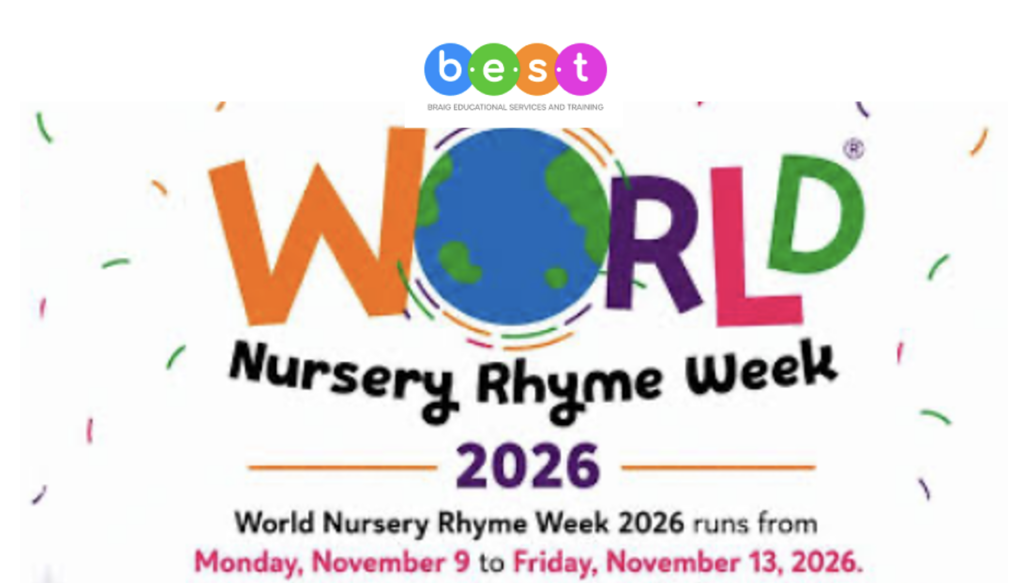
World Nursery Rhyme Week returns from Monday 9 November to Friday 13 November 2026, providing early childhood education and care services with a wonderful opportunity to celebrate the importance of nursery rhymes in children’s learning and development.
Established in 2013 by Music Bugs, this international initiative has involved more than eight million children worldwide. Each year, five nursery rhymes are selected as part of the Rhyme a Day Challenge, encouraging educators, families and children to explore language, music, rhythm, storytelling and movement.
Nursery rhymes may appear simple, but they provide valuable opportunities to support early literacy, communication, memory, mathematical thinking, social development and emotional wellbeing.
For babies, nursery rhymes can strengthen attachment and communication through familiar voices, eye contact and gentle movements. For toddlers, repetition and actions encourage emerging language, coordination and confidence. Older children can explore storytelling, patterns, prediction, numeracy and creative expression.
World Nursery Rhyme Week also provides an opportunity for educators to reflect on how familiar songs and rhymes are embedded within everyday practice, rather than being limited to group times or special occasions.
In this BEST article, we explore the five official nursery rhymes for 2026, practical programming ideas for different age groups, Australian Auslan resources, connections to EYLF V2.0 and MTOP V2.0, and examples of how services can document meaningful quality improvement across all seven National Quality Areas using the three Exceeding NQS themes.
The Five Official Nursery Rhymes for 2026
| Date | Official nursery rhyme | Learning opportunities |
| Monday 9 November | Hickory Dickory Dock | Counting, sequencing, positional language and rhythm |
| Tuesday 10 November | Doctor Foster | Weather, sensory investigation, storytelling and vocabulary |
| Wednesday 11 November | Pussy Cat, Pussy Cat | Imagination, communication, places and storytelling |
| Thursday 12 November | Row Row Row Your Boat | Cooperation, movement, rhythm and scientific exploration |
| Friday 13 November | 1, 2, 3, 4, 5 (Once I Caught a Fish Alive) | Counting, number recognition, coordination and patterns |
Services can participate by registering for the free official resource pack, which provides supporting activities for the selected rhymes.
Official website: World Nursery Rhyme Week – How to Take Part and Register
Educational Programming Ideas for Different Age Groups
The following experiences are designed to demonstrate how one nursery rhyme can be adapted to suit children’s ages, interests, abilities and developmental needs. Each experience includes a relevant resource and opportunities for intentional teaching.
Babies (1-2 Years): Row Row Row Your Boat – Connection Through Music and Movement
Learning experience: Educators introduced Row Row Row Your Boat during individual interactions and small-group experiences, using gentle rhythmic movements, eye contact, facial expressions and familiar voices.
Babies were encouraged to participate through vocalisations, smiles, reaching, body movements and anticipation of repeated words. Educators responded to each baby’s cues, adapting the pace and movement to ensure experiences remained comfortable and enjoyable.
The experience supported early communication, secure relationships, sensory awareness and emerging understanding of rhythm and repetition.
Intentional teaching: Educators modelled simple words and actions, paused to encourage responses and repeated familiar phrases to strengthen recognition and anticipation.
Learning framework links: EYLF Outcomes 1, 3 and 5.
Resource: Auslan Stage Left – Nursery Rhyme Resources offers an opportunity to incorporate visual communication and signing alongside familiar songs.
Toddlers (2–3 Years): Hickory Dickory Dock – The Mouse and the Clock
Learning experience: Educators created a simple clock using cardboard, large numbers and a toy mouse. Children explored the clock while singing Hickory Dickory Dock, moving the mouse up, down, around and behind the clock.
The experience encouraged children to practise positional language, counting, turn-taking and hand-eye coordination. Educators extended the activity by inviting children to predict where the mouse might go next.
Children’s interests were followed, allowing the experience to develop into imaginative play, construction and storytelling.
Intentional teaching: Educators introduced mathematical vocabulary, modelled counting and encouraged children to describe the mouse’s movements.
Learning framework links: EYLF Outcomes 4 and 5.
Resource: Educators Domain – Hickory Dickory Dock Activities includes clock investigations, mouse games and sensory experiences in its 2026 activity bundle.
3-Year-Old Kindergarten: Doctor Foster – Investigating Rain, Puddles and Weather
Learning experience: Children investigated rain and water through a sensory experience inspired by Doctor Foster. Educators provided containers, water, natural materials and opportunities to explore pouring, splashing and movement.
Children were encouraged to predict what might happen when water was poured onto different surfaces and to describe their observations using words such as wet, dry, shallow, deep and flowing.
The experience was extended through discussions about weather, rain clouds and the importance of water in the natural environment.
Intentional teaching: Educators encouraged children to ask questions, make predictions, compare observations and explore cause-and-effect relationships.
Learning framework links: EYLF Outcomes 2, 4 and 5.
Resource: Educators Domain – Doctor Foster Rain and Puddle Activities includes weather investigations and sensory experiences.
4-Year-Old Kindergarten: 1, 2, 3, 4, 5 – Fishing for Numbers
Learning experience: Educators created a fishing experience using numbered fish and magnetic fishing rods. Children were encouraged to catch fish, identify numerals, count their catches and compare quantities.
Educators extended learning by introducing simple mathematical questions, including which group contained more fish, which contained fewer and how many fish remained.
Children were also invited to create their own fish, develop number games and explore patterns.
Intentional teaching: Educators supported number recognition, one-to-one correspondence, mathematical vocabulary and problem-solving through playful interactions.
Learning framework links: EYLF Outcomes 4 and 5.
Resource: Educators Domain – 1, 2, 3, 4, 5 Fishing Activities includes fish-themed sensory play, counting and creative experiences.
Outside School Hours Care: Pussy Cat, Pussy Cat – Reimagining Traditional Nursery Rhymes
Learning experience: School-aged children were invited to revisit traditional nursery rhymes and transform them into contemporary stories, performances or creative productions.
Using Pussy Cat, Pussy Cat as inspiration, children developed alternative characters, locations and adventures. They worked collaboratively to write scripts, create props and perform their stories through drama, puppetry or digital storytelling.
Children were encouraged to take ownership of the experience, negotiate roles and contribute their individual ideas.
This approach recognised that older children may already know traditional nursery rhymes and benefit from more challenging, creative and self-directed experiences.
Intentional teaching: Educators supported collaborative planning, creative literacy, communication, problem-solving and children’s agency.
Learning framework links: MTOP V2.0 Outcomes 1, 2, 4 and 5.
Resource: Educators Domain – Nursery Rhyme Activity and Poster Set includes creative experiences and connections to MTOP V2.0 suitable for adaptation in OSHC.
Bringing Nursery Rhymes to Life with Australian Sign Language (Auslan)
World Nursery Rhyme Week provides an excellent opportunity for educators to introduce children to Auslan, Australia’s national sign language.
Using Auslan alongside familiar nursery rhymes can support inclusive communication, visual learning, participation and children’s understanding that people communicate in different ways.
Educators can introduce simple signs for familiar words such as cat, mouse, boat, fish, rain and numbers.
For babies and toddlers, combining familiar words with visual signs and gestures can encourage attention, interaction and emerging communication. Older children can explore how signs, facial expressions and body movements contribute to meaning.
It is important to distinguish between Auslan and key-word signing. Using a few Auslan signs alongside spoken English is not the same as teaching a complete Auslan translation of a nursery rhyme. Auslan has its own grammar and linguistic structure and is an important part of Australian Deaf culture.
Where possible, educators should use resources developed by Deaf Auslan users and organisations with appropriate linguistic expertise.
Useful Australian resources include:
- Auslan Stage Left – Nursery Rhymes – A collection of nursery rhyme resources in Auslan.
- Auslan Signbank – An Australian dictionary for researching individual signs and regional variations.
- Ipswich Libraries – First 5 Forever Quick Rhymes – Early literacy rhyme resources, including Auslan-supported material.
Educators can also invite families to share songs, rhymes and communication practices from home, ensuring children’s cultural and linguistic identities are reflected in the educational program.
Linking Nursery Rhymes to EYLF V2.0 and MTOP V2.0
Nursery rhyme experiences can support all five learning outcomes within the Early Years Learning Framework and My Time, Our Place.
| Learning outcome | Opportunities through nursery rhymes |
| Outcome 1 – Identity | Building confidence, positive relationships, participation and belonging |
| Outcome 2 – Connectedness | Exploring cultural traditions, family songs, cooperation and community connections |
| Outcome 3 – Wellbeing | Supporting emotional expression, movement, coordination and secure relationships |
| Outcome 4 – Confident and involved learners | Exploring counting, patterns, prediction, sequencing, investigation and creative thinking |
| Outcome 5 – Effective communicators | Developing vocabulary, listening, storytelling, phonological awareness and alternative communication |
The value of these experiences extends beyond learning specific songs. Educators can use nursery rhymes as a starting point for observing children’s interests, identifying learning opportunities and planning meaningful extensions.
Children’s responses should inform future programming, rather than educators expecting every child to participate in identical experiences.
QIP write up
QA1 – Educational Program and Practice
Theme 1 – Embedded Practice
Nursery rhymes, music, movement and storytelling were embedded throughout our educational program and everyday routines. Educators intentionally incorporated rhymes into transitions, individual interactions, group experiences and child-initiated play. Experiences were adapted to reflect children’s developmental stages, interests, communication needs and learning goals, supporting continuity between planned experiences and spontaneous learning opportunities.
Theme 2 – Critical Reflection
Educators critically reflected on how nursery rhymes were being used within the program and whether opportunities for intentional teaching extended beyond traditional group times. These discussions identified opportunities to strengthen phonological awareness, mathematical thinking, visual communication and child-led exploration. Programming was subsequently adjusted to provide more responsive, inclusive and meaningful experiences.
Theme 3 – Family and Community Engagement
Families were invited to contribute nursery rhymes, songs and storytelling traditions from their home environments. Their contributions influenced the selection of songs and learning experiences, ensuring the program reflected the cultural and linguistic diversity of our service community. These contributions were incorporated into ongoing programming rather than being limited to World Nursery Rhyme Week.
QA2 – Children’s Health and Safety
Theme 1 – Embedded Practice
Music, singing and movement were consistently incorporated into everyday wellbeing practices, supporting children during transitions, rest preparation and emotionally challenging moments. Educators responded to children’s individual sensory preferences and communication needs, providing opportunities for participation without requiring children to join large-group experiences. Materials and equipment used during nursery rhyme experiences were selected and supervised with consideration of children’s ages, abilities and safety requirements.
Theme 2 – Critical Reflection
Educators reflected on how musical experiences influenced children’s emotional regulation, engagement and wellbeing. Consideration was given to children who experienced sensory sensitivities, communication difficulties or discomfort during group activities. As a result, educators adjusted the volume, duration, group size and presentation of musical experiences to ensure children could participate comfortably and safely.
Theme 3 – Family and Community Engagement
Families shared information about songs and rhymes that provided comfort and familiarity at home. Educators used this knowledge to support children’s wellbeing, particularly during orientation, transitions and times of emotional distress. Where appropriate, guidance from families and relevant support professionals informed individual approaches to communication and sensory participation.
QA3 – Physical Environment
Theme 1 – Embedded Practice
Indoor and outdoor learning environments were organised to encourage independent access to musical instruments, storytelling materials, puppets and nursery rhyme resources. Children were able to revisit familiar rhymes through spontaneous play, construction, dramatic play and creative expression. Educators used existing materials and recycled resources to extend learning while promoting sustainable practices.
Theme 2 – Critical Reflection
Educators evaluated how the physical environment supported children’s access to music, language and imaginative play. Reflection identified opportunities to make resources more accessible and to provide quieter spaces for children who preferred individual or small-group experiences. Changes were implemented to strengthen children’s independence, participation and engagement.
Theme 3 – Family and Community Engagement
Families contributed ideas and reusable materials that supported the development of musical and storytelling experiences. Children’s home languages and cultural traditions were reflected within learning spaces, strengthening their sense of belonging. Family feedback informed decisions about the resources and experiences made available to children.
QA4 – Staffing Arrangements
Theme 1 – Embedded Practice
Educators worked collaboratively to provide consistent opportunities for music, language and communication throughout the day. Team members shared their knowledge of nursery rhymes, storytelling techniques and developmentally appropriate teaching strategies. Educators supported one another to adapt experiences for different ages and abilities, ensuring continuity of practice across rooms and staffing arrangements.
Theme 2 – Critical Reflection
Team discussions identified differences in educators’ confidence and approaches to using music, rhythm and nursery rhymes as intentional teaching strategies. Educators shared resources and reflected on how they could strengthen their knowledge of early language development, inclusive communication and Auslan. These discussions informed professional learning priorities and improvements to everyday practice.
Theme 3 – Family and Community Engagement
Educators drew on the knowledge and expertise of families and community members to broaden their understanding of different musical and storytelling traditions. This engagement supported professional learning and encouraged educators to consider alternative approaches to communication and participation. Knowledge gained through these relationships was shared across the educator team.
QA5 – Relationships with Children
Theme 1 – Embedded Practice
Educators used familiar nursery rhymes to build secure, respectful and responsive relationships with children. Individual singing, finger play and shared musical experiences were incorporated into everyday interactions, particularly with babies and toddlers. Educators followed children’s cues, acknowledged their preferences and encouraged participation through gestures, vocalisations, movement and verbal communication.
Theme 2 – Critical Reflection
Educators reflected on the quality of interactions occurring during musical experiences, considering whether children were genuinely engaged and whether their choices were respected. Reflection highlighted the importance of allowing children to initiate songs, change words, suggest actions or decline participation. Educators adapted their approaches to strengthen children’s agency, confidence and sense of belonging.
Theme 3 – Family and Community Engagement
Families shared familiar songs and rhymes that held personal or cultural significance for their children. Educators incorporated these into daily interactions, creating connections between home and the service. This supported continuity of relationships and helped children feel recognised, understood and valued within the learning environment.
QA6 – Collaborative Partnerships with Families and Communities
Theme 1 – Embedded Practice
The service maintained ongoing opportunities for families to contribute to the educational program through music, storytelling and cultural experiences. Nursery rhymes were used as a familiar and accessible way for families to participate in their children’s learning. Educators shared ideas and resources that families could use at home, strengthening continuity between home and the service.
Theme 2 – Critical Reflection
Educators critically reflected on whether family participation opportunities were accessible and meaningful for all families. Consideration was given to language differences, work commitments, cultural preferences and individual family circumstances. The service reviewed its communication approaches and introduced more flexible opportunities for families to contribute songs, recordings, written suggestions and cultural knowledge.
Theme 3 – Family and Community Engagement
Families actively contributed to the selection of nursery rhymes and musical experiences, sharing songs in home languages and explaining their cultural significance. These contributions influenced the educational program and encouraged children to recognise and celebrate different forms of communication and storytelling. Relationships with community organisations and relevant cultural and language resources further supported inclusive practice.
QA7 – Governance and Leadership
Theme 1 – Embedded Practice
The educational leader supported educators to recognise the learning opportunities provided through everyday music, nursery rhymes and storytelling. Planning discussions, programming reviews and professional conversations reinforced the importance of intentional teaching, inclusive practice and meaningful documentation. These expectations were incorporated into the service’s ongoing approach to curriculum development and quality improvement.
Theme 2 – Critical Reflection
The leadership team facilitated discussions about the educational value of nursery rhymes and how these experiences contributed to learning outcomes and the National Quality Standard. Educators examined whether existing practices were sufficiently inclusive, intentional and responsive to children’s interests. Outcomes from these discussions informed professional development priorities, programming improvements and ongoing QIP review.
Theme 3 – Family and Community Engagement
The leadership team encouraged families and community members to contribute their perspectives on music, language and cultural inclusion. Family feedback and educator reflections were considered during program reviews and quality improvement discussions. This engagement supported a shared understanding of the service’s educational priorities and informed decisions about future resources, professional learning and community partnerships.
Links and Resources for Educators
The following resource pages were located and checked through web search. Individual videos, downloadable files and purchasing processes may be subject to the providers’ access arrangements.
| Resource | What educators will find |
| World Nursery Rhyme Week – Official Website | Information about the 2026 celebration and the five official rhymes |
| Register for World Nursery Rhyme Week | Free registration and access to the official participation resource pack |
| Educators Domain – 2026 Nursery Rhyme Activity Bundle | A paid, updated bundle containing posters, learning stories, sensory play, STEM, music and curriculum-linked experiences |
| Auslan Stage Left – Free Nursery Rhymes | Free Auslan videos, including Hickory Dickory Dock and Row Row Row Your Boat |
| Auslan Signbank | An Australian dictionary for researching individual signs |
| ACECQA – Approved Learning Frameworks | EYLF V2.0, MTOP V2.0 and supporting information sheets |
| ACECQA – Exceeding NQS | Official guidance on the three Exceeding themes and assessment expectations |
| ACECQA – National Quality Standard | Detailed guidance on the Quality Areas, Standards and elements |
Bringing Nursery Rhymes into Everyday Practice
World Nursery Rhyme Week is a valuable opportunity to celebrate the role of music, language and storytelling in children’s development. However, the greatest educational benefits occur when these experiences continue beyond the designated celebration.
Educators can strengthen their everyday practice by observing how children respond to rhymes, adapting experiences to individual interests and developmental needs, incorporating family contributions and recognising the learning that occurs through familiar interactions.
For educational leaders and directors, the week also provides an opportunity to consider how simple experiences can demonstrate intentional teaching, inclusive programming, responsive relationships and meaningful family engagement.
Importantly, Exceeding practice is not demonstrated through the number of activities completed, photographs collected or special events celebrated. It is demonstrated through consistent, high quality practice that has been critically reflected upon and meaningfully shaped by the service community.
How BEST Childcare Consulting Can Help
At BEST Childcare Consulting, we support early childhood education and care services to move beyond simply documenting activities and towards demonstrating meaningful, embedded educational practice.
Our tailored professional development, educator mentoring, programming support and quality improvement guidance help services connect everyday experiences with EYLF V2.0, MTOP V2.0 and the National Quality Standard.
We work alongside directors, educational leaders and educators to strengthen intentional teaching, critical reflection, curriculum planning and Exceeding NQS evidence.
Our approach focuses on bringing policies, educational philosophies and quality improvement goals out of the cupboard and into everyday classroom practice, where they make a genuine difference to children’s learning, development and wellbeing.
As always, use these inspirations to lead your service throughout the whole year in your everyday practices to truly earn an exceeding rating.
Contact us TODAY.