
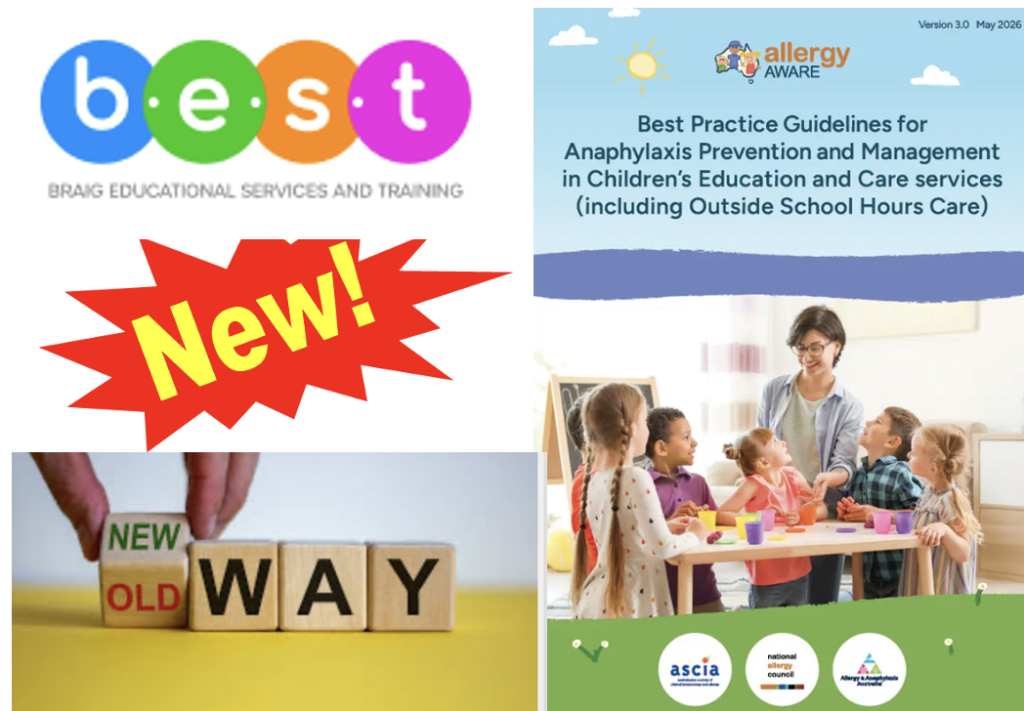
Perfect for all early childhood services, OSHC, family daycare and vacation care services in Australia. Best Practice Guidelines for Anaphylaxis Prevention and Management in Children’s Education and Care Services (Version 3.0 – May 2026)
By BEST Childcare Consultancy
A major new resource has been released for the children’s education and care sector: Best Practice Guidelines for Anaphylaxis Prevention and Management in Children’s Education and Care Services (Version 3.0 – May 2026). The updated national guidelines were developed by the National Allergy Council with input from health professionals, education departments, ACECQA, allergy organisations and early childhood providers across Australia.
These guidelines are designed to help services reduce the risk of anaphylaxis while ensuring children with allergies can fully participate in childcare experiences, excursions and everyday learning.
Importantly, the 2026 update introduces new expectations around adrenaline devices, drills, excursion planning and food allergy management training.
What is New in the 2026 Update?
The updated guidelines now include:
- Guidance on new adrenaline devices available in Australia (including injector devices and nasal spray options).
- Information on conducting anaphylaxis emergency drills.
- New tools and checklists for excursions, events and off-site activities.
- Recommendation that children undergoing Oral Immunotherapy (OIT) have this documented in care plans.
- Stronger recommendations for staff who prepare or supervise food to complete allergen management training.
- More emphasis on annual communication with families and allergy education for children.
- Greater focus on post-incident review, reporting and emotional support after allergic emergencies.
What Childcare Educators Need to Know
Educators are now expected to move beyond simply “knowing who has allergies.”
The guidelines recommend educators:
1. Be “Allergy Aware”, Not “Allergen Free”
The document clearly states food bans and labels such as “nut free” are not considered effective prevention strategies. Instead, services should implement allergy-aware risk reduction strategies.
Examples include:
- Handwashing routines
- Close meal supervision
- Preventing food sharing
- Managing cooking experiences safely
- Allergen-restricted seating when necessary
- Correct formula preparation
- Cleaning practices to reduce contamination
2. Recognise First-Time Anaphylaxis
Children may experience anaphylaxis without any previous diagnosis.
Educators should know:
- Signs of severe allergic reactions
- How to follow ASCIA Action Plans
- When to administer adrenaline immediately
- That adrenaline should be given if unsure rather than delayed
3. Complete Ongoing Training
The guidelines recommend:
- Full anaphylaxis training every 2 years
- Refresher training twice yearly
- Hands-on practice using trainer devices
- Training before commencing employment or during induction
4. Food Preparation Requires Specific Training
Untrained staff should not prepare or serve food to children with allergies.
This is significant for educators supervising meals or helping in kitchens.
What Childcare Management & Approved Providers Need to Know
Management responsibilities in the new resource are extensive.
Services should have:
Site-specific Anaphylaxis Policies
Policies must cover:
- Identification of children at risk
- Medical plans
- Risk minimisation
- Communication strategies
- Emergency response
- Incident reporting
- Staff training
- Food management
Policies should be reviewed at least every 2 years.
Individual Risk Plans
Children with allergies should have:
- Current ASCIA Action Plans
- Individualised anaphylaxis care plans
- Excursion risk plans
- Food management strategies
- OIT documentation where relevant
General Use Adrenaline Devices
The new guidelines recommend:
- At least one general use adrenaline device onsite
- Additional devices based on risk assessment
- Devices on excursions
- Expiry checks every 3 months
- Accessible but secure storage (not locked away)
Annual Communication Expectations
Management should communicate allergy policies with:
- Families
- Volunteers
- Relief staff
- Visitors
- Broader service community
Communication should occur at least yearly or whenever circumstances change.
Incident Reporting Requirements
All allergic reactions involving anaphylaxis risk should be reported to regulatory authorities within 24 hours through NQA ITS systems.
Post-incident debriefing is also recommended.
What Families Need to Know
Families have important responsibilities too.
Parents should provide:
✓ Current ASCIA Action Plans signed by doctors
✓ Updated plans if allergies change
✓ Information about medications or OIT programs
✓ Emergency devices where prescribed
✓ Details before excursions or catered events
Families should also understand:
- Childcare cannot promise to be “allergen free”
- Shared responsibility improves safety
- Open communication with educators matters greatly
What Children Need to Learn
The new guidelines highlight age-appropriate allergy education for children.
Children can learn:
- Not sharing food
- Washing hands after eating
- Respecting peers’ allergies
- Understanding allergies are serious
- Inclusive practices without bullying or exclusion
This aligns strongly with protective behaviours, empathy and inclusion.
Which Regulations Does This Resource Relate To?
The updated guidelines connect directly to the Education and Care Services National Law and National Regulations.
Key regulations referenced include:
National Regulation 85
Incident, injury, trauma and illness procedures
National Regulation 89
First aid kits
National Regulation 90
Medical conditions policy
National Regulation 91
Medical conditions policy provided to families
National Regulations 92–96
Medication administration and emergency exceptions
National Regulation 94
Emergency administration of medication for anaphylaxis
National Regulation 95–96
Medication procedures and self-administration
National Regulation 99–101
Excursion planning and risk assessments
National Regulation 136
Staff first aid qualifications and training
National Regulation 145 & 153
Staff training records
National Regulation 162
Health information in enrolment records
National Regulation 168–171
Policies, procedures and availability
National Regulation 173–176
Display requirements and regulatory notifications
Why This Update Matters for Exceeding Practice
These guidelines go beyond compliance.
Services embedding these recommendations demonstrate:
- Proactive risk management
- Continuous improvement
- Strong family partnerships
- Community communication
- Child-centred inclusion
- Reflective practice after incidents
- Ongoing workforce capability building
These are all practices closely connected with Exceeding themes across multiple Quality Areas.
What training do educators need?
This is one of the biggest areas of confusion in childcare, because first aid, asthma, anaphylaxis, and ASCIA training overlap but are not always the same requirement.
For educators working in Australian early childhood settings, the minimum staffing requirements under the National Regulations include access to people with approved first aid qualifications, approved anaphylaxis management training, and approved emergency asthma management training. One person can hold multiple qualifications if the course is ACECQA-approved.
HLTAID012 – Provide First Aid in an Education and Care Setting (or equivalent approved childcare first aid courses) often includes content on CPR, asthma and anaphylaxis emergencies and may satisfy multiple requirements if the qualification code is ACECQA approved. However, services must check the actual course code because some first aid certificates mention asthma/anaphylaxis but are not approved for those components.
So, do you need both HLTAID012/childcare first aid AND ASCIA training?
- Legally: Not always. If your ACECQA-approved first aid qualification already covers approved asthma and anaphylaxis competencies, ASCIA is generally not an additional mandatory requirement under the Regulations.
- Best practice: Yes, many services encourage or require staff to also complete ASCIA Anaphylaxis e-training for Children’s Education and Care, because it is childcare-specific, free, updated regularly, and focuses deeply on allergy prevention, ASCIA Action Plans, adrenaline devices and responding to anaphylaxis in education settings. The 2026 Best Practice Guidelines recommend all staff complete anaphylaxis training every two years and refresher training twice yearly.
- Important distinction: ASCIA training is education and competency building, while formal first aid qualifications are regulated vocational qualifications. ASCIA itself states its e-training should be completed alongside hands-on practice using adrenaline trainer devices.
The safest approach for management is: verify ACECQA approval codes on all first aid certificates and add ASCIA CEC e-training as annual or biennial professional development for all educators. That combination exceeds minimum compliance and aligns closely with the new 2026 Allergy Aware guidelines.
QIP Write up
Quality Area 1 – Educational Program and Practice
Exceeding Theme 1: Practice is embedded in service operations
Educators embedded allergy awareness and safe food practices into everyday routines including mealtimes, cooking experiences and hygiene procedures. Children regularly engaged in learning about inclusion, handwashing, not sharing food and keeping peers safe around allergies.
Exceeding Theme 2: Practice is informed by critical reflection
The team critically reflected on how intentional teaching opportunities could strengthen children’s understanding of allergies, safety and empathy. Reflection informed adjustments to routines, experiences and discussions to better support inclusion and protective behaviours.
Exceeding Theme 3: Practice is shaped by meaningful engagement with families and/or community
Families contributed information regarding children’s health needs and allergy management, supporting responsive curriculum planning. Educators incorporated family perspectives and current community health recommendations to strengthen learning experiences around wellbeing and safety.
Quality Area 2 – Children’s Health and Safety
Exceeding Theme 1: Practice is embedded in service operations
The service embedded allergy prevention, anaphylaxis management and emergency response procedures into everyday practice, policies and risk assessments. Mealtime supervision, documentation, medication management and emergency preparation were consistently implemented across all environments.
Exceeding Theme 2: Practice is informed by critical reflection
Educators and leadership reflected on emergency responses, risk minimisation strategies and training effectiveness to identify opportunities for improvement. Reflection supported updates to procedures, communication systems and health management practices.
Exceeding Theme 3: Practice is shaped by meaningful engagement with families and/or community
Families collaborated with educators to maintain current medical information and develop individualised health plans. Ongoing partnerships supported shared understanding and consistency in managing allergies and anaphylaxis risks.
Quality Area 3 – Physical Environment
Exceeding Theme 1: Practice is embedded in service operations
The physical environment was organised to support allergy safety through cleaning routines, safe food preparation areas and considered storage of medications and adrenaline devices. Educators implemented practices that reduced cross contamination risks while maintaining inclusive experiences for children.
Exceeding Theme 2: Practice is informed by critical reflection
The service regularly reviewed environmental risks associated with meals, excursions, celebrations and cooking experiences. Reflection informed changes to layouts, supervision practices and allergy risk minimisation strategies.
Exceeding Theme 3: Practice is shaped by meaningful engagement with families and/or community
Family feedback supported decisions around environmental adjustments needed to safely include children with allergies. Partnerships with families and health professionals informed practical changes to create safer environments.
Quality Area 4 – Staffing Arrangements
Exceeding Theme 1: Practice is embedded in service operations
The service maintained systems to ensure educators held current approved qualifications in first aid, asthma and anaphylaxis management where required. Ongoing professional learning, refresher training and induction processes supported educator confidence and capability.
Exceeding Theme 2: Practice is informed by critical reflection
Leadership reviewed staff knowledge, emergency preparedness and training outcomes to identify learning needs. Reflection informed decisions to strengthen hands-on practice, emergency drills and educator support.
Exceeding Theme 3: Practice is shaped by meaningful engagement with families and/or community
Staff learning was informed by family experiences, health professionals and evidence-based allergy organisations. Collaborative relationships strengthened educator understanding of individual needs and best practice responses.
Quality Area 5 – Relationships with Children
Exceeding Theme 1: Practice is embedded in service operations
Educators intentionally promoted empathy, inclusion and respect when discussing allergies and medical needs with children. Daily routines encouraged children to support peers through safe practices such as handwashing and not sharing food.
Exceeding Theme 2: Practice is informed by critical reflection
The team reflected on ways to reduce stigma or exclusion for children with allergies while supporting safety. Reflection strengthened inclusive approaches and respectful conversations about differences and wellbeing.
Exceeding Theme 3: Practice is shaped by meaningful engagement with families and/or community
Families shared strategies that supported children’s confidence and comfort in managing allergies within the service. Educators used this information to strengthen trusting relationships and responsive practices.
Quality Area 6 – Collaborative Partnerships with Families and Communities
Exceeding Theme 1: Practice is embedded in service operations
Communication regarding allergies, emergency procedures and medical documentation was embedded throughout enrolment, policy review and ongoing conversations. Families were regularly supported to provide updated health information and participate in planning.
Exceeding Theme 2: Practice is informed by critical reflection
The service reflected on the effectiveness of communication systems relating to allergies and medical management. Feedback informed improvements to enrolment processes, reminders and sharing of health information.
Exceeding Theme 3: Practice is shaped by meaningful engagement with families and/or community
Strong partnerships with families and health organisations supported consistent approaches to allergy management between home and care settings. Collaboration promoted shared responsibility for children’s safety and wellbeing.
Quality Area 7 – Governance and Leadership
Exceeding Theme 1: Practice is embedded in service operations
Leadership ensured policies relating to medical conditions, emergency management, excursions and allergy prevention were regularly reviewed and implemented. Governance systems supported proactive compliance and continuous improvement rather than reactive responses.
Exceeding Theme 2: Practice is informed by critical reflection
Leaders reflected on incidents, updated guidelines and staff feedback to evaluate service practices and identify priorities for improvement. Reflection supported changes to policies, professional learning and risk management processes.
Exceeding Theme 3: Practice is shaped by meaningful engagement with families and/or community
Decision making around training, policies and safety procedures was informed through consultation with educators, families and external organisations. Leadership fostered a culture of collaboration, transparency and shared commitment to children’s health and safety.
Helpful Links & Resources
Updated Best Practice Guidelines (2026):
Allergy Aware – Best Practice Guidelines for CEC Services
ASCIA Action Plans:
ASCIA Action Plans & First Aid Plans
Food Allergen Training for Childcare:
https://allergyaware.org.au/training/all-about-allergens-for-childrens-education-care
ACECQA Health & Safety Resources:
https://www.acecqa.gov.au/resources/supporting-materials/infosheet/health-and-safety
National Quality Framework:
https://www.acecqa.gov.au
BEST Childcare Consulting
As always, use these updates not only to meet compliance requirements but to strengthen everyday practice, build confidence in educators, and create safer, more inclusive environments for every child. The strongest allergy management systems are embedded into daily routines all year round — not only revisited after an incident occurs.
Contact us today.