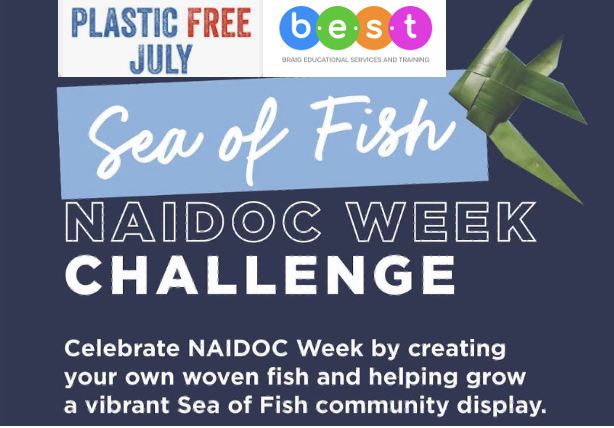
Perfect for NAIDOC Week (5-12 July 2026), Plastic Free July and The Sea of Fish Challenge 2026
By BEST Childcare Consulting
Every July, early childhood services across Australia celebrate NAIDOC Week and Plastic Free July. While these two national events may appear quite different, they are united by one powerful idea—care. Care for Country. Care for Sea Country. Care for culture. Care for community. Care for future generations.
The Sea of Fish Challenge, created by Connecting the Dots through Culture, brings these shared values together through one meaningful, collaborative project that helps children explore the connection between Aboriginal and Torres Strait Islander perspectives, environmental sustainability and caring for our oceans and waterways. More than an art activity, it encourages children to recognise that respecting culture and protecting the environment go hand in hand.
The challenge also aligns with the United Nations Sustainable Development Goals (SDGs) by supporting Responsible Consumption and Production (SDG 12), Climate Action (SDG 13), Life Below Water (SDG 14) and Life on Land (SDG 15). Through play, creativity and inquiry, children learn that even the smallest actions can help care for Country, Sea Country and the world around them. The Sea of Fish Challenge supports the vision of the EYLF V2.0 by nurturing children’s sense of belonging, connection and responsibility, while inspiring them to become respectful custodians of Country, Sea Country and the world around them—one fish, one conversation and one small action at a time.
What is the Sea of Fish Challenge?
The Sea of Fish Challenge is a national community initiative inviting children, educators, families, schools and organisations to create individual fish artworks that become one collective “Sea of Fish.”
Each fish represents an individual story.
When displayed together they become a powerful visual reminder that every person contributes to caring for our oceans, waterways, culture and communities.
The challenge encourages educators to respectfully embed Torres Strait Islander perspectives, celebrate Sea Country, inspire environmental responsibility and strengthen children’s understanding that everyone has a role in caring for the world around them.
Unlike many art activities, the finished display is only one part of the learning. The real value lies in the conversations, questions, investigations and relationships developed throughout the process.
Understanding Sea Country
When many people hear the word Country, they naturally think of the land. However, for Aboriginal and Torres Strait Islander peoples, Country includes both land and sea.
Sea Country refers to the oceans, reefs, beaches, estuaries, rivers, islands, tidal areas and marine environments that Aboriginal and Torres Strait Islander peoples have cared for since time immemorial. Like land Country, Sea Country is not simply a place—it is a living, interconnected system of culture, identity, spirituality, responsibility and relationships.
Sea Country holds ancestral stories, language, cultural practices, sacred places, traditional food sources and ecological knowledge that has been passed from generation to generation. Caring for Sea Country is an ongoing cultural responsibility built on respect, reciprocity and sustainability.
For Torres Strait Islander peoples, the sea is central to everyday life. It connects islands, families and communities. Knowledge of tides, currents, winds, marine animals and seasonal changes has supported sustainable living for thousands of years and continues to guide caring for Sea Country today.
Many Aboriginal nations throughout Australia also maintain deep cultural connections with coastal waters, rivers, wetlands and estuaries. Traditional ecological knowledge has long informed sustainable fishing, seasonal harvesting, habitat protection and respectful use of natural resources. These practices demonstrate an understanding that people have a responsibility to care for Country so that Country can continue to care for future generations.
For educators, this provides an important shift in thinking. Sustainability is not simply about recycling. It is about relationships—with people, animals, plants, waterways and the places that sustain us all.
The Sea of Fish Challenge provides children with an authentic opportunity to begin understanding these relationships through storytelling, creativity and inquiry.
Why Fish?
Fish are much more than marine animals.
For Aboriginal and Torres Strait Islander peoples they represent food, culture, connection, stories, identity and caring for Sea Country.
Fish have sustained communities for countless generations and continue to hold significant cultural importance throughout Australia.
By creating fish together, children begin conversations about:
- respecting Sea Country
- caring for marine life
- sustainable living
- cultural knowledge
- belonging to community
- our shared responsibility to protect the environment.
Each fish becomes a symbol of children’s own commitment to caring for the places, plants, animals and people around them.
Connecting with NAIDOC Week
The Sea of Fish Challenge provides educators with a respectful and practical way to embed Torres Strait Islander perspectives into everyday practice.
Rather than celebrating culture for one week each year, the challenge encourages ongoing conversations about:
- Sea Country
- Torres Strait Islander culture
- identity
- belonging
- storytelling
- traditional ecological knowledge
- caring for community.
Families can also contribute fish from home, strengthening genuine partnerships while creating a visible celebration of community participation.
As hundreds of individual fish come together, children experience an important message that reflects the spirit of NAIDOC Week 2026 – 50 Years of Deadly—that every person contributes to stronger, healthier communities.
Connecting with Plastic Free July
Plastic Free July encourages everyone to make small changes that collectively create significant environmental impact.
The Sea of Fish Challenge provides a practical way for children to understand this concept.
Rather than purchasing new craft materials, children can create fish using:
- recycled cardboard
- cereal boxes
- magazines
- reused paper
- fabric offcuts
- clean recycled plastics
- natural materials collected responsibly.
As children create, educators can investigate:
- how plastic enters our waterways
- why healthy oceans matter
- how marine animals are affected by pollution
- simple ways families can reduce single-use plastics
- how caring for Sea Country helps protect all living things.
The artwork itself becomes both an environmental statement and a celebration of children’s commitment to protecting our oceans and waterways.
More Than an Art Activity
The Sea of Fish Challenge is not about producing identical artwork.
It is about creating opportunities for meaningful conversations.
Children might investigate:
- What is Sea Country?
- Why is the ocean important?
- How have Aboriginal and Torres Strait Islander peoples cared for Sea Country for thousands of years?
- What animals live in our oceans?
- What happens when plastic reaches the sea?
- What can we do every day to help?
These inquiries help children develop empathy, curiosity and a sense of responsibility for the natural world.
Linking to the Early Years Learning Framework
The Sea of Fish Challenge naturally supports all five EYLF Learning Outcomes.
Children:
- develop a strong sense of identity through belonging to a collaborative community project
- connect with and contribute to their world
- demonstrate increasing responsibility for environmental sustainability
- become confident communicators through storytelling and discussion
- become involved learners through inquiry, creativity and investigation.
The challenge also reflects the EYLF Principles and Practices through Aboriginal and Torres Strait Islander perspectives, sustainability, partnerships with families, cultural responsiveness and intentional teaching.
Creating Your Sea of Fish
Some services may create twenty fish. Others may create hundreds. Imagine fish swimming across entrance foyers, hallways, ceilings, fences, libraries and community spaces. Invite families to create fish at home. Partner with local schools, libraries or aged care services. Share stories about caring for Country and Sea Country. Connect with local Aboriginal and Torres Strait Islander community members wherever possible to strengthen cultural learning and authenticity. Every fish tells a story. Together they become a visible reminder that when communities work together, small individual actions create lasting positive change.
The Bigger Picture
The Sea of Fish Challenge reminds us that caring for Country and Sea Country belongs to everyone.
By combining the messages of NAIDOC Week and Plastic Free July, children learn that respecting Aboriginal and Torres Strait Islander cultures and protecting the environment are not separate ideas—they are deeply connected.
Through one simple collaborative project, children discover that culture teaches us how to care for the environment, and caring for the environment is one way we show respect for culture.
One fish may seem small. Thousands of fish swimming together create a movement. Let’s fill Australia with a Sea of Fish.
QIP write up
Quality Area 1 – Educational Program and Practice
Embedded Practice
The Sea of Fish Challenge was intentionally embedded throughout the educational program as an ongoing inquiry project rather than a one-off craft activity. Educators responded to children’s interests by exploring Sea Country, Aboriginal and Torres Strait Islander perspectives, marine ecosystems, sustainability and environmental responsibility through play-based investigations, storytelling, science, creative arts and outdoor learning. Children’s voices guided the direction of the project, with learning documented through observations, learning stories, critical reflections and planning cycles aligned with the EYLF V2.0.
Critical Reflection
Educators reflected on how children’s understanding of sustainability became deeper and more meaningful when environmental education was connected with culture, relationships and caring for Country and Sea Country. The team considered how authentic First Nations perspectives enriched children’s learning and strengthened curriculum decision-making beyond significant cultural events.
Meaningful Engagement with Families and Community
Families were invited to create fish with their children, share sustainability practices from home and participate in discussions about caring for oceans, waterways and Country. Information displays, newsletters and conversations encouraged families to continue environmental learning at home while strengthening genuine partnerships between home and the service.
Quality Area 2 – Children’s Health and Safety
Embedded Practice
Children explored the relationship between healthy environments and healthy communities by investigating the importance of clean oceans, rivers and waterways. Learning experiences focused on protecting marine life, reducing plastic pollution and understanding that caring for the environment contributes to the wellbeing of people, animals and future generations. Safe practices were reinforced through environmental investigations and sustainable everyday routines.
Critical Reflection
Educators reflected on how environmental sustainability contributes to children’s developing sense of social responsibility, citizenship and wellbeing. The team discussed opportunities to further embed environmental responsibility into everyday practices while helping children understand that caring for Sea Country is an important part of caring for one another.
Meaningful Engagement with Families and Community
Families were encouraged to participate by reducing single-use plastics, recycling materials for the project and discussing ways they care for local beaches, rivers and natural environments. These shared experiences strengthened consistent messages between home and the service.
Quality Area 3 – Physical Environment
Embedded Practice
Learning environments evolved throughout the project as children’s collaborative Sea of Fish display transformed indoor and outdoor spaces into vibrant representations of Sea Country. Natural, recycled and open-ended materials were intentionally selected to promote sustainability while creating inviting environments that encouraged curiosity, creativity and collaborative learning.
Critical Reflection
Educators reflected on how thoughtfully designed learning environments inspire children’s environmental awareness and strengthen connections with nature. The team considered ways the physical environment could continue to reflect sustainability, Aboriginal and Torres Strait Islander perspectives and children’s growing understanding of caring for Country and Sea Country throughout the year.
Meaningful Engagement with Families and Community
Families contributed recyclable materials and fish created at home, creating a shared community display that celebrated children’s learning while demonstrating collective responsibility for environmental sustainability.
Quality Area 4 – Staffing Arrangements
Embedded Practice
Educators worked collaboratively to facilitate meaningful learning experiences that respectfully embedded Aboriginal and Torres Strait Islander perspectives alongside sustainability education. Professional conversations supported consistent approaches across the service and strengthened educators’ confidence in responding to children’s ideas through intentional teaching and inquiry.
Critical Reflection
The team reflected on their own cultural competence, environmental practices and confidence in embedding First Nations perspectives authentically throughout everyday curriculum rather than limiting learning to commemorative events. Reflection informed ongoing professional learning and continuous improvement.
Meaningful Engagement with Families and Community
Educators collaborated with families and community members to strengthen children’s learning through shared knowledge, conversations and participation, recognising that meaningful partnerships enrich educational outcomes for all children.
Quality Area 5 – Relationships with Children
Embedded Practice
Educators fostered warm, respectful and responsive relationships that encouraged children to confidently share ideas, ask questions and investigate environmental and cultural concepts together. The collaborative nature of the Sea of Fish Challenge promoted inclusion, teamwork, empathy and children’s sense of belonging within the learning community.
Critical Reflection
Educators reflected on how collaborative inquiry projects strengthened children’s agency, confidence and social competence. The team recognised that meaningful conversations about culture, sustainability and shared responsibility encouraged children to become active contributors within their communities.
Meaningful Engagement with Families and Community
Children proudly shared their fish, stories and learning with families, creating opportunities for meaningful conversations that strengthened relationships between children, educators and families while celebrating children’s achievements.
Quality Area 6 – Collaborative Partnerships with Families and Communities
Embedded Practice
The Sea of Fish Challenge strengthened partnerships with families by actively involving them in children’s learning about sustainability, Sea Country and Aboriginal and Torres Strait Islander perspectives. Families contributed fish, shared environmental actions from home and participated in discussions that connected learning across home and the service.
Critical Reflection
Educators reflected on how authentic family engagement significantly enriched children’s understanding of environmental responsibility and cultural respect. The team considered additional opportunities to build stronger partnerships with local Aboriginal and Torres Strait Islander community members, environmental organisations and community groups.
Meaningful Engagement with Families and Community
The collaborative display celebrated the contributions of children, families and the wider community, demonstrating shared responsibility for caring for Country and Sea Country. Community participation reinforced children’s understanding that positive environmental change is achieved when everyone works together.
Quality Area 7 – Governance and Leadership
Embedded Practice
Leadership supported a whole-service approach to embedding sustainability, Aboriginal and Torres Strait Islander perspectives and community engagement throughout the curriculum. The Sea of Fish Challenge aligned with the service philosophy, EYLF V2.0, National Quality Standard, sustainability commitments and, where applicable, the service’s Reconciliation Action Plan. Educational leadership ensured the project remained meaningful, culturally respectful and connected to continuous quality improvement.
Critical Reflection
Leadership reflected on how projects such as the Sea of Fish Challenge move beyond event-based programming by embedding culture, sustainability and environmental stewardship into everyday practice. Ongoing reflection considered how children’s learning, educator practice and community partnerships could continue to strengthen authentic cultural responsiveness and environmental leadership across the service.
Meaningful Engagement with Families and Community
Service leadership promoted the project through family communication, community partnerships and collaborative participation, recognising families and community members as valued contributors to children’s learning. The challenge fostered a shared commitment to caring for Country, Sea Country and future generations while strengthening the service’s culture of collaboration, inclusion and continuous improvement.
Links and Resources
Sea of Fish Challenge
NAIDOC Week
Plastic Free July
Early Years Learning Framework (EYLF V2.0)
- Belonging, Being and Becoming: The Early Years Learning Framework V2.0
National Quality Framework (NQF)
Guide to the National Quality Framework
Aboriginal and Torres Strait Islander Histories and Cultures
Reconciliation Australia
United Nations Sustainable Development Goals
Sustainability in Early Childhood
- Australian Association for Environmental Education (AAEE)
Marine Conservation
Educational Resources for Children
BEST Childcare Consulting
Related BEST Articles
Embedding Aboriginal and Torres Strait Islander Perspectives in Early Childhood Education
Expand your service’s learning with our companion articles
Raising Environmentally Responsible Children Through Sustainability, Country and Sea Country
Embedding Aboriginal and Torres Strait Islander Perspectives in Early Childhood Education
Together, these three articles provide a complete professional learning package that helps educators connect culture, sustainability, Sea Country and the National Quality Framework into one meaningful learning journey for children, families and communities.
BEST Childcare Consulting
The Sea of Fish Challenge is more than an environmental project. It is a reminder that every child has the capacity to care, every family has something valuable to contribute, and every educator has the opportunity to inspire future custodians of Country and Sea Country.
When we embed culture, sustainability and community into everyday practice, we don’t simply celebrate NAIDOC Week or Plastic Free July—we nurture children who understand that caring for people, place and the planet is part of who they are.
As always, use these inspirations to lead your service throughout the whole year in your everyday practices to truly earn an Exceeding rating.
At BEST Childcare Consulting, we’re passionate about helping services turn meaningful ideas into embedded practice. If you’d like support with cultural responsiveness, sustainability, professional development or Assessment and Rating preparation, contact us TODAY—we’d love to support your journey.
Contact us today.