
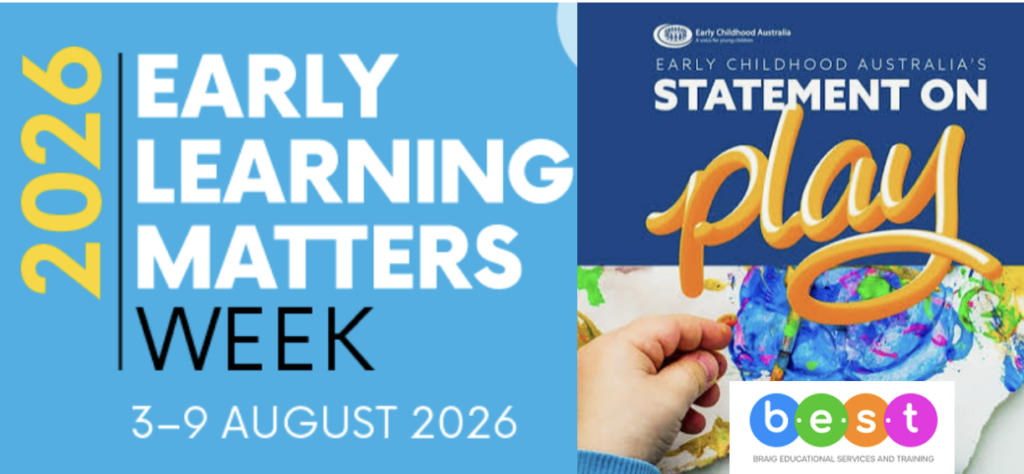
Perfect for Early Learning Matters Week 3–9 August 2026
By BEST Childcare Consulting
Children are never “just playing”.
Through play, children build language, confidence, creativity, resilience, relationships, problem-solving skills and a deeper understanding of the world around them.
Early Learning Matters Week, from 3–9 August 2026, is the perfect opportunity to celebrate the vital role of early childhood education and advocate for every child’s right to meaningful, uninterrupted and joyful play.
Our latest BEST article explores why play-based learning matters, how educators intentionally extend learning through play, practical programming ideas for services, and QIP examples across all seven Quality Areas.
Because play is not separate from learning. Play is learning.
Play based learning matters, Early Learning Matters
Every day in early childhood education and care, children build towers, create imaginary worlds, investigate insects, negotiate friendships, mix mud, tell stories, test ideas and ask endless questions.
To an untrained eye, these moments may look like children are “just playing”.
Early childhood educators understand that something far more important is happening.
Through play, children develop language, confidence, creativity, resilience, physical skills, emotional regulation, relationships and the capacity to think deeply about the world around them. Play is not time away from learning. For young children, play is one of the most powerful ways learning happens.
Early Learning Matters Week, held across Australia from 3–9 August 2026, provides an important opportunity to celebrate the profound impact of high-quality early childhood education and care on children, families and communities. Organised by Early Childhood Australia, the week is a national movement bringing together educators, families, caregivers and community leaders to advocate for the value of early learning.
This year, services can use Early Learning Matters Week to champion an especially important message:
Every child has the right to experience meaningful, uninterrupted and joyful play.
Early Childhood Australia’s Statement on Play recognises that the right to play belongs to every child, regardless of age, ability or background. It applies across early learning services, schools, families and communities, and calls on adults to protect, promote and value children’s opportunities to play.
This is particularly important at a time when children’s lives can become increasingly busy, structured and focused on measurable academic outcomes. Early childhood services have a vital advocacy role in helping families and communities understand that play-based learning is not an easier or less valuable alternative to formal instruction. It is a sophisticated, evidence-informed approach requiring skilled educators who observe, listen, plan, scaffold, respond and intentionally extend children’s thinking.
The Early Years Learning Framework Version 2.0 identifies play-based learning and intentionality as a central practice. It recognises that children learn through different forms of play and that both children and educators can take intentional roles within these experiences.
Early Learning Matters Week is therefore more than a celebration. It is an opportunity to:
- protect children’s right to play
- help families recognise the learning occurring through play
- celebrate the expertise and intentionality of educators
- strengthen community understanding of quality early childhood education
- demonstrate how play supports every area of children’s development, wellbeing and learning.
Why Play-Based Learning Matters
Play gives children the freedom to explore ideas, make choices, take reasonable risks and learn through experience.
When children build with blocks, they encounter mathematical concepts such as balance, measurement, shape, pattern and spatial awareness.
When children participate in dramatic play, they develop language, cooperation, empathy, imagination and an understanding of their social world.
When children climb, dig, run and investigate outdoors, they develop strength, coordination, confidence, curiosity and connection with the natural environment.
When children engage with art, music, movement and storytelling, they communicate ideas, express emotions and develop their individual identities.
When children encounter challenges during play, they learn to persist, adapt, negotiate and try again.
Play-based learning also respects children as capable and active participants in their own education. Rather than positioning children as passive recipients of information, it provides opportunities for them to initiate ideas, test theories and influence the direction of their learning.
This reflects Element 1.2.3 of the National Quality Standard, which requires each child’s agency to be promoted so that children can make choices and decisions that influence events and their world. It also aligns with Element 1.2.2, under which educators respond to children’s ideas and play and extend their learning through questions, interactions and feedback.
Play-Based Learning Is Intentional
Advocating for play-based learning does not mean educators simply provide toys and step away.
High-quality play-based programs are deliberately and thoughtfully created. Educators:
- know each child’s interests, abilities, culture and learning dispositions
- design engaging and inclusive environments
- select open-ended materials that can be used in many ways
- observe children closely
- recognise learning as it occurs
- introduce ideas, language and resources
- ask questions that deepen children’s thinking
- model skills where appropriate
- allow time for sustained and uninterrupted play
- document and evaluate children’s learning
- use observations to guide future planning.
ACECQA explains that play-based learning with intentionality can expand children’s thinking, strengthen their desire to learn and promote positive learning dispositions. Intentionality may be evident in planned experiences, but it is also demonstrated when educators notice spontaneous play and provide timely support or scaffolding.
The educator’s role may change from moment to moment. At times, the educator may observe quietly. At other times, they may join the play, introduce new vocabulary, pose a question, help resolve a problem or provide a resource that takes the investigation in a new direction.
The skill lies in knowing when to step forward, when to step back and when to follow the child’s lead.
Educational Programming and Advocacy Ideas
1. Create a “Learning Through Play” Exhibition
Create an exhibition throughout the service showing photographs of children engaged in different types of play.
Include examples of:
- construction and block play
- dramatic and imaginative play
- sensory exploration
- nature play
- music and movement
- creative arts
- physical play
- loose-parts play
- scientific investigation
- collaborative games.
Beside each photograph, explain the learning taking place. For example:
What may look like block play is also mathematics, engineering, communication, persistence, creativity and cooperation.
Link documentation to the EYLF principles, practices and learning outcomes.
Useful resource:
Early Years Learning Framework Version 2.0
2. Host a “Come and Play With Us” Family Session
Invite families to spend time playing alongside children within the service.
Set up experiences using:
- loose parts
- clay
- water
- blocks
- natural materials
- dramatic-play resources
- puzzles
- musical instruments
- outdoor physical challenges.
Encourage educators to explain how children’s ideas, agency and problem-solving are supported through each experience.
Provide families with a short explanation of why uninterrupted play is essential for children’s development and how play can be supported at home without expensive toys or highly structured activities.
Useful resource:
ECA Statement on Play
3. Develop “The Learning Behind the Play” Displays
Choose familiar experiences from each learning environment and explain the rich learning occurring within them.
Examples could include:
Sandpit play
Children may be developing:
- measurement and volume concepts
- coordination and physical strength
- cooperation
- scientific thinking
- creativity
- language
- problem-solving.
Dramatic play
Children may be developing:
- communication
- empathy
- social understanding
- negotiation
- imagination
- cultural knowledge
- early literacy and numeracy.
Outdoor climbing
Children may be developing:
- balance
- strength
- risk-assessment skills
- persistence
- confidence
- spatial awareness.
Use these displays to challenge the idea that meaningful learning must always produce a finished product.
4. Ask Children: “What Does Play Mean to You?”
Invite children to share their views about play through:
- drawings
- photographs
- group discussions
- recorded conversations
- paintings
- clay models
- dramatic performances
- child-led tours of favourite play spaces.
Possible questions include:
- What do you love to play?
- How does playing make you feel?
- What do you learn when you play?
- Where is your favourite place to play?
- Who do you like to play with?
- What makes play fair and inclusive?
- What would you add to our playground or learning environment?
Display children’s responses prominently and use them to inform curriculum decisions.
This supports children’s agency and demonstrates that their perspectives genuinely influence the program.
5. Protect a Period of Uninterrupted Play
Review the daily routine and identify whether children have sufficient time to become deeply engaged in play.
Consider whether play is regularly interrupted by:
- unnecessary transitions
- whole-group expectations
- rigid meal schedules
- educator-directed activities
- cleaning routines
- pressure to move between indoor and outdoor environments.
Trial an extended period of uninterrupted play and observe changes in children’s:
- concentration
- cooperation
- creativity
- problem-solving
- emotional regulation
- sustained shared thinking.
Use educator reflections and observations to consider whether routines could be permanently adjusted.
6. Create a Play Provocation Trail
Develop a series of open-ended invitations throughout the service.
These might include:
- ramps, tubes and rolling objects
- mirrors, light and transparent materials
- natural loose parts
- pulleys and baskets
- clay and natural impressions
- water channels
- shadow investigations
- cardboard construction
- fabric, pegs and shelter building
- maps and small-world materials.
Avoid determining a single expected outcome. Instead, allow children to explore the resources in their own ways.
Educators can observe, document emerging theories and add materials in response to children’s ideas.
Useful resource:
ACECQA—Play-based learning and intentionality
7. Hold a Screen-Free Family Play Challenge
Invite families to choose one evening or weekend period to replace recreational screen time with shared play.
Suggestions may include:
- building a cubby
- cooking together
- playing outdoors
- creating with recycled materials
- visiting a local park
- playing board games
- dancing
- making music
- storytelling
- exploring nature.
Invite families to share photographs, stories or children’s comments afterward.
The aim should not be to criticise families’ use of technology, but to celebrate simple opportunities for connection, imagination and shared enjoyment.
8. Celebrate Educators as Play Advocates
Create profiles highlighting how educators support children’s play.
Each profile could include:
- the educator’s favourite childhood play memory
- why they believe play matters
- how they extend children’s learning through play
- an example of a recent investigation
- the professional knowledge guiding their decisions.
This helps families understand that educators are not passive supervisors of play. They are trained professionals who use observation, curriculum knowledge, relationships and intentional teaching to support complex learning.
9. Conduct a Play Environment Audit
Invite educators and children to evaluate the service’s environments.
Consider:
- Can children independently access resources?
- Are materials open-ended and flexible?
- Are there opportunities for energetic and quiet play?
- Can children engage in messy play?
- Are there places for solitude and small-group interaction?
- Do the environments represent children’s cultures, families and communities?
- Can children change or rearrange aspects of the environment?
- Are children with disability able to participate meaningfully?
- Are there adequate opportunities for outdoor and nature-based play?
- Are play experiences protected from unnecessary adult interruption?
Use the findings to guide improvements to the physical environment and QIP.
10. Take Play Into the Community
Organise a play-based community experience such as:
- a pop-up play session at a local park
- a visit to the library
- an intergenerational play morning
- a nature-play excursion
- a loose-parts play event
- a community art installation
- a collaborative music or storytelling session.
Use the event to share the message that children need welcoming, inclusive and safe opportunities to play throughout their communities—not only within early childhood services.
11. Register and Share Your Early Learning Matters Week Event
Register your service’s activities with Early Learning Matters Week and share your advocacy message with the wider community.
The official 2026 services flyer encourages services to enable play, share documentation of children’s learning and help others understand the importance of early childhood education.
Official links
Register an Early Learning Matters Week event
Early Learning Matters Week resources
Early Learning Matters Week calendar of events
QIP write up
The following examples are written in the past tense and structured under the three Exceeding NQS themes.
Quality Area 1 – Educational Program and Practice
Practice was embedded in service operations
Play-based learning was consistently embedded throughout the service’s educational program and daily practice. Educators provided children with extended periods of uninterrupted play and intentionally designed experiences that reflected children’s interests, ideas, cultures, strengths and emerging theories. Educators observed children closely, responded to spontaneous learning opportunities and used questioning, modelling, feedback and additional resources to deepen children’s thinking.
Practice was informed by critical reflection
Educators critically reflected on whether routines, transitions and adult-led expectations were supporting or unnecessarily interrupting children’s play. The team examined assumptions about school readiness and considered whether the program gave sufficient value to creativity, inquiry, physical exploration, imagination and child-directed learning. These reflections led to longer uninterrupted play periods, more flexible routines and increased use of open-ended materials.
Practice was shaped by meaningful engagement with families and/or the community
Families contributed their perspectives on children’s interests, home play experiences and cultural approaches to learning. The service shared documentation explaining the learning occurring through play and invited families to participate in play-based experiences during Early Learning Matters Week. Family feedback strengthened curriculum planning and increased shared understanding of play as a meaningful and intentional context for learning.
Quality Area 2 – Children’s Health and Safety
Practice was embedded in service operations
Children were consistently supported to engage in active, challenging and developmentally appropriate play. Educators maintained effective supervision while enabling children to assess manageable risks, test their physical abilities and develop confidence. Play environments supported movement, sensory exploration, emotional regulation, rest and children’s overall wellbeing.
Practice was informed by critical reflection
Educators reflected on the balance between protecting children from harm and providing opportunities for reasonable risk, challenge and independence. The team considered whether some rules or restrictions were based on genuine safety requirements or adult discomfort. This reflection supported a more balanced approach that protected children while recognising the developmental benefits of adventurous and active play.
Practice was shaped by meaningful engagement with families and/or the community
Families shared information about children’s physical abilities, health needs, confidence and experiences with outdoor play. The service discussed the benefits of active and risk-benefit play with families and responded respectfully to concerns. Community spaces and local environments were incorporated into the program to broaden children’s opportunities for physical exploration and wellbeing.
Quality Area 3 – Physical Environment
Practice was embedded in service operations
Indoor and outdoor environments consistently provided flexible and inclusive opportunities for construction, creativity, movement, sensory exploration, investigation, dramatic play, quiet reflection and engagement with nature. Resources were accessible to children and could be transported, combined and transformed according to children’s ideas.
Practice was informed by critical reflection
Educators critically examined whether environments were overly adult-directed or restricted children to predetermined uses of resources. The team reflected on accessibility, inclusion, representation, sustainability and opportunities for children to influence their surroundings. Children’s observations and ideas resulted in changes to play spaces and the introduction of additional loose parts and natural materials.
Practice was shaped by meaningful engagement with families and/or the community
Children and families contributed materials, cultural knowledge and suggestions for improving the learning environment. Community members supported nature-based and creative projects, and children participated in decisions about how spaces were organised. These contributions helped ensure the environment reflected the identities, interests and experiences of the service community.
Quality Area 4 – Staffing Arrangements
Practice was embedded in service operations
Educators worked collaboratively to protect children’s play, maintain continuity and create opportunities for sustained engagement. Team members shared observations, positioned themselves effectively throughout the environment and supported one another to engage in meaningful interactions without compromising supervision or children’s autonomy.
Practice was informed by critical reflection
The team reflected on how staffing decisions, break arrangements and deployment practices affected children’s ability to sustain play and relationships. Educators discussed when adult involvement enriched play and when stepping back better supported children’s agency. These professional conversations strengthened consistency across the service.
Practice was shaped by meaningful engagement with families and/or the community
Educators shared their professional knowledge about play with families and community participants. Families were invited to speak with educators about the educational purpose behind everyday experiences, strengthening recognition of educators as skilled professionals and advocates for children’s learning.
Quality Area 5 – Relationships with Children
Practice was embedded in service operations
Warm, respectful and responsive relationships provided children with the emotional security needed to explore, experiment and engage confidently in play. Educators listened carefully to children, followed their interests, respected their choices and supported collaborative problem-solving during social play.
Practice was informed by critical reflection
Educators reflected on whether adult expectations, language or intervention were unintentionally controlling children’s play. The team examined how power, bias, inclusion and differing communication styles influenced children’s participation. This led to more responsive approaches that protected children’s dignity, agency and right to contribute.
Practice was shaped by meaningful engagement with families and/or the community
Families shared information about children’s preferred ways of playing, communicating and building relationships. Educators incorporated this knowledge into their interactions and supported children to maintain continuity between home, community and the service. Children’s views about fairness, inclusion and belonging were used to guide social learning experiences.
Quality Area 6 – Collaborative Partnerships with Families and Communities
Practice was embedded in service operations
Families were consistently recognised as partners in children’s learning. The service regularly communicated the value of play-based learning through conversations, displays, newsletters, documentation and family participation. Community relationships expanded children’s access to diverse people, places and experiences.
Practice was informed by critical reflection
The service reflected on whether communication about play was accessible, respectful and meaningful to all families. Educators considered differing cultural expectations, beliefs about school readiness and previous experiences of education. Communication strategies were adapted to explain the learning behind play without dismissing families’ questions or concerns.
Practice was shaped by meaningful engagement with families and/or the community
Family perspectives directly influenced Early Learning Matters Week activities and ongoing curriculum planning. Families shared games, stories, traditions, materials and childhood play memories. Community organisations participated in play-based experiences that strengthened children’s connection with their local area and reinforced the shared responsibility to protect opportunities for play.
Quality Area 7 – Governance and Leadership
Practice was embedded in service operations
The service philosophy, policies, curriculum decisions and professional expectations consistently recognised play as central to children’s learning, wellbeing and development. Educational leaders supported educators to use intentional play-based approaches and ensured that time, resources and environments enabled sustained play.
Practice was informed by critical reflection
Leaders facilitated critical reflection about the service’s responsibility to advocate for children’s right to play. The team examined whether operational decisions, family expectations or external pressures were reducing opportunities for child-directed learning. This reflection informed updates to the service philosophy, professional learning priorities and Quality Improvement Plan.
Practice was shaped by meaningful engagement with families and/or the community
Families, children and community members contributed to discussions about the service philosophy and the importance of play. Leaders used Early Learning Matters Week to strengthen public understanding of high-quality early childhood education and promote the expertise of educators. Feedback from stakeholders informed future advocacy and improvement priorities.
Links and Resources
Early Learning Matters Week
Early Learning Matters Week official website
Early Learning Matters Week resources
Register your service or event
Early Learning Matters Week calendar of events
Early Learning Matters Week 2026 Services Flyer
Play-Based Learning and Advocacy
Early Childhood Australia—Statement on Play
Early Childhood Australia—Advocacy Statements
ACECQA—Play-based learning and intentionality
ACECQA—Play-based learning and intentionality information sheet
Frameworks and Quality Standards
Early Years Learning Framework Version 2.0
Quality Area 1—Educational Program and Practice
Guide to the National Quality Framework
BEST Childcare Consulting
Every block tower, imaginary adventure, muddy experiment, shared story and curious question carries learning within it.
When children play, they are not waiting for their education to begin. They are actively building knowledge, relationships, confidence and a sense of who they are.
Early Learning Matters Week gives services an important opportunity to celebrate this learning, but it also calls us to advocate for it.
As educators, leaders, families and communities, we share a responsibility to protect children’s time, space and freedom to play. We must confidently explain the learning behind the experience, resist unnecessary pressure to make early childhood education look like formal schooling, and continue creating environments where children can explore, imagine, connect and flourish.
Play is not an optional extra. It is not a reward for completing the “real” learning. Play is learning. Play is wellbeing. Play is belonging. Play is childhood.
As always, use these inspirations to lead your service throughout the whole year in your everyday practices to truly earn an Exceeding rating.
Contact BEST Childcare Consulting TODAY
BEST Childcare Consulting supports Australian early childhood services through compliance spot-check audits, targeted professional development, quality improvement guidance and practical mentoring.
Contact us TODAY to strengthen your service’s play-based pedagogy, confidently communicate the learning behind the play and embed meaningful Exceeding practice across your entire service.