Perfect for Children’s Book Week 22–28 August 2026
By BEST Childcare Consulting
Children’s Book Week is one of Australia’s most treasured celebrations of early literacy, imagination and storytelling. Held from 22–28 August 2026, this year’s Children’s Book Council of Australia (CBCA) theme, “Symphony of Stories,” celebrates the unique way stories, voices and experiences come together to inspire learning, creativity and connection. For early childhood services, Book Week is much more than costumes and favourite characters—it is an opportunity to foster a lifelong love of reading, celebrate outstanding Australian children’s literature and create meaningful literacy experiences that support every child’s language, identity, belonging and imagination.
Children’s Book Week, Symphony of Stories
Every story shared with a child offers something precious. A story can provide comfort, inspire laughter, introduce a new idea, reflect a child’s identity or transport them into a world they have never imagined. Stories help children make sense of their experiences, understand the perspectives of others and discover that their own thoughts, feelings and voices matter.
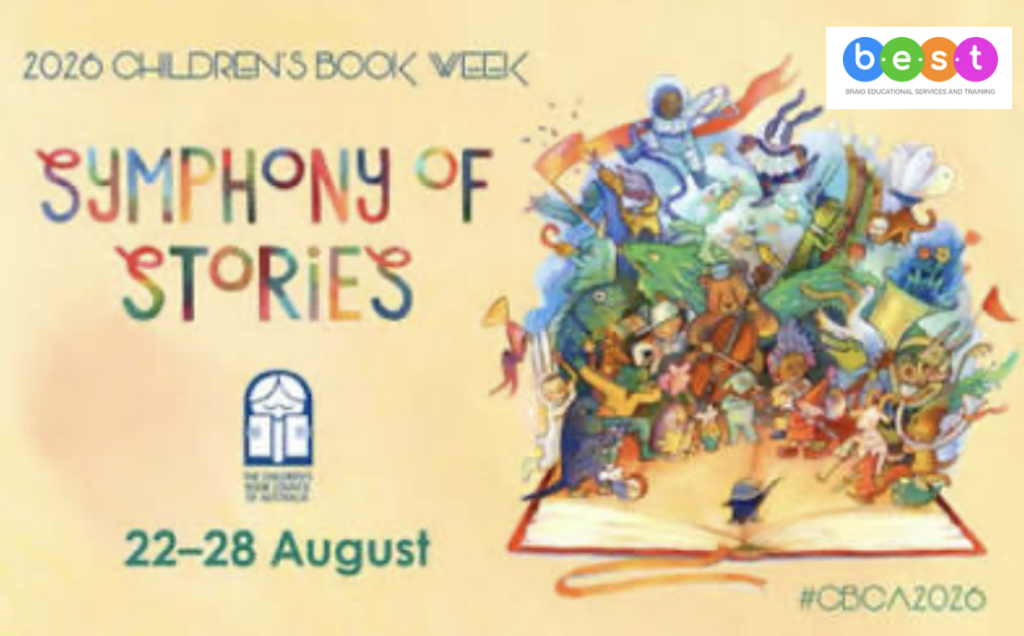
From Saturday 22 August to Friday 28 August 2026, early childhood services, schools, libraries and communities across Australia will celebrate Children’s Book Week. The official Children’s Book Council of Australia theme for 2026 is “Symphony of Stories,” with artwork created by award-winning Australian author and illustrator Briony Stewart. The theme represents stories coming together like the individual sounds within a symphony—each with its own rhythm, character and meaning, yet becoming even more powerful when experienced together.
Children’s Book Week is often associated with colourful costumes and parades, but its true value reaches far beyond dressing as a favourite character. It is an opportunity to celebrate Australian authors and illustrators, nurture children’s love of books and recognise literacy as something that develops through conversation, music, movement, storytelling, dramatic play, drawing, symbols and shared experiences.
The Early Years Learning Framework V2.0 recognises literacy as communication expressed through many forms, including storytelling, music, movement, dance, visual arts, drama and media. Children develop literacy when they listen, respond, imagine, question, retell, create and engage meaningfully with different kinds of texts.
For early childhood educators, Children’s Book Week provides a wonderful opportunity to slow down, gather together and rediscover the joy of sharing stories. It also reminds us that the most valuable literacy experiences are not limited to one special week. They grow through everyday conversations, accessible books, responsive educators and environments where every child is encouraged to contribute their own unique note to the service’s “Symphony of Stories.”
Why Stories Matter in Early Childhood Education
Children begin developing the foundations of literacy long before they can formally read or write. Babies listen to the rhythm and patterns of language. Toddlers point to pictures, repeat familiar words and anticipate what will happen next. Older children begin retelling stories, recognising symbols, creating characters and using drawing, dramatic play and early writing to communicate their ideas.
Shared reading supports children to encounter new vocabulary, understand how stories are structured, notice sounds and patterns in language and develop comprehension. Just as importantly, reading together creates moments of warmth, connection and belonging.
Books can help children recognise themselves, their families, cultures, abilities and experiences. They can also gently introduce children to lives and perspectives that differ from their own. A thoughtfully selected book collection can support inclusion, challenge stereotypes and communicate that every child and family belongs within the service community.
Public libraries also play an important role in early literacy by providing children and families with free access to books, story-time programs, rhyme sessions and other literacy experiences. Building relationships with local libraries can strengthen continuity between the service, home and broader community.
Bringing “Symphony of Stories” to Life
The 2026 theme encourages educators to think about the many voices, genres, styles, cultures and creative forms that make up the world of children’s literature.
Like a symphony, stories can be quiet or energetic, funny or reflective, familiar or surprising. They may be spoken, sung, danced, drawn, written, performed or communicated through gesture and visual symbols. Children can explore the rhythm of repeated phrases, create sound effects for characters, move their bodies to represent a storyline or combine music and dramatic play to create an entirely new story.
The theme also provides a powerful metaphor for inclusion. A symphony is created when different sounds contribute to a shared experience. In the same way, an early childhood community becomes richer when every child, family, educator and culture is heard, respected and represented.
Aboriginal and Torres Strait Islander Storytelling
Children’s Book Week provides an important opportunity to recognise that storytelling has always held a central place within Aboriginal and Torres Strait Islander cultures. Stories have carried knowledge, histories, relationships, identity, language and connections to Country and Sea Country across generations.
Early childhood services can respectfully include books created by Aboriginal and Torres Strait Islander authors and illustrators, particularly those connected to the local Country and community. These books allow children to encounter First Nations voices through authentic cultural perspectives rather than stories interpreted by others.
Educators should carefully consider who created each resource, whether the story is appropriate to share and whether cultural knowledge requires permission. Dreaming stories should not be treated simply as imaginative fairytales or reproduced through generic craft activities. Some stories, images and cultural knowledge may belong to particular people, communities or places.
Meaningful practice involves learning about the Traditional Custodians of the land on which the service operates, selecting authentic First Nations literature, consulting respectfully with local Aboriginal people and ensuring Aboriginal and Torres Strait Islander perspectives remain visible throughout the year—not only during significant cultural dates.
Educational Programming Ideas
1. Create a Symphony of Stories Soundscape
Select a familiar Australian picture book and invite children to create sounds for the characters, settings and events. Children might tap rhythm sticks for footsteps, shake leaves to represent wind, use drums during an exciting moment or hum softly for a calm scene.
Pause during the story and invite children to decide which instruments, natural materials, voices or body sounds best represent what is happening. Record the group’s soundscape and play it back while rereading the book.
This experience supports listening, rhythm, memory, cooperation, creative expression and comprehension while directly connecting with the “Symphony of Stories” theme.
Useful resources:
- Children’s Book Week 2026 – Children’s Book Council of Australia
- Meet the Symphony of Stories Characters
- ABC Kids Listen
2. Explore the 2026 CBCA Book of the Year Awards
Introduce children to age-appropriate books from the CBCA Book of the Year Awards, particularly titles within the Early Childhood category. Display the books attractively, read them across the week and invite children to revisit their favourites independently.
Create a child-friendly voting area where children can place a photo, symbol, counter or mark beside the book they enjoyed most. Discuss their reasons without expecting everyone to agree. Educators can document children’s comments about the illustrations, characters, events and feelings each story inspired.
This provides an authentic opportunity for children to express preferences, listen to different opinions and participate in shared decision-making.
Useful resources:
3. Establish a Storytelling Orchestra
Arrange children in a circle with simple instruments, scarves, puppets or loose parts. One child or educator begins a story, and each participant contributes a new character, sound, movement or event.
The story might begin:
“One morning, a tiny bird heard a mysterious sound coming from the bush…”
Each child adds their own “note” to the shared story. Educators can scribe the completed narrative, photograph the experience and turn it into a service-created book.
This experience reinforces the idea that every contribution matters and that a rich story can be created when many imaginations work together.
Useful resources:
- Early Years Learning Framework V2.0
- ACECQA—Play-based Learning and Intentionality
- Early Learning STEM Australia
4. Share Stories Through Music, Movement and Dance
Choose stories containing repeated phrases, rhythm, movement or musical ideas. Invite children to create actions for important words, move like the characters or use ribbons and scarves to represent the changing mood of the story.
Children could explore:
- fast and slow movements
- loud and quiet sounds
- high and low body shapes
- repeated rhythms
- character emotions
- beginning, middle and ending sequences.
Educators can encourage children to interpret the story in different ways rather than teaching one set performance. This recognises movement, music and dance as meaningful forms of literacy and communication.
Useful resources:
- The Early Years Learning Framework for Australia V2.0
- ABC Kids Listen—Music and Stories
- Sydney Opera House—Creative Learning
5. Celebrate Aboriginal and Torres Strait Islander Authors and Illustrators
Develop a collection of books by Aboriginal and Torres Strait Islander creators and share them regularly throughout the week. Research the author, illustrator, language group and Country connected to each book so educators can introduce it respectfully and accurately.
Invite children to notice the landscapes, animals, family relationships, words, symbols and ways of sharing knowledge represented in each story. Avoid copying Aboriginal artwork or asking children to reproduce sacred symbols. Instead, respond through meaningful experiences such as discussing Country, listening to language, visiting a local natural place or reflecting on the story’s message.
Where possible, seek guidance from local Aboriginal community members, cultural organisations or an Aboriginal-owned book supplier.
Useful resources:
- AIATSIS—Education Resources
- Magabala Books—Children and Young Adult Books
- Indigenous Literacy Foundation
- Narragunnawali—Curriculum Resources
6. Invite Families to Share Their Favourite Stories
Ask families to contribute a favourite childhood book, family story, song, rhyme or oral storytelling tradition. Families may visit the service to read in person, provide an audio recording, share a book in their home language or recommend a story that holds special meaning for their family.
Create a display explaining why each story was chosen. Include photographs, family comments and children’s responses where permission has been provided.
This supports home languages, cultural inclusion and continuity between children’s home and service experiences. It also communicates that literacy is strengthened when families’ knowledge and traditions are genuinely valued.
Useful resources:
- Raising Children Network—Reading and Storytelling
- Australian Library and Information Association—Early Childhood Development
- SBS Learn
7. Transform Favourite Books into Play Environments
Observe which books capture children’s interest and extend them through dramatic, sensory and construction play.
A story about a journey might inspire children to construct roads, boats or maps. A book about native animals could lead to a habitat investigation. A story set in a café might become a dramatic-play restaurant with menus, signs, order pads and recipes.
Provide open-ended materials rather than recreating every detail for the children. Encourage them to decide which characters, settings and events they want to represent and how the environment should develop.
This enables children to revisit and reinterpret texts, negotiate roles, solve problems and communicate their understanding through play.
Useful resources:
- ACECQA—Play-based Learning and Intentionality
- ACECQA—Intentionality Through the Physical Environment
- Raising Children Network—Why Play is Important
8. Connect with Your Local Library
Arrange a visit to the local library or invite a librarian to the service for a special story-time session. Introduce children to borrowing books, caring for shared resources and finding stories about subjects that interest them.
Provide families with information about library membership, Book Week events, rhyme-time sessions and story-time programs. Consider establishing a regular library excursion or rotating borrowing collection rather than making the partnership a one-off Book Week activity.
Children could also write or illustrate thank-you messages for the librarians, create a list of books they would like to borrow or help establish a small service lending library for families.
Useful resources:
- State Library of Western Australia—Children and Families
- Better Beginnings—Western Australian Family Literacy Program
- Australian Library and Information Association
- Find a Public Library in Western Australia
QIP write ups
Quality Area 1 – Educational Program and Practice
Embedded Practice
Children’s literature, shared reading and oral storytelling had been embedded throughout the daily educational program rather than being limited to Children’s Book Week. Educators had provided children with regular opportunities to listen, retell, dramatise, illustrate and create stories through books, music, movement, dramatic play and visual arts. Children’s ideas and interests had guided the selection of texts and the development of extended literacy projects.
Critical Reflection
Educators had critically reflected on whether the book collection genuinely represented the children, families and cultures within the service community. The team had reviewed texts for stereotypes, tokenism and outdated representations and had strengthened the collection with contemporary Australian literature, authentic Aboriginal and Torres Strait Islander books, inclusive family structures and stories representing diverse abilities, languages and experiences.
Meaningful Engagement with Families and Community
Families had shared favourite books, oral stories, songs and rhymes from their cultures and home languages. The service had collaborated with its local library and community storytellers to extend children’s access to literature and strengthen connections between literacy experiences at the service, at home and within the broader community.
Quality Area 2 – Children’s Health and Safety
Embedded Practice
Educators had used carefully selected literature to help children explore emotions, relationships, personal safety, healthy choices, consent, body autonomy and help-seeking in developmentally appropriate ways. Calm reading spaces had supported children to rest, regulate their emotions and seek connection with trusted educators throughout the day.
Critical Reflection
The team had reflected on the emotional content of books and considered whether particular stories might distress children or relate to experiences of trauma, grief, family separation or displacement. Educators had adjusted how stories were introduced, remained attentive to children’s responses and worked sensitively with families where additional support was required.
Meaningful Engagement with Families and Community
Families had been consulted about books addressing health, safety, identity and sensitive life experiences. Community organisations and recognised child-safety resources had informed the selection of appropriate texts, helping educators use stories as a safe starting point for meaningful conversations without replacing the service’s established protective-behaviours and safeguarding practices.
Quality Area 3 – Physical Environment
Embedded PracticeBooks and storytelling resources had been made accessible throughout indoor and outdoor environments rather than being confined to one bookshelf. Inviting reading spaces, puppets, story stones, musical instruments, writing materials, loose parts and dramatic-play resources had enabled children to encounter and create stories in many different ways.
Critical Reflection
Educators had evaluated whether existing book areas were genuinely inviting, inclusive and accessible to babies, toddlers and older children. The team had reconsidered book placement, noise levels, seating, lighting and the condition of resources and had created flexible spaces where children could read independently, gather with others or listen quietly with an educator.
Meaningful Engagement with Families and Community
Families had contributed suggestions, multilingual books and ideas for improving the literacy environment. The local library had supported the service with rotating collections and information about family programs, while children’s contributions had directly influenced the design and ongoing use of reading and storytelling spaces.
Quality Area 4 – Staffing Arrangements
Embedded Practice
Educators had shared responsibility for creating a language-rich environment and had used books, songs, rhymes and conversations consistently across all rooms and routines. Team planning had ensured that storytelling experiences reflected children’s developmental stages, communication methods, home languages and individual interests.
Critical Reflection
The team had reflected on educator confidence when reading aloud, using expressive language, facilitating group discussions and sharing stories from cultures other than their own. Professional conversations had strengthened educators’ understanding that effective literacy practice involved responsive interaction and genuine enjoyment rather than simply completing a scheduled group-time experience.
Meaningful Engagement with Families and Community
Educators had drawn upon the knowledge of families, librarians, Aboriginal community members and literacy organisations to strengthen their professional practice. Staff had shared reliable resources and learning with one another, ensuring that new approaches became part of consistent whole-service practice.
Quality Area 5 – Relationships with Children
Embedded Practice
Shared reading had been used to strengthen warm, responsive relationships between children and educators. Educators had listened to children’s interpretations, welcomed repeated readings and followed children’s interests without rushing conversations or requiring one correct response. Children’s own stories, humour and imaginative ideas had been treated with genuine respect.
Critical Reflection
Educators had reflected on whose voices were most frequently heard during group storytelling and whether quieter children, babies, children learning English and children who communicated nonverbally had equitable opportunities to participate. Practices had been adjusted through smaller groups, visual supports, gestures, puppets, individual reading and additional time for children to respond.
Meaningful Engagement with Families and Community
Families had shared information about children’s favourite stories, home languages and preferred ways of communicating. This knowledge had helped educators select familiar and meaningful texts, create stronger connections with children and ensure that storytelling experiences reflected each child’s identity and sense of belonging.
Quality Area 6 – Collaborative Partnerships with Families and Communities
Embedded PracticeFamily participation in literacy had been encouraged throughout the year through book borrowing, shared-reading suggestions, multilingual resources, family storytelling and regular information about community library programs. Educators had recognised families as children’s first and most influential teachers and had respected the different ways literacy was practised within each home.
Critical Reflection
The service had reflected on barriers that could prevent families from participating, including limited time, cost, transport, language and differing levels of confidence with reading. The service had responded by providing free and flexible options, promoting library membership, inviting audio or video contributions and recognising oral storytelling, songs and conversation as valuable literacy practices.
Meaningful Engagement with Families and Community
Partnerships had been established with the local library, Australian authors and illustrators, cultural organisations and community storytellers. These relationships had extended children’s access to books and authentic storytelling experiences while helping families connect with free literacy resources available within their community.
Quality Area 7 – Governance and Leadership
Embedded Practice
Educational leadership had supported a whole-service commitment to high-quality children’s literature and inclusive literacy practice. Resources had been allocated to maintaining diverse, contemporary and developmentally appropriate book collections, while policies and purchasing decisions had supported respectful representation and equitable access.
Critical Reflection
Leaders and educators had reviewed the service’s approach to Children’s Book Week and recognised that costumes and celebrations alone did not demonstrate meaningful literacy practice. The service had strengthened its focus on sustained shared reading, children’s agency, cultural responsiveness, family partnerships and the year-round integration of storytelling across the curriculum.
Meaningful Engagement with Families and Community
Leadership had sought feedback from children, families, educators and community partners when evaluating the service’s literacy priorities. Contributions had influenced resource purchases, library partnerships, professional learning and future improvement goals, ensuring that decisions reflected the strengths and aspirations of the service community.
Links and Resources
Children’s Book Week and Australian Literature
- Children’s Book Council of Australia
- Children’s Book Week 2026
- CBCA Book of the Year Awards
- CBCA Western Australia
- Meet the Symphony of Stories Characters
Early Literacy and Curriculum
- Early Years Learning Framework V2.0
- ACECQA—Play-based Learning and Intentionality
- Raising Children Network—Reading and Storytelling
- Australian Library and Information Association
Western Australian Library Programs
- State Library of Western Australia
- State Library of WA—Children and Families
- Better Beginnings
- Public Libraries in Western Australia
Aboriginal and Torres Strait Islander Literature and Resources
- AIATSIS Education Resources
- Indigenous Literacy Foundation
- Magabala Books
- Narragunnawali Curriculum Resources
BEST Childcare Consulting
Children’s Book Week reminds us that stories are far more than words printed on a page. They are the laughter shared when a familiar character appears, the comfort of sitting closely with a trusted educator, the excitement of predicting what might happen next and the pride a child feels when their own ideas become part of the story.
The 2026 theme, “Symphony of Stories,” celebrates the beauty created when different voices, experiences and imaginations come together. Within our early childhood services, every child contributes something unique to that symphony. Some children tell long and detailed stories. Others communicate through movement, music, drawing, gesture, play or a single carefully chosen word. Every contribution deserves to be noticed, respected and encouraged.
May Children’s Book Week inspire your service to fill every room with stories, every bookshelf with genuine representation and every child with the knowledge that their own voice is worth hearing.
As always, use these inspirations to lead your service throughout the whole year in your everyday practices to truly earn an exceeding rating.
Contact us TODAY.