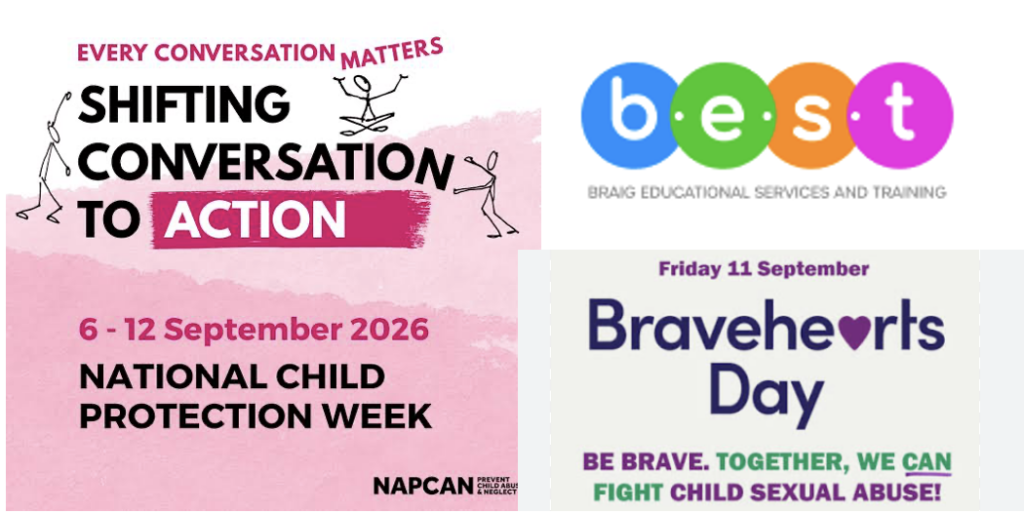
Perfect for 6–12 September 2026 – National Child Protection Week and 11 September 2026 – Bravehearts Day
By BEST Childcare Consulting
There are few responsibilities more important in early childhood education and care than keeping children safe.
Every day, families place enormous trust in educators. They entrust us with the people who matter most to them—their children. With that trust comes a responsibility that extends far beyond supervision, policies and compliance. It means creating environments where children know that their feelings matter, their bodies belong to them, their voices will be heard and the adults around them will act when something is not right.
National Child Protection Week provides an important opportunity for early childhood services to reflect on what child safety really looks like in everyday practice. It is also an opportunity to ensure that child protection is not simply something discussed during one week in September, but something visible in our relationships, environments, curriculum, policies and culture every day of the year.
In 2026, National Child Protection Week is particularly powerful because it coincides with Bravehearts Day on 11 September, providing services with an opportunity to strengthen children’s personal-safety education alongside the broader responsibility adults and organisations hold for creating child-safe environments.
Most importantly, child protection must never place responsibility for preventing abuse on children. We can teach children about body autonomy, feelings, consent, trusted adults and speaking up—but adults remain responsible for protecting children. Every Child Deserves to Feel Safe, Heard and Protected
National Child Protection Week 2026
National Child Protection Week is coordinated by NAPCAN—the National Association for Prevention of Child Abuse and Neglect—and will be held from 6–12 September 2026. 2026 Theme: “Every Conversation Matters: Shifting Conversation to Action” The theme continues the message that conversations about children’s safety matter, while deliberately taking this one step further. Talking about child safety creates awareness. Acting on those conversations creates change.
NAPCAN explains that National Child Protection Week encourages Australians to recognise that protecting children is a shared responsibility involving families, communities, educators, organisations, governments and young people themselves.
For early childhood services, shifting conversation into action might mean:
- listening seriously when a child communicates discomfort;
- reviewing supervision arrangements after educators identify a potential blind spot;
- changing a procedure following critical reflection;
- strengthening children’s opportunities to exercise choice and consent;
- ensuring children know which adults they can approach for help;
- supporting families with reliable child-safety information;
- ensuring educators understand how to recognise and respond to indicators of abuse;
- reviewing environments from a child’s perspective;
- strengthening online and digital safety practices; and
- ensuring children’s voices genuinely influence decisions affecting them.
National Child Protection Week therefore provides an ideal opportunity to ask:
What are we actually doing differently because of the conversations we have had about child safety?
Bravehearts Day – 11 September 2026
Bravehearts Day provides another important opportunity to focus specifically on the prevention of child sexual abuse and the role adults, communities and organisations play in protecting children.
For early childhood services, one of the most useful Bravehearts resources is Ditto’s Keep Safe Adventure Program.
The program provides age-appropriate personal-safety education for children in the early years and lower primary school and is aligned with the Early Years Learning Framework (EYLF) and Australian Curriculum.
Rather than frightening children or introducing concepts beyond their developmental understanding, the program helps children gradually build knowledge about feelings, body ownership, warning signs, trusted adults and seeking help.
Bravehearts summarises its child-friendly personal-safety messages through Ditto’s Three Rules:
1. We all have the right to feel safe with people.
2. It’s OK to say NO if you feel unsafe or unsure.
3. Nothing is so yucky that you can’t tell someone about it.
These messages can become powerful foundations for children’s understanding of body autonomy, consent, help-seeking and personal safety.
Educational Programming Ideas
Child-protection education should always be developmentally appropriate, trauma-aware, child-centred and embedded naturally within everyday learning. Children should never be pressured to disclose personal experiences publicly or participate in discussions that make them uncomfortable.
Babies – Building Safety Through Responsive Relationships
For babies, child-protection education begins with relationships—not formal lessons.
Narrate Caregiving and Respect Body Autonomy
Before changing a nappy, wiping a face or helping a child dress, educators can calmly explain what they are about to do.
“I’m going to help change your nappy now.”
Pause, observe the child’s response and communicate throughout the routine.
Although babies cannot provide informed consent to necessary care, this respectful approach establishes an important early message: your body matters and adults should communicate with you before touching or caring for your body.
Respond to Children’s Communication
Treat crying, turning away, reaching towards an educator, facial expressions and body movements as meaningful communication.
When educators consistently respond to children’s signals, babies begin learning that their communication has influence and that trusted adults respond when they need help.
Safe and Secure Relationships
Prioritise predictable routines, warm interactions and consistent educators wherever possible. Secure, responsive relationships provide the earliest foundation for children’s sense of safety.
Feelings Through Books and Songs
Introduce simple language such as happy, sad, scared, worried, safe through songs, puppets, photographs and picture books.
These early experiences gradually develop the emotional vocabulary children will later need to communicate when something does not feel right.
Toddlers – My Body, My Feelings and My Voice
Bravehearts advises that children younger than three may not yet understand or retain the complete Ditto program. Instead, concepts can be introduced gradually through stories, posters and songs, one idea at a time.
“My Body Belongs to Me”
During everyday routines, reinforce children’s ownership of their bodies.
Encourage educators to ask before physical affection:
“Would you like a cuddle?”
If the child says no, respect the response wherever safely possible.
This teaches children that saying “no” has meaning.
Safe and Unsafe Feelings
Use photographs, puppets or emotion cards to explore simple scenarios:
“How might Teddy feel?”
“What could Teddy do if he feels worried?”
The objective is not to ask children about potentially abusive situations, but to help them recognise and communicate emotions.
Trusted Adults
Display photographs of familiar trusted adults within the child’s world—educators and family members—and reinforce that children can seek help when they feel worried, frightened or unsure.
Correct Names for Body Parts
Use anatomically correct terminology naturally and without embarrassment alongside other body-part vocabulary.
Correct terminology supports children’s body knowledge and their ability to communicate clearly.
Songs for Safety
Bravehearts provides Ditto’s Keep Safe Adventure songs covering concepts including safe and unsafe feelings, warning signs, body ownership and telling someone.
Use one concept at a time with younger children rather than attempting to teach all personal-safety messages simultaneously.
3-Year-Old Kindy – Introducing Ditto’s Keep Safe Adventure
Three years is the age from which Bravehearts specifically recommends its Early Years Ditto’s Keep Safe Adventure program.
Introduce Ditto’s Three Rules
Display the three rules within the learning environment and revisit them naturally throughout the year.
Children could create artwork representing what “feeling safe” means to them.
Safe and Unsafe Feelings
Read stories or use puppets to explore different feelings.
Ask:
“How does your body tell you when you’re happy?”
“What might your body feel like when you’re worried?”
Children might identify butterflies in their tummy, shaking, crying, wanting to hide or wanting to find an adult.
My Safety Team
Invite children to identify several trusted adults they could speak to if they felt worried or unsafe.
Children could draw their own Safety Team or create one with family photographs.
Importantly, educators should explain that if one adult does not help, children can keep telling until somebody listens and helps.
Body Ownership
Through dolls, books and age-appropriate discussions, reinforce:
“Your body belongs to you.”
Discuss appropriate boundaries and children’s right to communicate when touch makes them uncomfortable.
Book a Ditto Show
Services can consider booking Bravehearts’ Ditto’s Keep Safe Adventure Show – Early Years, specifically developed for children aged three to four.
The interactive program uses age-appropriate language, songs and movement to teach personal-safety concepts.
4-Year-Old Kindy – Strengthening Children’s Protective Skills
Four-year-olds can begin exploring personal-safety concepts with greater depth while keeping learning positive and empowering.
Recognise – React – Report
Introduce the simple sequence:
Recognise: Something feels unsafe or unsure.
React: Move away or say no where possible.
Report: Tell a trusted adult.
Use fictional puppet scenarios rather than asking children to discuss personal experiences publicly.
Body Warning Signs
Create a body outline and discuss how our bodies sometimes tell us something is wrong.
Children may identify:
- fast heartbeat;
- sweaty hands;
- shaky legs;
- butterflies in the tummy;
- wanting to cry;
- feeling frozen; or
- wanting to get away.
Explain that these feelings can be signals to seek help from a trusted adult.
Safety Network
Children can identify trusted adults across different environments:
Home – Early Learning Service – Family – Community.
Discuss what they could do if their first trusted adult was unavailable or did not understand.
NAPCAN 2026 – Conversation into Action Artwork
NAPCAN’s 2026 National Child Protection Week art activity invites children and young people to think about actions they or adults can take to help families, friends and communities thrive.
Ask children:
“What helps children feel safe here?”
Their responses might lead to drawings, paintings, photographs or a collaborative mural.
Most importantly—act on their ideas.
That is exactly what Shifting Conversation to Action means.
Ditto’s Keep Safe Adventure Resources
Extend learning using Bravehearts’ storybooks, activity resources, songs and free digital game, which explore feelings, warning signs, body ownership, eSafety and trusted adults.
OSHC – Voice, Consent, Safety and Speaking Up
For school-aged children, child protection education can become increasingly sophisticated while remaining strengths-based.
What Makes a Child-Safe OSHC?
Invite children to conduct a child-led review of their environment.
Ask:
“Where do you feel safest?”
“Are there places where you don’t feel comfortable?”
“Who could you talk to here?”
“What could adults do to make OSHC safer?”
Document their recommendations and report back on the actions taken.
Consent in Everyday Life
Explore consent through ordinary situations:
- borrowing another person’s belongings;
- taking photographs;
- posting or sharing images;
- hugging;
- entering someone’s personal space;
- joining games; and
- sharing information online.
Teach that consent should be freely given and that people can change their minds.
Online Safety
Discuss privacy, gaming, messaging, images, online friendships and what children should do if something online makes them uncomfortable.
Reinforce that children should not be blamed for seeking help—even if they clicked something, responded to somebody or initially agreed to something.
Trusted Adult Network
Encourage children to identify several adults they could approach at home, school, OSHC or within their wider community.
Child Safety Action Project
In keeping with NAPCAN’s 2026 theme, allow children to identify one real improvement they want the service to make.
Educators and management then work with children to implement it.
Conversation has now become action.
QIP Write up
QA1 – Educational Program and Practice
Embedded Practice:
Personal safety, body autonomy, emotional literacy, help-seeking and children’s rights had been embedded throughout the educational program rather than being limited to National Child Protection Week. Educators had intentionally incorporated age-appropriate protective-behaviour concepts through everyday conversations, literature, music, play and routines.
Critical Reflection:
Educators had critically reflected on whether personal-safety learning was developmentally appropriate and whether practices genuinely empowered children without inadvertently placing responsibility for preventing abuse upon them. This reflection had reinforced that adults remained responsible for creating child-safe environments.
Meaningful Engagement with Families and/or Community:
Families had been provided with information about the concepts children were exploring and resources from recognised organisations including NAPCAN and Bravehearts, supporting consistent safety language between home and the service.
QA2 – Children’s Health and Safety
Embedded Practice:
Child protection had been understood as an everyday responsibility encompassing supervision, safe environments, responding to children’s communication, recognising indicators of harm, responding appropriately to disclosures and following reporting obligations.
Critical Reflection:
The service had reviewed its child-safety practices, supervision arrangements and educators’ understanding of reporting and response procedures, identifying opportunities to strengthen preventative approaches rather than relying solely upon responses after concerns arose.
Meaningful Engagement with Families and/or Community:
Recognised child-safety organisations and resources had been incorporated into professional learning and family education, strengthening shared understanding of children’s safety and wellbeing.
QA3 – Physical Environment
Embedded Practice:
The physical environment had been considered through a child-safety lens, including visibility, supervision, privacy, toileting and nappy-changing areas, access points and spaces where children could seek support from educators.
Critical Reflection:
Educators had considered the environment from children’s perspectives and invited children, where developmentally appropriate, to identify places where they felt safe, comfortable or uncertain.
Meaningful Engagement with Families and/or Community:
Feedback from children, families, educators and relevant guidance had informed environmental decisions, demonstrating that safety considerations were responsive to the service community.
QA4 – Staffing Arrangements
Embedded Practice:
Child safety responsibilities had been understood by all educators and staff rather than being viewed solely as the responsibility of nominated supervisors or management. Supervision, professional boundaries and appropriate educator conduct had formed part of everyday professional expectations.
Critical Reflection:
The service had critically reflected on staffing arrangements, supervision practices, professional boundaries and educator confidence in recognising and responding to child-safety concerns.
Meaningful Engagement with Families and/or Community:
Professional learning and external child-protection resources had strengthened educator capability and supported consistent child-safe practice across the team.
QA5 – Relationships with Children
Embedded Practice:
Respectful relationships had supported children’s right to communicate preferences, refuse unwanted affection, express discomfort and seek help. Educators had listened seriously to children’s verbal and non-verbal communication and responded sensitively.
Critical Reflection:
Educators had examined everyday practices—including physical affection, caregiving routines and adult-directed expectations—to consider whether children’s autonomy, dignity and voice were consistently respected.
Meaningful Engagement with Families and/or Community:
Educators had worked respectfully with families to develop shared approaches to body autonomy, emotional language, consent and children’s right to feel safe.
QA6 – Collaborative Partnerships with Families and Communities
Embedded Practice:
Child safety had been recognised as a shared responsibility requiring strong partnerships between children, families, educators and the wider community.
Critical Reflection:
The service had reflected on whether child-protection communication with families extended beyond policies and enrolment documentation to meaningful conversations about children’s rights, protective behaviours, online safety and help-seeking.
Meaningful Engagement with Families and/or Community:
Families had been connected with reputable child-safety resources including NAPCAN and Bravehearts and encouraged to continue age-appropriate personal-safety conversations at home.
QA7 – Governance and Leadership
Embedded Practice:
Child safety had remained a central governance priority supported by policies, procedures, professional expectations, risk management, staff induction, ongoing training and clear reporting processes.
Critical Reflection:
Leadership had used National Child Protection Week as an opportunity to critically review whether child-safe policies were genuinely reflected in daily practice and whether educators understood not only what procedures required, but whythey existed.
Meaningful Engagement with Families and/or Community:
Children, educators, families and recognised child-safety organisations had contributed to the service’s ongoing child-safety culture, demonstrating that safeguarding children was a shared and continuously evolving responsibility.
Keep It Going All Year
Child protection cannot finish on 12 September. The strongest outcome from National Child Protection Week is not a beautiful display or one week of planned experiences. It is a change that remains after the posters come down.
Keep personal-safety language embedded in everyday interactions. Continue asking permission before appropriate physical contact. Keep teaching emotional vocabulary. Continue respecting children’s “no”. Keep talking about trusted adults. Continue using anatomically correct terminology. Keep teaching children that they can seek help. Continue asking children what makes them feel safe. Continue listening. And, importantly, continue acting on what they tell you.
Services can revisit personal-safety learning throughout the year, incorporate Bravehearts resources into the ongoing curriculum, include child protection in staff meetings and professional development, provide regular information to families and periodically ask children for their perspectives on the safety of their environment.
Bravehearts itself recommends a holistic approach incorporating both annual personal-safety education for children and annual child-protection training for educators and staff. This moves child protection beyond an annual event and into the culture of the service.
Official Links and Resources
NAPCAN – National Child Protection Week 2026
National Child Protection Week 2026 – NAPCAN
Information about the national campaign, dates, purpose and 2026 activities.
NAPCAN – 2026 Theme
Every Conversation Matters: Shifting Conversation to Action
Official explanation of the 2026 National Child Protection Week theme.
NAPCAN – Get Involved in 2026
National Child Protection Week 2026 Resources and Campaign Materials
Access 2026 posters, campaign resources, activities and information about events.
Bravehearts – Ditto’s Keep Safe Adventure Program
Ditto’s Keep Safe Adventure Program
Bravehearts’ personal-safety education program aligned with the Early Years Learning Framework and Australian Curriculum.
Bravehearts – Early Years Educator’s Guide
Ditto’s Keep Safe Adventure – Early Years Educator’s Guide Excerpt
A particularly useful resource for early childhood services, containing personal-safety learning experiences and resources adapted from Bravehearts’ Early Years Educator’s Guide.
Bravehearts – Ditto’s Keep Safe Adventure Show
Ditto’s Keep Safe Adventure Show for Early Learning Services
Information about the Early Years, Foundation and Years 1–2 versions of the Ditto program.
Book a Bravehearts Ditto Show
Book a Ditto’s Keep Safe Adventure Show
Services can submit an expression of interest for a Ditto personal-safety education session.
Bravehearts – Personal Safety Resources
Ditto’s Keep Safe Adventure Personal Safety Resources
Includes Ditto songs, books, activities, parent resources and information about the free Ditto mobile game.
Bravehearts – Free Child Protection Resources
Free Resources for Parents, Carers and Communities
Includes downloadable information about personal safety, child sexual abuse prevention, body ownership and supporting children.
Bravehearts – Child Protection Training for Educators
Child Protection Online Training Courses
Includes child-protection foundation and refresher training relevant to professionals working with children.
BEST Childcare Consulting
National Child Protection Week reminds us of something that should sit at the heart of every early childhood service: Children should not have to become brave enough to overcome unsafe systems. Adults must build systems that keep children safe. Teach children that their bodies belong to them. Teach them that their feelings matter. Teach them that they can say no. Teach them that they can tell someone when something does not feel right. But alongside those lessons, make sure the adults are listening. Make sure educators know what to do. Make sure policies translate into practice. Make sure children’s voices influence decisions. And when a conversation identifies something that could make children safer—act on it. That is how we move from Every Conversation Matters to Shifting Conversation to Action.
As always, use these inspirations to lead your service throughout the whole year in your everyday practices to truly demonstrate embedded, reflective and meaningful practice.
Contact us TODAY.