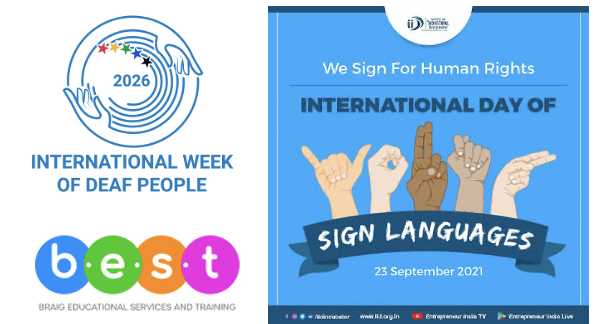
Perfect for National Week of Deaf People 21–27 September 2026 and International Day of Sign Languages on 23 September 2026
BY BEST Childcare Consulting
Communication is so much more than the words we speak. It is the movement of our hands, the expression on our faces, the direction of our eyes, the gestures we make and the ways we connect with one another.
For children, being able to communicate means being able to belong. It means being able to tell someone what they need, share an idea, make a friend, participate in play, express an emotion and know that other people are interested in what they have to say.
During National Week of Deaf People, 21–27 September 2026, early childhood education and care services have a wonderful opportunity to celebrate the many ways human beings communicate and introduce children to Auslan – Australian Sign Language.
This is not simply a week about hearing loss. It is an opportunity to celebrate Deaf people, Deaf culture, language, identity, diversity and inclusion, while helping children understand from their earliest years that there is no single “right” way to communicate. Every Child Deserves to Be Heard – In Every Language
National Week of Deaf People 2026
National Week of Deaf People is coordinated in Australia by Deaf Australia, the Deaf-led national organisation representing Auslan users.
The Australian celebration coincides with the World Federation of the Deaf’s International Week of Deaf People, held from 21–27 September 2026. 2026 Theme: Declaring Deaf People’s Human Rights. The World Federation of the Deaf has confirmed the 2026 theme: “Declaring Deaf People’s Human Rights.” The theme is particularly significant because 2026 marks 20 years since the adoption of the United Nations Convention on the Rights of Persons with Disabilities (CRPD). For Deaf people, language rights are human rights. Access to sign language, information, education, communication and participation enables Deaf people to participate fully within their families, communities, education and society.
For early childhood educators, this provides an important opportunity to consider inclusion beyond simply asking: “Can this child participate?” Instead, we can ask: “Have we created an environment where every child can communicate, understand, contribute and belong?”
International Day of Sign Languages – 23 September 2026
National Week of Deaf People also includes the International Day of Sign Languages on 23 September. The United Nations established the day to raise awareness of the importance of sign language to the human rights of Deaf people. There are more than 300 different sign languages used throughout the world.
In Australia, our national sign language is Auslan – Australian Sign Language.
Importantly, Auslan is not simply English communicated with the hands. It is a complete, natural language with its own grammar, vocabulary and linguistic structure. Auslan also incorporates facial expression, handshape, movement and body positioning as meaningful components of communication. Introducing children to Auslan therefore provides much more than an entertaining activity for one week. It introduces them to another language and another way of understanding communication.
A Note About Deaf Culture
It is important that National Week of Deaf People does not unintentionally present deafness solely through a medical or deficit perspective. Many people identify culturally and linguistically as Deaf, with a capital “D”, reflecting their connection with Deaf culture, community and Auslan. Deaf communities have their own history, experiences, traditions, language and cultural identity.
For educators, this means moving beyond activities about “what it might be like not to hear” and instead providing children with authentic opportunities to learn about Deaf people, Deaf achievements, Auslan and Deaf culture.
Avoid simulations such as asking children to cover their ears or wear earplugs to “experience being Deaf”. These activities cannot replicate Deaf people’s lived experiences and can unintentionally reinforce the idea that deafness is simply a limitation. Instead, celebrate language, culture, communication, identity and inclusion.
Building Bridges – Helping Educators Create Deaf-Friendly Learning Environments
Celebrating Auslan with children is important, but meaningful inclusion also requires educators to understand the communication barriers that Deaf and hard-of-hearing children may experience and know how to remove them.
Deaf Children Australia’s Building Bridges program provides a practical way for services to strengthen this knowledge. The free, self-paced online course was developed to help educators and wider learning communities become more confident and informed when supporting Deaf and hard-of-hearing children.
The program explores areas including:
- Deaf awareness and inclusive practice;
- practical communication strategies;
- different types and experiences of deafness;
- hearing and assistive technologies;
- bimodal-bilingual approaches incorporating signed and spoken languages;
- recognising listening fatigue;
- creating more accessible learning environments; and
- developing a practical vocabulary of everyday Auslan signs.
Building Bridges also provides access to an extensive Auslan video library containing more than 200 useful signs, organised around everyday situations including feelings, greetings, lunchtime, classroom activities, playground experiences and going home.
For early childhood services, many of these concepts can be directly transferred into everyday practice. Educators might consider whether they consistently face children when communicating, whether visual information accompanies verbal instructions, whether unnecessary background noise creates communication barriers, and whether children can clearly see the faces and hands of people communicating with them.
The Building Bridges resources also provide an excellent opportunity for team professional development during National Week of Deaf People. Rather than only planning experiences for children, services could use the week to identify one resource for educators to explore together and then critically reflect: What communication barriers might exist in our service—and what can we change to remove them? This transforms National Week of Deaf People from an awareness event into genuine service improvement
Auslan and the Western Australian School Curriculum
Auslan is also recognised as a language that can be formally taught within Western Australian schools. The School Curriculum and Standards Authority (SCSA) provides access to the Australian Curriculum: Auslan, with both First Language and Second Language pathways extending from Foundation to Year 10.
Importantly for early childhood services, the Foundation Auslan curriculum specifically builds upon the Early Years Learning Framework (EYLF) and introduces Auslan through play-based learning, gestures, signing, stories, rhymes and visual experiences.
Introducing authentic Auslan experiences in early childhood therefore does more than promote inclusion and celebrate Deaf culture. It can also provide children with an early introduction to a recognised Australian language that they may continue learning throughout their formal schooling.
While Western Australian schools are not required to select Auslan as their chosen language, its inclusion within the curriculum demonstrates the importance of recognising Auslan as a complete language and an important part of Australia’s linguistic and cultural landscape.
Educational Programming Ideas
Babies – Communication Begins Before Words
Babies already communicate long before they begin speaking. Facial expressions, eye contact, pointing, reaching, gestures, movement and sounds all communicate meaning.
This makes infancy a beautiful time to introduce simple Auslan naturally within everyday interactions.
Sign and Say
Choose several meaningful Auslan signs that can be incorporated into routines.
Examples might include:
milk – more – finished – eat – drink – mum – dad – sleep – book
Educators can use the Auslan sign while also saying the word.
Keep the focus on genuine Auslan signs sourced from reputable Australian resources rather than generic internet “baby signs”.
Signed Songs
Introduce signs into familiar nursery rhymes and songs.
Rather than expecting babies to copy signs, allow them to watch educators’ hands, faces and movements.
Faces Communicate Too
Play simple imitation games involving facial expressions.
Smile.
Look surprised.
Look excited.
Wave.
Point.
Copy children’s expressions and movements.
This reinforces an important early understanding: communication happens in many different ways.
Toddlers – Hands Can Talk Too!
Toddlers are developing language rapidly and are often delighted to discover that their hands can communicate meaning.
Auslan Sign of the Day
Introduce one useful Auslan sign each day.
Choose words that are relevant to children’s everyday lives:
hello – goodbye – please – thank you – friend – play – eat – drink – more – finished.
Place an image of the sign within the room and encourage educators to use it throughout the day rather than teaching it once and forgetting it.
Auslan Mealtimes
Introduce simple signs relating to mealtimes such as:
eat – drink – water – more – finished.
Children can begin using the signs naturally during routines.
Signed Storytime
Choose a familiar picture book and introduce several Auslan signs for important words within the story.
For example, an animal story might introduce:
dog – bird – kangaroo – cat.
Children can sign whenever the animal appears.
How Do We Communicate?
Provide mirrors and invite children to explore facial expressions and gestures.
Ask:
“Can you show me happy without talking?”
“How could you show me you want more?”
“How could you say hello with your hands?”
3-Year-Old Kindy – Discovering Auslan
At three, children can begin exploring Auslan more intentionally while learning about different ways people communicate.
Learn the Auslan Alphabet
Introduce several letters from the Auslan fingerspelling alphabet, beginning with children’s initials.
Children can find their own letter and practise forming the handshape.
Create an Auslan alphabet display where children’s photographs sit beside their fingerspelled initial.
What’s Your Name?
Explore how names can be fingerspelled in Auslan.
Educators can introduce children to the idea that Deaf people may also have name signs, while explaining that culturally appropriate name signs are generally given within the Deaf community rather than invented by hearing people.
Auslan Emotion Signs
Introduce Auslan signs connected with children’s emotional literacy:
happy – sad – angry – scared – excited.
Connect these to your existing emotional-regulation program.
Ask:
“How are you feeling today?”
Children can answer verbally, visually or using a sign.
Auslan Storytime
Watch an authentic Auslan story presented by a Deaf storyteller.
Deaf Children Australia’s Auslan Storytime program provides bilingual experiences led by a Deaf Auslan storyteller alongside a spoken-English storyteller.
Pause afterwards and discuss what children noticed about the storyteller’s hands, face, eyes and body.
Match the Sign
Create picture cards showing familiar objects and match them with videos or visual representations of their Auslan signs.
4-Year-Old Kindy – Language, Culture and Inclusion
Four-year-old children can begin exploring the concept that languages and communities can be different while equally valuable.
Meet the Deaf Community
Introduce children to Deaf adults through age-appropriate videos, books or, ideally, a Deaf community visitor.
Rather than focusing on what a Deaf person “can’t” do, explore:
What language do they use?
How do people communicate?
What things do we have in common?
Auslan Storytelling
Choose a children’s story and learn five key Auslan signs from it.
Children can then use the signs during repeated readings.
Deaf Children Australia’s Auslan Storytime model provides a wonderful example: stories are shared bilingually in Auslan and spoken English, accompanied by songs, key signs and creative activities.
Count in Auslan
Learn the Auslan signs for numbers.
Use them during everyday mathematical experiences:
“How many children are here?”
“How many apples?”
“What number comes next?”
This embeds Auslan within the curriculum rather than treating it as an isolated activity.
Inclusive Communication Board
Create a visual communication area containing:
- Auslan signs;
- photographs;
- symbols;
- children’s home languages;
- visual routines;
- emotions; and
- other communication supports used within your service.
Discuss: “How many different ways can we communicate?”
OSHC – Deaf Culture, Language and Advocacy
School-aged children can explore the cultural, linguistic and human-rights dimensions of National Week of Deaf People in greater depth.
Auslan Spelling Bee
Deaf Children Australia offers an Auslan Spelling Bee, providing a fun way for children, schools and community groups to learn the Auslan fingerspelling alphabet.
Children can learn to fingerspell their names and gradually progress to simple words.
Deaf Culture Research Project
Invite children to investigate:
- What is Auslan?
- What is Deaf culture?
- Why is “Deaf” sometimes written with a capital D?
- How is Auslan different from English?
- Are sign languages the same throughout the world?
- What is International Day of Sign Languages?
Children can present their discoveries through posters, videos, presentations or an Auslan-inspired display.
Communication Accessibility Audit
Invite children to walk through the OSHC environment and ask: “Could everyone access the information here if they couldn’t hear it?”
Look at:
- announcements;
- emergency information;
- group instructions;
- videos;
- alarms;
- visual timetables; and
- communication during noisy activities.
Ask children to recommend improvements.
Learn From Deaf People
Use Deaf-led resources wherever possible. Explore videos and resources produced by Deaf Australia and Deaf Children Australia so children are learning from Deaf people rather than simply learning about Deaf people.
QIP write ups
QA1 – Educational Program and Practice
Embedded Practice:
Auslan, visual communication and learning about Deaf culture had been incorporated into the educational program through songs, stories, routines, emotional literacy experiences and intentional teaching rather than being limited to National Week of Deaf People.
Critical Reflection:
Educators had critically reflected on whether previous experiences had presented deafness predominantly from a medical or deficit perspective. This reflection had resulted in greater emphasis being placed on Deaf culture, linguistic diversity, strengths, identity and children’s right to accessible communication.
Meaningful Engagement with Families and/or Community:
Families and Deaf-led organisations had been identified as valuable sources of knowledge, and reputable Auslan and Deaf-culture resources had informed curriculum decision-making.
QA2 – Children’s Health and Safety
Embedded Practice:
Educators had recognised that accessible communication was essential to children’s safety and wellbeing. Visual cues, gestures, Auslan and individual communication strategies had supported children to understand routines, communicate needs and seek assistance.
Critical Reflection:
Educators had considered whether important safety information was communicated in ways accessible to all children rather than relying exclusively on spoken instructions.
Meaningful Engagement with Families and/or Community:
Families had been consulted regarding children’s individual communication requirements, hearing devices, communication preferences and strategies necessary to support their safety and wellbeing.
QA3 – Physical Environment
Embedded Practice:
The environment had incorporated visual communication supports, appropriate lighting, accessible positioning, reduced unnecessary background noise and spaces that enabled children to clearly see educators and one another during communication.
Critical Reflection:
Educators had examined whether environmental factors created communication barriers for Deaf and hard-of-hearing children and identified opportunities to improve visual and communication accessibility.
Meaningful Engagement with Families and/or Community:
Children, families and relevant professionals had contributed perspectives regarding environmental adjustments and communication accessibility.
QA4 – Staffing Arrangements
Embedded Practice:
Educators had developed shared knowledge of inclusive communication strategies and understood the importance of facing children, gaining attention before communicating and supporting spoken information with visual cues where appropriate.
Critical Reflection:
The team had critically considered its confidence and knowledge regarding Deaf awareness, Auslan, listening fatigue, assistive technologies and accessible communication practices. Educators had used reputable professional learning, including Deaf Children Australia’s Building Bridges resources, to identify practical strategies for removing communication barriers and strengthening the participation of Deaf and hard-of-hearing children in everyday experiences.
Meaningful Engagement with Families and/or Community:
Professional learning and reputable resources from Deaf-led and Deaf-focused organisations had strengthened educators’ knowledge and inclusive practice.
QA5 – Relationships with Children
Embedded Practice:
Educators had recognised and responded respectfully to children’s individual communication methods, ensuring children experienced genuine opportunities to express ideas, needs, emotions and preferences.
Critical Reflection:
Educators had reflected on whether communication differences were ever incorrectly interpreted as disengagement, inattention or behaviour and considered how their own practices could remove communication barriers.
Meaningful Engagement with Families and/or Community:
Families’ knowledge of their child’s communication style, strengths and preferences had informed responsive relationship practices.
QA6 – Collaborative Partnerships with Families and Communities
Embedded Practice:
The service had valued families as partners in determining communication approaches and had promoted awareness of Auslan, Deaf culture and inclusive communication within the wider service community.
Critical Reflection:
Educators had considered whether inclusion extended beyond accommodating individual children to actively challenging assumptions and building broader community understanding of communication diversity.
Meaningful Engagement with Families and/or Community:
The service had engaged with resources from Deaf Australia and Deaf Children Australia and had explored opportunities for authentic Deaf-led community involvement.
QA7 – Governance and Leadership
Embedded Practice:
Inclusive communication had been reflected within service philosophy, policies, enrolment practices, curriculum planning, professional learning and individual support arrangements.
Critical Reflection:
Leadership had reviewed whether policies and practices unintentionally assumed spoken communication as the default and had considered opportunities to strengthen accessibility throughout the service.
Meaningful Engagement with Families and/or Community:
Children, families, educators and relevant community organisations had contributed to ongoing improvements in communication accessibility and inclusive practice.
Keep It Embedded Throughout the Year
Don’t stop signing when September ends.
One of the most meaningful things a service can do during National Week of Deaf People is choose a small number of practices that will remain permanently.
- Keep using simple Auslan signs during routines.
- Keep an Auslan alphabet visible and accessible.
- Include books featuring Deaf children and adults in your permanent library.
- Include Auslan songs and signed stories throughout the year.
- Use visual information alongside spoken instructions.
- Include Deaf people within your images of community diversity.
- Ensure videos used with children are captioned where possible.
- Continue examining environments for communication barriers.
Most importantly, when a Deaf or hard-of-hearing child attends your service, work closely with the child and their family rather than assuming one communication approach will suit every child. Inclusion is not asking a child to fit into the way everyone else communicates. True inclusion means creating a community where everyone has a way to communicate, participate and belong.
Official Links and Resources
Deaf Australia – National Week of Deaf People 2026
Theme: Declaring Deaf People’s Human Rights
Official Australian information about National Week of Deaf People and the Australian Deaf community.
https://www.deafaustralia.org.au/events/national-week-of-deaf-people
Deaf Children Australia – Building Bridges
A free, self-paced professional learning course and resource collection designed to help educators and learning communities create inclusive environments for Deaf and hard-of-hearing children. It includes Deaf-awareness information, communication strategies, downloadable inclusion resources and access to more than 200 practical Auslan signs.
https://www.deafchildrenaustralia.org.au/building-bridges
Deaf Children Australia – Auslan Library
A particularly useful practical resource for educators, with video demonstrations of Auslan signs grouped into everyday themes including Welcome and Hello, Feelings, In the Classroom, It’s Lunchtime, On the Playground and Going Home.
https://www.deafchildrenaustralia.org.au/auslan-library
Deaf Children Australia – Downloadable Information
Free educator resources covering topics including tips for communicating, listening fatigue, inclusive classrooms, assistive technology, language development, fingerspelling, everyday Auslan, Auslan numbers and the Auslan alphabet.
https://www.deafchildrenaustralia.org.au/downloadable-information
Deaf Australia
Australia’s Deaf-led national representative organisation for Auslan users.
https://www.deafaustralia.org.au
World Federation of the Deaf – International Week of Deaf People 2026
Official information about the 21–27 September 2026 international campaign, including the 2026 theme and daily topics.
United Nations – International Day of Sign Languages
Official information about International Day of Sign Languages, celebrated annually on 23 September.
https://www.un.org/en/observances/sign-languages-day
Deaf Children Australia – Learn Auslan
A particularly useful resource for early childhood services, including bilingual Auslan-English resources and Platypus Playhouse learning materials.
https://www.deafchildrenaustralia.org.au/auslan
Deaf Children Australia – Auslan Storytime
A Deaf-led bilingual program for children aged 0–10 years, featuring stories in Auslan and spoken English, songs, key Auslan signs and creative activities.
https://www.deafchildrenaustralia.org.au/auslan-storytime
Deaf Children Australia – Downloadable Activities
Includes Auslan activities, emotion resources, counting cards, colours, signs for making friends and other practical learning materials.
https://www.deafchildrenaustralia.org.au/downloadable-activity-resources
Deaf Children Australia – Educator Hub
Practical information for educators about Deaf awareness, communication, inclusive environments and supporting Deaf and hard-of-hearing children.
https://www.deafchildrenaustralia.org.au/educator-hub
Deaf Children Australia – Understanding Deafness for Educators
Includes practical resources covering everyday Auslan signs, fingerspelling, communication, emotional language, assistive technology and inclusive learning environments.
https://www.deafchildrenaustralia.org.au/understanding-deafness-for-educators
Deaf Children Australia – Practical Tools and Guides
Includes downloadable Auslan alphabet and number resources, Deaf-awareness information and guidance for creating communication-friendly environments.
https://www.deafchildrenaustralia.org.au/practical-tools-and-guides-for-families
A Final Thought from BEST Childcare Consulting
Children notice difference from a very young age. Our role is not to teach them to ignore those differences. Our role is to help them understand that difference is part of being human.
When children see educators signing hello, watch a story told in Auslan, discover that hands and facial expressions can form a complete language, or meet a Deaf person proudly sharing their culture and language, we are planting the foundations of genuine inclusion.
We are teaching children that communication does not have to sound the same to have equal value. We are teaching them to look at the person in front of them and ask: “How can we communicate?”
This National Week of Deaf People, celebrate Auslan. Celebrate Deaf culture. Celebrate communication. And most importantly, ensure those celebrations become part of the inclusive culture of your service throughout the entire year.
As always, use these inspirations to lead your service throughout the whole year in your everyday practices to truly demonstrate embedded, reflective and meaningful practice.
Contact us TODAY