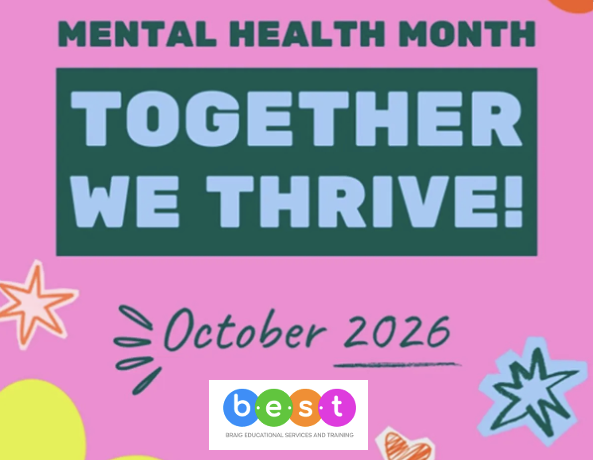
Perfect for Mental Health Month Australia October 2016, & 10 October 2026 – World Mental Health Day 2026 Australian Theme: Together We Thrive
By BEST Childcare Consulting
Every day in early childhood education and care, we think about children’s wellbeing. Educators notice when a child is overwhelmed, help children regulate their emotions, create environments where children feel safe and secure, build trusting relationships and teach children that it is okay to express their feelings and ask for help.
During Mental Health Month this October, however, there is another important question for our sector to consider: Who is looking after the wellbeing of the people doing the caring?
Mental Health Month is recognised throughout October in Australia, with World Mental Health Day held on 10 October. Mental Health Australia’s 2026 theme, Together We Thrive, focuses on connection, belonging and our collective responsibility for creating the conditions in which people and communities can flourish.
For early childhood education and care, that message is particularly relevant. Supporting educator wellbeing requires more than encouraging people to practise self-care or become more resilient. It means listening to educators, understanding the pressures they experience and creating workplaces where people feel safe, respected, connected, supported and valued.
For childcare services, educator mental health and wellbeing should not be viewed as separate from quality practice. It intersects with staffing, supervision, workplace health and safety, relationships with children, leadership, organisational culture and ultimately the quality and safety of children’s experiences.
Educator Wellbeing Matters in Early Childhood Education and Care
Early childhood education and care is enormously rewarding work, but it can also be physically, cognitively and emotionally demanding. Throughout a single day, an educator may supervise multiple children, respond to emotional dysregulation and challenging behaviour, support children with additional needs, communicate with families, manage routines and transitions, complete documentation, maintain hygiene and safety requirements and respond to unexpected situations. Throughout all of this, educators are expected to remain patient, responsive, emotionally available and actively engaged with children.
The wellbeing of the person undertaking this work matters.
Well-supported educators are better positioned to build positive relationships, collaborate effectively with colleagues, engage meaningfully with children and contribute to a positive organisational culture. ACECQA has specifically encouraged services to consider educator wellbeing and the role it plays in educators’ work with children, families and colleagues.
This does not mean that an educator experiencing stress or mental health difficulties cannot provide high-quality education and care. Mental health should never become a measure of someone’s professional competence. Rather, services should recognise that the conditions in which people work can support or undermine wellbeing and that organisations have an important responsibility for creating healthy working environments.
Together We Thrive: Wellbeing Is Not Just an Individual Responsibility
The 2026 theme Together We Thrive reminds us that wellbeing does not exist entirely within an individual. Connection matters. Belonging matters. Feeling respected and valued matters. Knowing someone will listen when things become difficult matters.
This is particularly relevant in childcare, where effective teamwork is fundamental to almost everything educators do. An educator should be able to tell a colleague or leader, “I need some help here,” “I am feeling overwhelmed,” or “I don’t think this system is working,” without being regarded as incapable, difficult or weak. Similarly, educators should be able to recognise when a colleague needs assistance and step in without that support being perceived as criticism.
A mentally healthy childcare workplace is not one where nobody experiences stress. Early childhood education is dynamic work and there will inevitably be demanding days, difficult situations and periods of increased pressure. A healthy workplace is one where people can talk about those challenges, seek assistance, contribute to solutions and trust that legitimate concerns will be taken seriously.
Are We Actually Listening to Our Educators?
Mental Health Month provides an opportunity for early childhood leaders to consider whether their wellbeing initiatives reflect what educators actually need.
Services might organise a wellbeing morning tea, appreciation activity, mindfulness session or reminders about self-care. These activities can be positive. However, they should complement rather than replace genuine consultation with educators about the factors affecting their wellbeing at work.
If educators consistently report that they are overwhelmed during particular transitions, struggle to access meaningful breaks, feel burdened by competing responsibilities, experience uncertainty about expectations or do not feel adequately supported when difficult situations occur, the organisational response cannot simply be to encourage greater resilience.
Their experience may be telling us something about the workplace.
Mental Health Month therefore provides an opportunity to ask educators what makes their working day harder than it needs to be, when they feel most and least supported, whether particular systems or expectations create unnecessary pressure, whether they feel comfortable asking for assistance and what practical changes might improve their working environment.
Importantly, listening should lead somewhere. Consultation that repeatedly asks educators to identify problems but produces no consideration, feedback or action can itself become frustrating. Genuine consultation requires services to listen, reflect, respond and then review whether the changes made a difference.
Moving Beyond the “Self-Care” Response
There is an important place for individual wellbeing strategies. Sleep, exercise, healthy relationships, relaxation, mindfulness, meaningful breaks and maintaining interests outside work can all contribute positively to mental health.
However, educator wellbeing cannot become solely the educator’s responsibility. Sometimes the solution is not helping an educator become better at coping with a difficult working environment. Sometimes the working environment itself needs attention.
A mindfulness activity cannot resolve an unreasonable workload. A wellbeing poster cannot compensate for bullying or disrespectful workplace relationships. A morning tea cannot ensure educators receive meaningful breaks. Encouraging employees to become more resilient should never become an alternative to identifying and addressing workplace risks.
Supporting educator wellbeing is not simply about helping educators become more resilient to unhealthy working conditions. It is also about creating healthy working conditions in the first place.
That requires services to consider how work is designed, how teams communicate, whether educators receive appropriate support, how difficult incidents are managed, whether expectations are realistic and whether employees genuinely feel safe raising concerns.
Educator Mental Health Is Also a Work Health and Safety Issue
Psychological health is part of workplace health and safety. For Western Australian childcare services, WorkSafe WA identifies psychosocial hazards as factors arising from the design or management of work, the working environment or workplace relationships and interactions that can cause physical or psychological harm.
Examples relevant to early childhood workplaces can include excessive work demands, inadequate support, lack of role clarity, poor leadership or workplace culture, poor organisational change management, inadequate recognition, fatigue, burnout, traumatic events, bullying, harassment, violence and aggression.
In an early childhood setting, these hazards may look different from those in an office or industrial workplace. They might involve sustained periods of high demands, managing multiple competing responsibilities while supervising children, difficulty accessing breaks, inadequate support during challenging behaviour, uncertainty about responsibilities, poor workplace relationships or exposure to distressing incidents.
Western Australia’s Psychosocial Hazards in the Workplace Code of Practice specifically recognises issues including stress, fatigue, burnout, bullying, harassment, violence and aggression, discrimination and misconduct. Importantly, the Code confirms that health under the WHS framework includes both physical and psychological health.
This means educator wellbeing should not sit separately from a service’s broader approach to workplace health and safety.
Not every demanding day or stressful situation constitutes a psychosocial hazard. Early childhood education and care will inevitably involve periods of pressure. Services should instead consider the nature of the hazard and the level of exposure, including how frequently it occurs, how long it continues, its severity and whether multiple hazards interact.
Listen to the People Actually Doing the Work
One of the most useful ways of identifying workplace pressures is also one of the simplest: ask the people doing the work.
Leaders cannot always identify workplace pressures by reviewing policies, procedures and rosters. The educators actually undertaking the work often have the clearest understanding of where the pressure points exist.
Educators know which transition regularly becomes difficult. They know whether staffing arrangements work in practice. They know whether breaks are genuinely accessible rather than simply appearing on a roster. They know when administrative expectations compete with their ability to remain engaged with children. They know whether asking another educator for assistance is encouraged in theory but discouraged in practice.
And they know whether they feel safe enough to tell management when something is not working.
Listening to educators is therefore more than a gesture of appreciation. Their lived experience can provide important information about how work is actually being experienced and where changes may be required.
Educator Wellbeing, Fatigue and Effective Supervision
There is also an important connection between educator wellbeing and children’s safety.
Effective supervision requires educators to remain attentive, engaged and responsive to changing circumstances. Fatigue, excessive workload and competing demands can affect a person’s capacity to maintain attention and respond effectively to what is occurring around them.
This is particularly relevant to ACECQA’s current focus on active, dynamic and effective supervision. ACECQA emphasises that educator-to-child ratios alone do not achieve adequate supervision. Educators must actively monitor children, respond to changing circumstances and use professional judgement to adapt their supervision approach.
A strong service therefore recognises that supporting educators and protecting children are not competing priorities. They reinforce one another.
A workplace culture where an educator feels comfortable saying, “I need another educator here,” before a situation escalates supports both educator wellbeing and children’s safety. Similarly, noticing that another educator is becoming overwhelmed and stepping in should be regarded as effective teamwork rather than evidence that someone has failed.
Recognising fatigue, communicating with colleagues and knowing when additional support is required are important aspects of professional judgement and a strong supervision culture.
Turn Mental Health Month into Action
Mental Health Month should be recognised and celebrated. Share mental health information, recognise your educators, organise team activities and encourage conversations about wellbeing. But October can also be used to look more deeply at the workplace itself.
Ask educators what currently supports their wellbeing and what creates unnecessary pressure. This could occur through team discussions, individual conversations, surveys or confidential feedback. Look for patterns rather than treating each comment as an isolated concern. If several educators identify the same difficult routine, workload pressure or communication issue, there may be an opportunity for meaningful improvement.
Consider whether educators consistently receive meaningful breaks, whether particular times of the day involve excessive competing demands, whether employees feel comfortable requesting assistance and how educators are supported following challenging or distressing incidents. Communication practices, role clarity, recognition, consultation during organisational change and access to professional support are also worth examining.
Then act on what you learn.
Some issues may have relatively simple solutions, such as reallocating responsibilities during a difficult transition, changing how information is communicated or creating a clearer process for requesting assistance. Other issues may require longer-term planning, additional resources or organisational change.
Finally, return to the educators and ask whether the change actually helped.
Wellbeing should not become something that appears on the calendar in October and disappears again in November.
A Mental Health Month Critical Reflection for Your Childcare Service
Rather than simply asking “What are we doing for staff wellbeing?”, Mental Health Month provides an opportunity to ask deeper questions about what it is actually like to work within your service.
Do educators genuinely feel supported, and how do you know? What happens when an educator says they are overwhelmed? Do educators feel safe asking for help without fearing judgement? Which parts of the working day create the greatest pressure? Are there systems or expectations that everyone has simply become accustomed to but which create unnecessary stress?
Consider whether educators consistently receive meaningful breaks, how fatigue is recognised and responded to, how employees are supported after challenging or distressing incidents and whether educators have genuine input into decisions affecting their work. From a WHS perspective, consider whether psychosocial hazards have been examined alongside physical hazards and what evidence demonstrates that existing wellbeing strategies are actually helping.
Perhaps the most useful question is also the simplest:
If our educators could change one thing about their working environment to improve their wellbeing, what would they change?
Ask them.
And genuinely listen to the answer.
QIP Write up
Quality Area 1 – Educational Program and Practice
Embedded Practice: Children’s emotional literacy, self-regulation, help-seeking and wellbeing were embedded throughout everyday play, routines, conversations and learning experiences.
Critical Reflection: Educators reflected on behaviour as communication and considered how children’s emotions, experiences and environments influenced behaviour and engagement.
Meaningful Engagement: Families shared strategies they used at home to support their child’s emotional wellbeing, which informed our program and educator responses.
Quality Area 2 – Children’s Health and Safety
Embedded Practice: Children’s psychological wellbeing was recognised as an important part of health and safety, with educators consistently supporting children to express feelings, seek help and identify trusted adults.
Critical Reflection: We reflected on how educator fatigue, workload and competing demands could influence active, dynamic and effective supervision and children’s safety.
Meaningful Engagement: Families shared information about circumstances affecting their child’s emotional wellbeing, helping educators provide consistent and individualised support.
Quality Area 3 – Physical Environment
Embedded Practice: Our environments provided children with opportunities for active play, connection, quiet experiences, retreat and emotional regulation.
Critical Reflection: We considered whether noise, crowding, room layout or environmental demands contributed unnecessarily to stress for children or educators and made changes where required.
Meaningful Engagement: Children, families and educators contributed ideas about environments and spaces that helped children feel calm, comfortable and secure.
Quality Area 4 – Staffing Arrangements
Embedded Practice: Educators were encouraged to communicate when they needed assistance, with asking for help and supporting colleagues embedded as normal professional teamwork.
Critical Reflection: We examined whether staffing arrangements, workloads, breaks and competing responsibilities supported educator wellbeing in practice, rather than simply meeting minimum requirements.
Meaningful Engagement: Educator feedback about the realities of their working day directly informed changes to staffing practices, routines and team support.
Quality Area 5 – Relationships with Children
Embedded Practice: Educators consistently used warm, responsive relationships to support children’s emotional wellbeing, recognising behaviour as communication and responding with empathy and curiosity.
Critical Reflection: Educators reflected on how stress, fatigue and workload could influence interactions and considered what support helped them remain emotionally available and responsive to children.
Meaningful Engagement: Families shared their knowledge of their child’s emotions, temperament and regulation strategies, strengthening consistency between home and the service.
Quality Area 6 – Collaborative Partnerships with Families and Communities
Embedded Practice: Mental health and emotional wellbeing became part of our ongoing conversations with families, with reliable information and support resources made readily available.
Critical Reflection: We considered whether our approach to mental health was inclusive, culturally responsive and sensitive to the different ways families may understand and discuss wellbeing.
Meaningful Engagement: Families contributed their perspectives and were connected with reputable Australian mental health and wellbeing resources where appropriate.
Quality Area 7 – Governance and Leadership
Embedded Practice: Educator psychological health and wellbeing were incorporated into leadership and WHS practices, including consideration of psychosocial hazards, workload, fatigue, support and workplace relationships.
Critical Reflection: We moved beyond asking “What are we doing for staff wellbeing?” to examining “What is it actually like to work here, and how do we know?”
Meaningful Engagement: Educator voice and lived experience directly informed workplace wellbeing priorities, with recognised sector, mental health and WHS guidance used to support our decisions.
Children’s Mental Health and Wellbeing
While this article deliberately focuses on early childhood educator mental health and workplace wellbeing, Mental Health Month is also an important opportunity to reflect on children’s developing social and emotional wellbeing. Early childhood services are uniquely positioned to help children build the foundations of positive mental health through secure relationships, belonging, play, emotional literacy, connection, agency and responsive support.
Through everyday interactions and relationships, children learn that their feelings can be expressed and acknowledged, that trusted adults can help, that difficult emotions can be managed with support and that it is safe to ask for help. These experiences contribute to children’s developing confidence, resilience, sense of security and capacity to form positive relationships with others.
Children’s wellbeing and educator wellbeing should therefore not be viewed as entirely separate conversations. The wellbeing of children is supported by the relationships and environments surrounding them, while educators need workplaces that enable them to provide the responsive, emotionally available care that children need. A mentally healthy early learning community includes children, educators, leaders and families, making the 2026 Mental Health Month theme Together We Thrive particularly meaningful for early childhood education and care.
This October, Let’s Do More Than Raise Awareness
Mental Health Month gives early childhood services an important opportunity to talk about mental health, reduce stigma, encourage help-seeking and remind educators and families that support is available. Services can share resources, recognise and celebrate educators, organise a team morning tea, start conversations about mental health and wellbeing and encourage people to seek professional support when they need it. These actions are worthwhile, but our sector can also use Mental Health Month as an opportunity to look more deeply at the workplace itself.
Consider whether educators are genuinely supported and, importantly, how you know. Ask whether the service is listening to what educators say about their working experiences, whether workplace factors affecting their wellbeing could be changed and whether people feel psychologically safe enough to speak when something is not working. Rather than assuming what educators need, ask them what would make a meaningful difference and involve them in developing the response.
Most importantly, listen to the people doing the caring. The educators who spend every day protecting children’s safety, supporting their emotions, building their confidence and creating their sense of belonging deserve workplaces that take their wellbeing seriously too.
This Mental Health Month, our message to early childhood services is simple: listen to your people, look after each other and create workplaces where children and educators can thrive. When we support the people who care for our children, we strengthen our educators, our children, our families, our services and our wider early childhood community. Together We Thrive.
Useful Resources
Mental Health Australia – Mental Health Month & World Mental Health Day 2026
2026 theme: Together We Thrive.
Mental Health Australia – World Mental Health Day 2026
Be You – Educator Wellbeing
This is particularly relevant to the BEST article because it provides resources specifically around educator wellbeing, including resources for educators and leaders.
Be You – Educator Wellbeing Resources
Be You – Early Learning Educators
This page is specifically designed for educators working in early learning services, with free professional learning, wellbeing tools and resources.
Be You – Resources for Early Learning Educators
ACECQA – Supporting Educator Wellbeing
A very useful direct link for connecting the article to Quality Area 4 and educator wellbeing.
ACECQA – Supporting Educator Wellbeing
Safe Work Australia – Psychosocial Hazards
Covers job demands, poor support, role clarity, traumatic events, bullying, aggression, workplace relationships and other psychosocial hazards.
Safe Work Australia – Psychosocial Hazards
WorkSafe WA – Psychosocial Hazards in the Workplace: Code of Practice
This is the particularly important WA-specific resource for your article.
WorkSafe WA – Psychosocial Hazards in the Workplace Code of Practice
Lifeline – Crisis Support
Confidential crisis support is available 24 hours a day, 7 days a week on 13 11 14, with text and online chat also available. If life is in danger, call 000.
Lifeline – Crisis Support 13 11 14
BEST Childcare Consulting
At BEST Childcare Consulting, we understand that quality early childhood education and care depends on more than policies and compliance. It depends on the people implementing them every day.
BEST works alongside early childhood services to strengthen educator practice, leadership, supervision, compliance, critical reflection and continuous improvement, with practical support grounded in the realities of operating a childcare service.
Whether you are reviewing educator wellbeing and psychosocial safety, strengthening active, dynamic and effective supervision, preparing your QIP or looking more broadly at how your systems and practices are working in reality, BEST can help you turn reflection into practical improvement.
Call us TODAY.