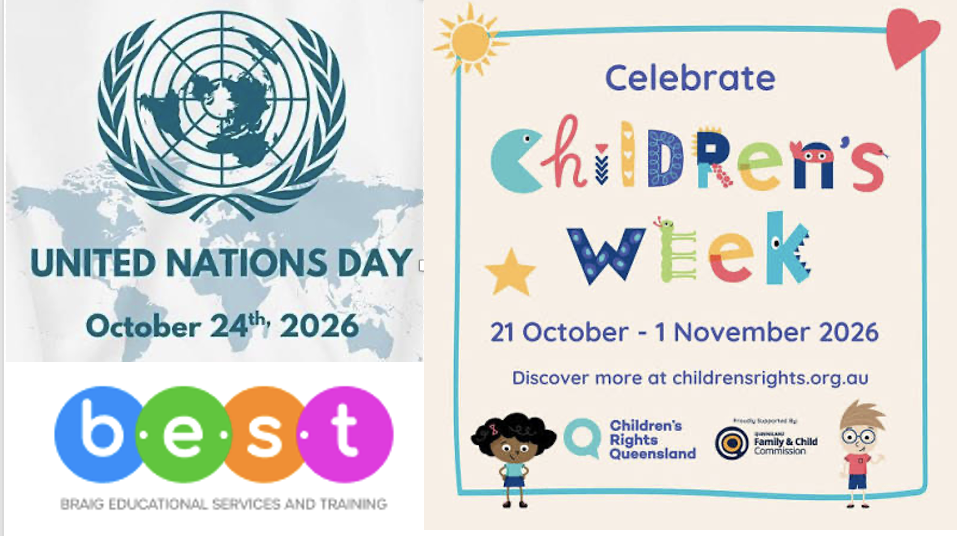
Perfect for National Children’s Week (24 Oct – 1 Nov 2026) Theme: “Children have the right to use their own language, celebrate their culture and practise their religion.” – UNCRC Article 30, which connects to United Nations Day on 24 October 2026
By BEST Childcare Consulting
Every child who walks through the doors of an early childhood education and care service brings something uniquely their own—their family, their language, their culture, their traditions, their experiences and their developing sense of who they are.
They also bring with them something that belongs equally to every child: their rights.
National Children’s Week, held from 24 October to 1 November 2026, provides education and care services with an important opportunity to celebrate children and reflect on how their rights, voices, cultures and identities are recognised within everyday practice.
The beginning of Children’s Week in 2026 also coincides with United Nations Day on 24 October, creating a particularly meaningful opportunity to introduce children to the idea that children everywhere have rights.
For early childhood services, this week is about much more than adding multicultural experiences to the program. It is an opportunity to ask: Do the children in our service genuinely see themselves, their families, their languages and their cultures reflected in the place where they spend so much of their childhood?
Understanding the 2026 National Children’s Week Theme
Each year, National Children’s Week celebrates children’s talents, skills, achievements and rights, with the national theme based on an article from the United Nations Convention on the Rights of the Child (UNCRC).
For 2026, the focus is Article 30: “Children have the right to use their own language, celebrate their culture and practise their religion.” This is a powerful theme for early childhood education and care. Article 30 reminds us that language, culture and belief are not simply topics for occasional programmed experiences. They are part of a child’s identity, family connections and sense of belonging. Children should experience education and care environments where who they are is recognised and respected.
This might mean hearing familiar words from their home language, seeing their families and communities represented in books and resources, sharing traditions that are important to them, seeing Aboriginal and Torres Strait Islander cultures meaningfully represented, and learning that other children and families may have languages, cultures and beliefs different from their own.
It also means recognising that there is no single way for a child or family to express culture.
Services should avoid reducing cultural responsiveness to flags, food, costumes or occasional cultural celebrations. These experiences may have value when they are meaningful to children and families, but genuine cultural responsiveness goes much further.
The EYLF V2.0 describes cultural responsiveness as involving respect for multiple cultural ways of knowing, doing and being. It requires educators to learn with and from children, families and communities and to critically reflect on their own perspectives, assumptions and practices.
Children’s Week therefore provides an opportunity not simply to celebrate diversity, but to examine whether children’s cultural identities are genuinely embedded within everyday practice.
Free Children’s Rights Book – Written and Illustrated by WA Children
One of our favourite free resources for National Children’s Week is this beautiful Children’s Rights book for children aged 0–4 years, produced by Meerilinga Young Children’s Foundation for Children’s Week 2020. What makes this resource particularly meaningful is that it was written and illustrated by Western Australian children, for children. Guided by author and illustrator Briony Stewart, young children were invited to express what their rights meant to them through their own words, ideas and artwork.
The book explores children’s rights through concepts young children can readily connect with, including playing, resting, discovering, growing, knowing, caring, sharing, feeling safe and being yourself. This makes it an excellent starting point for National Children’s Week 2026. Educators can read the book with children and then use the children’s own ideas and illustrations to begin conversations about this year’s Article 30 theme – children’s right to use their own language, celebrate their culture and practise their religion. Ask your children what being themselves means to them, what is special about their family, what languages they use or hear at home, what traditions are important to them and what helps them feel that they belong.
Even better, you can read the entire book online for free, making it an easy resource to share with educators and families during Children’s Week.
Read the free Children’s Rights 0–4 Years book online:
https://www.childrensweekwa.org.au/wp-content/uploads/2025/02/40923-MEER-Childrens-Week-Childrens-Book-0-4-yrs_WEB-2_compressed.pdf
Educational Programming Ideas
The most meaningful Children’s Week experiences will emerge from the actual children, families and communities within your service.
Rather than attempting to represent every culture through generic activities, begin with the people who already belong to your service.
Babies
For babies, Article 30 can be explored through relationships, familiar language, music, sensory experiences and belonging.
Ideas include:
- Ask families to provide important words used at home, such as hello, goodbye, sleep, bottle, Mum, Dad, Grandma or comfort words.
- Incorporate familiar home-language words naturally into routines.
- Play lullabies, nursery rhymes and music contributed by families.
- Create family photo books that babies can access throughout the day.
- Include dolls, images and books reflecting diverse families and cultures.
- Invite families to record a favourite song, rhyme or short story in their home language.
- Incorporate family knowledge into feeding, sleeping, comforting and care routines.
- Include appropriate Aboriginal and Torres Strait Islander music, stories and perspectives.
- Display photographs of familiar people and experiences at babies’ eye level.
For babies, cultural responsiveness is particularly meaningful when it is embedded within everyday caregiving relationships, rather than treated as a separate activity.
Toddlers
Toddlers are rapidly developing language, identity and awareness of themselves and others.
Ideas include:
- Create a “Languages We Speak” display using words contributed by families.
- Learn greetings, counting words and simple phrases used by children at home.
- Provide culturally diverse dolls and dramatic-play materials.
- Include household and cooking items that authentically reflect children’s families.
- Read stories featuring diverse families, languages and communities.
- Invite families to share songs, stories, music and traditions.
- Create self-portraits and family portraits.
- Provide mirrors and diverse skin-tone art materials.
- Explore foods familiar to children and families.
- Talk positively about similarities and differences.
- Create simple discussions around belonging: “What makes your family special?”
Educators can ensure children’s home languages are viewed as strengths and important parts of identity.
3-Year Kindy
Three-year-olds can begin exploring identity, belonging, diversity and rights through conversation, play and investigation.
Ideas include:
- Create a class book titled “This Is Us.”
- Invite each child to contribute something about their family, language or culture.
- Investigate the languages spoken within the group.
- Create a map showing children’s family connections around Australia and the world.
- Invite family members to share stories, songs, cooking, music, art or traditions.
- Explore local Aboriginal culture, language and connection to Country using appropriate local resources and community connections.
- Read books featuring diverse cultures, languages and family structures.
- Encourage children to dictate stories about traditions important to their family.
- Develop dramatic-play environments inspired by children’s actual family and community experiences.
- Ask children, “What makes you feel like you belong here?”
- Introduce the idea that children have rights.
The focus should remain on curiosity, respect and belonging, without presenting any culture as unusual or exotic.
4-Year Kindy
Older preschool children can engage more explicitly with the concept of children’s rights.
Introduce Article 30 in child-friendly language:
“Every child has the right to speak their language and be part of their culture.”
Ideas include:
- Develop a Children’s Rights project.
- Ask children what culture, family and belonging mean to them.
- Create an “Our Languages, Our Families, Our Community” project.
- Interview family members about traditions they would like to pass on to their children.
- Explore local Aboriginal language and culture through appropriate community connections.
- Create books, artwork, photographs or digital stories representing children’s identities.
- Explore traditional and contemporary music, art, stories and games.
- Discuss fairness and inclusion in age-appropriate ways.
- Audit the room with children by asking: “Can everyone who comes here see something that represents them?”
- Invite children to decide how they would like their family, culture or identity represented.
- Ask children for ideas about making the service welcoming for everyone.
This moves children beyond simply noticing diversity towards understanding respect, fairness, inclusion and rights.
OSHC
School-age children can take a much stronger leadership role.
Ideas include:
- Establish a Children’s Rights Committee.
- Investigate the United Nations Convention on the Rights of the Child.
- Research Article 30 and discuss what it means in children’s own lives.
- Ask children to audit books, displays and resources for cultural representation.
- Create podcasts or videos about culture, language, identity and belonging.
- Develop a multilingual welcome display designed by children.
- Research languages spoken within the local community.
- Invite children to teach peers words or phrases they use with their families.
- Explore cultural music, art, games and storytelling selected by children themselves.
- Investigate local Aboriginal and Torres Strait Islander cultures with particular attention to local Traditional Custodians.
- Discuss stereotypes, discrimination, fairness and respectful responses.
- Create a Children’s Week exhibition for families.
- Ask children to develop recommendations for how the OSHC service could better recognise cultural diversity throughout the year.
Under My Time, Our Place V2.0, this provides meaningful opportunities for children to exercise agency and influence decisions within their service.
QIP write up
QA1 – Educational Program and Practice
Embedded Practice:
Educators had consistently incorporated children’s cultures, languages, family experiences and identities into curriculum decision-making. Children’s Week had strengthened existing practice rather than operating as a stand-alone cultural celebration.
Critical Reflection:
Educators had critically reflected on whether cultural experiences within the program were authentic and meaningful or risked becoming tokenistic. This reflection had influenced subsequent curriculum decisions.
Meaningful Engagement with Families and/or Community:
Families had contributed words, stories, traditions, music and cultural knowledge that educators incorporated into children’s learning experiences.
QA2 – Children’s Health and Safety
Embedded Practice:
Educators had recognised children’s cultural identity, language, relationships and sense of belonging as important contributors to emotional wellbeing. Individual care practices had continued to respect family knowledge, preferences and children’s needs.
Critical Reflection:
The team had reflected on whether all children experienced the service as emotionally and culturally safe and whether routines, language or practices could unintentionally exclude children or families.
Meaningful Engagement with Families and/or Community:
Families had been consulted about culturally significant practices and individual needs, strengthening educators’ capacity to provide respectful and responsive care.
QA3 – Physical Environment
Embedded Practice:
Indoor and outdoor environments had reflected the identities, languages, cultures and communities of children attending the service through authentic resources, photographs, books and play materials.
Critical Reflection:
Educators had audited the environment and considered whose cultures and experiences were highly visible, whose were missing and whether representations were authentic or stereotypical.
Meaningful Engagement with Families and/or Community:
Children and families had contributed ideas and resources that strengthened representation within the environment.
QA4 – Staffing Arrangements
Embedded Practice:
Educators had shared cultural knowledge, resources and professional learning and supported one another to strengthen culturally responsive practice.
Critical Reflection:
The team had discussed personal assumptions and unconscious bias and considered how educators’ own cultural perspectives could influence interactions, expectations and curriculum decisions.
Meaningful Engagement with Families and/or Community:
Educators had drawn upon family and community expertise rather than assuming they held all the knowledge required to appropriately represent different cultures.
QA5 – Relationships with Children
Embedded Practice:
Children’s identities, languages, cultures and family experiences had been consistently acknowledged within respectful educator-child relationships. Educators had actively listened to children and supported them to express their identities in ways meaningful to them.
Critical Reflection:
Educators had reflected on whether every child experienced genuine belonging and whether children’s voices meaningfully influenced decisions about cultural representation.
Meaningful Engagement with Families and/or Community:
Knowledge shared by families had enabled educators to know children more deeply and strengthen culturally responsive relationships.
This work particularly supported Element 5.1.2 – Dignity and rights of the child.
QA6 – Collaborative Partnerships with Families and Communities
Embedded Practice:
Family cultures, values, beliefs, languages and knowledge had been recognised as essential sources of information when planning for children.
Critical Reflection:
Educators had considered whether existing approaches genuinely invited participation from all families and whether communication methods unintentionally created barriers.
Meaningful Engagement with Families and/or Community:
Families and community members had actively contributed knowledge, stories, languages, experiences and feedback rather than being passive recipients of the program.
QA7 – Governance and Leadership
Embedded Practice:
Commitments to children’s rights, inclusion, diversity and cultural responsiveness had been reflected in the service philosophy, policies, professional expectations and continuous improvement processes.
Critical Reflection:
Leadership had used Children’s Week to facilitate whole-service reflection on Article 30 and considered whether the service’s philosophy, policies and everyday practices genuinely reflected its commitment to children’s rights.
Meaningful Engagement with Families and/or Community:
Feedback from children, families, educators and community members had informed priorities for ongoing service improvement beyond Children’s Week.
Keeping Article 30 Alive Throughout the Year
Perhaps the most important question comes after 1 November: What happens when Children’s Week finishes? If multilingual welcome signs disappear, cultural resources return to cupboards and conversations about children’s rights stop, the service has celebrated an event rather than embedded meaningful practice. Instead, National Children’s Week can be used as a starting point for ongoing reflection and improvement, ensuring the principles of Article 30 remain visible throughout the year.
Children’s home languages can continue to be visible, heard and valued within everyday routines, environments and interactions. Services can continue sourcing books, images, music and resources that authentically represent the children, families and broader community, while regularly reviewing environments for diversity, representation and stereotypes. When new families join the service, enrolment and orientation can provide opportunities to learn about the languages they use at home, cultural practices, values, traditions and other aspects of family identity that are important to them. Meaningful relationships with local Aboriginal and Torres Strait Islander communities can also continue to develop, ensuring First Nations perspectives are respectfully and authentically embedded rather than reserved for particular dates on the calendar.
Families should continue to be invited to contribute their knowledge, experiences and perspectives throughout the year—not only when a cultural celebration occurs. Educator meetings, programming discussions and critical reflection can similarly include consideration of children’s rights, cultural responsiveness, inclusion and belonging. Teams can regularly ask whether their practices genuinely reflect the children and families currently attending the service and identify whose voices, languages, cultures or experiences may still be missing.
Most importantly, continue asking children themselves. Ask: Do you feel like you belong here? What is important to your family? What would you like us to know about you? What should we have in our room? What would make our service welcoming for everyone? Their answers can provide valuable direction for curriculum decisions, environments and ongoing quality improvement.
Cultural responsiveness is not achieved through a single week. It develops through relationships, reflection, listening and a willingness to continually evaluate and change practice. National Children’s Week can start the conversation, but children themselves should help us decide where that conversation goes next.
Official Links and Resources
National Children’s Week – Official Australian Website
Information about National Children’s Week and the annual UNCRC theme.
National Children’s Week Australia
Children’s Week Western Australia
The official WA Children’s Week site confirms 24 October–1 November 2026 and the Article 30 theme.
Children’s Week WA
Children’s Week WA – Free Resources
This is particularly useful for childcare services. It includes posters, songs, books, colouring activities, podcasts and videos.
Children’s Week WA Resources
Children’s Week WA – Children’s Rights Books
Includes downloadable resources developed with WA children, including Children’s Rights with Pictures and stories from different age groups.
Children’s Week WA Children’s Rights Books
United Nations – United Nations Day
Official UN information about United Nations Day, 24 October.
United Nations Day – United Nations
United Nations – Convention on the Rights of the Child
Official information about the UN Convention underpinning National Children’s Week and Article 30.
UN Convention on the Rights of the Child
ACECQA – Cultural Responsiveness
Excellent resource for connecting the 2026 theme to the EYLF V2.0. ACECQA specifically discusses respecting different backgrounds, beliefs, values, customs and multiple cultural ways of knowing, doing and being.
ACECQA – EYLF V2.0 Cultural Responsiveness
ACECQA – Respect for Diversity
Useful for connecting Article 30 with family cultures, values, beliefs, language, traditions and cultural identity.
ACECQA – EYLF V2.0 Respect for Diversity
ACECQA – Responsiveness to Children
Useful for the article’s emphasis on children’s voices, strengths and participation.
ACECQA – EYLF V2.0 Responsiveness to Children
ACECQA – Approved Learning Frameworks
Direct access to EYLF V2.0 and My Time, Our Place V2.0, making this useful for both LDC/kindergarten and OSHC services.
ACECQA – Approved Learning Frameworks
ACECQA – National Quality Standard
Current NQS information covering all seven Quality Areas.
ACECQA – National Quality Standard
BEST Childcare Consulting
At BEST Childcare Consulting, we believe meaningful quality improvement starts by looking beyond what we do and asking why we do it, whose voices are represented and whether everyday practice genuinely reflects the children and families in our care.
National Children’s Week provides services with a valuable opportunity to celebrate children, strengthen children’s voices and critically reflect on how children’s rights are embedded within everyday practice.
United Nations Day reminds us that these rights are not privileges given to children by adults—they are rights that belong to all children.
And Article 30 reminds us that recognising children’s language, culture and identity is not simply a programming opportunity. It is their right.
Contact us TODAY.