
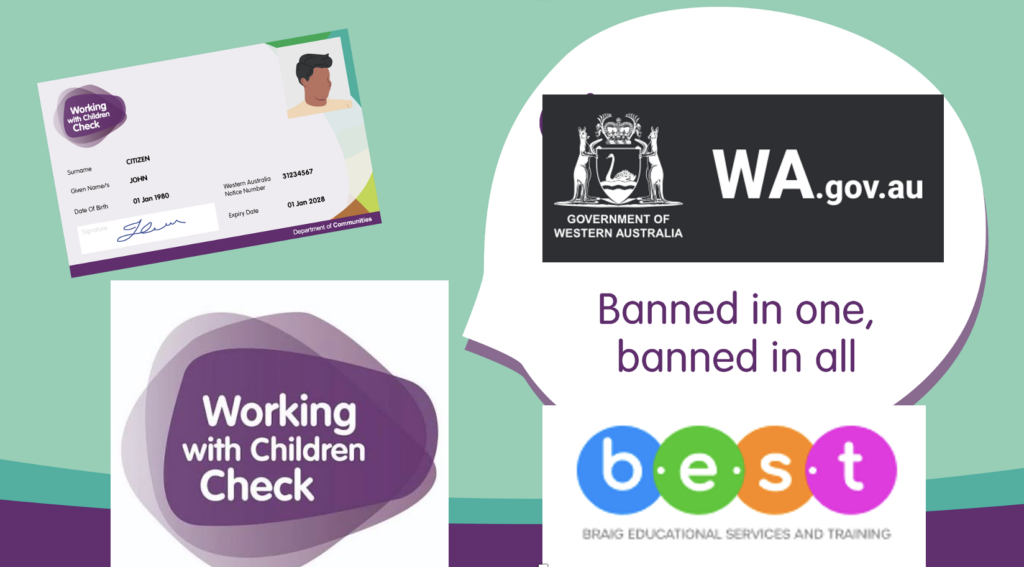
Perfect for understanding the “Banned in One, Banned in All” changes implemented from 17 September 2026
By BEST Childcare Consulting
Working with Children Check (WWC) laws have changed in WA, from 17 September 2026, changes introduced through the Working with Children (Screening) Amendment Bill 2025 implement the mutual recognition of adverse interstate WWC decisions. For early childhood education and care services, this is an important child-safety development.
If a person receives an adverse WWC decision in another Australian state or territory, that decision is now recognised in WA. Put simply: “Banned in one, banned in all.”
For childcare services, this is also a timely reminder to check who needs a WWC Check, who may be exempt. Educators are relatively straightforward. But what about the parent helping with an excursion? A grandparent who volunteers each week? The plumber fixing a toilet? The photographer taking children’s photographs? A gardener working while children are outside? A university student? Or the instructor from an external children’s program such as dance, sport, music or fitness? The answer depends on the person’s role and circumstances.
Our latest BEST article breaks down what the changes mean and provides practical links, factsheets and templates to help services check their compliance.
What has changed in WA?
The WA Government’s changes implement mutual recognition of adverse Working with Children decisions made elsewhere in Australia. Banned in one, banned in all. If a person has an adverse interstate WWC decision, that decision is now recognised in WA. This includes relevant interstate negative notices, suspensions and interim bars.
Importantly, the reforms also prevent affected people from relying upon several exemptions that would ordinarily allow a person to undertake particular child-related work without a WA WWC Check.
These include the:
- child volunteer exemption;
- parent volunteer exemption;
- unpaid student on placement under 18 exemption;
- short-term visitor to WA exemption; and
- one-off national events and national tours exemption.
For childcare providers, this creates an important organisational responsibility. If a service becomes aware that an employee, volunteer or student is subject to an adverse interstate WWC decision, it must immediately take steps to ensure that person does not continue undertaking child-related work.
This can apply even where the person would ordinarily have been exempt from holding a WWC Check.
Read and action
WA Government – Banned in one, banned in all:
Changes to Working with Children Checks – Amendments to the Act
Factsheet NEG06 – Adverse interstate WWC decisions:
Available from the WA Government WWC Resources page under Screening process factsheets:
WWC Check Resources and Factsheets
Factsheet CRW04 – Narrowing of access to exemptions:
Also available from the WWC Resources page under Exemption factsheets.
First: Does This Person Actually Need a WWC Check?
A common misconception is that anyone who enters a childcare service, or anyone who has contact with children, must have a WWC Check. That is not how the WA legislation operates.
Does this Person need a WWC, management should work through three questions:
1. Is there an agreement to work?
This can be a written or unwritten agreement and can include paid employment, self-employment, unpaid work or volunteering.
2. Is the person undertaking child-related work?
Their usual duties must involve, or be likely to involve, contact with children in connection with a prescribed category of child-related work.
A childcare service is one of those prescribed categories.
3. Does an exemption apply?
If the work is child-related and there is no applicable exemption, the person generally requires a WWC Check.
Importantly, if someone is not undertaking child-related work, or an exemption applies, they may actually be ineligible to obtain a WWC Check. A service cannot simply require every visitor or contractor to obtain one regardless of whether they are legally eligible.
Read and action
Start here whenever you are unsure:
WA Government – Who Needs a WWC Check?
This page provides the three-step test for determining whether a WWC Check is required and explains the major exemptions.
Childcare-specific guidance:
Look for Factsheet CAT01 – Categories of child-related work: A child care service on:
WA Government WWC Resources
1. Centre Directors, Managers and Approved Provider Personnel
For childcare services, the rules applying to managerial roles deserve particular attention.
An individual licensee and managerial officer of a childcare service requires a WWC Check even if they do not personally have contact with children.
For people employed within the service whose normal duties involve contact with children—including educators and many operational employees—a WWC Check will ordinarily be required unless a specific exemption applies.
Services should therefore determine WWC eligibility as part of recruitment and appointment processes rather than simply asking whether the applicant already possesses a card.
Management action
Ensure the service has a nominated person responsible for WWC compliance and that your records identify:
- employees, volunteers and students undertaking child-related work;
- WWC Card number;
- expiry date;
- application status where applicable;
- card validation;
- exemptions being relied upon where relevant; and
- action required when a card approaches expiry or the service receives a notification.
Templates and further information
Download the WA Government WWC Compliance Toolkit – ORG01:
WWC Resources – Compliance Toolkit and Templates
Download the official Record Keeping Spreadsheet – ORG08:
On the same page, go to Organisation resources and templates → Template ORG08: WWC Check, Record keeping spreadsheet.
This is particularly useful for Directors and management teams because it provides a government template rather than requiring the service to develop its own register.
2. Educators and Other Employees
Educators whose usual duties involve working with children require a WWC Check.
This includes casual and relief educators where their role involves child-related work.
Other employees require closer consideration of their usual duties.
For example, a cook, cleaner, gardener, administration employee or maintenance employee may require a WWC Check where their employment at the childcare service and their usual duties involve, or are likely to involve, contact with children.
The important question is therefore not simply:
“Are they an educator?”
Instead ask:
“What are their usual duties, and do those duties involve or make contact with children likely?”
Management action
Before a new employee commences:
- determine whether the position is child-related work;
- check whether the person has a current WWC Card or application where required;
- validate the card;
- record the details in your WWC register; and
- register the card holder with the WWC Screening Unit where required.
Check and register employees
Check whether a WWC Card is valid:
WA Working with Children Check Portal
From this page, select Check WWC Card validity.
Register existing WWC Card holders who commence or cease child-related work:
Use Register card holders from the same WA WWC portal.
Childcare-specific factsheet:
Download Factsheet CAT01 – A child care service from:
WWC Resources
3. Hiring New Staff: Make WWC Checking Part of Recruitment
The new national mutual-recognition arrangements make good recruitment and WWC record keeping increasingly important.
A WWC Card should not simply be sighted and photocopied.
As part of recruitment, establish:
- whether the position constitutes child-related work;
- whether the applicant has a current WA WWC Card or pending application;
- whether the card is valid;
- the card/application details and expiry date;
- whether the service has completed its required registration/notification processes;
- how renewal dates will be monitored; and
- what management will do if it receives information concerning a Negative Notice, Interim Negative Notice or adverse interstate decision.
A WWC Check is also only one component of child-safe recruitment. It does not replace reference checking, employment-history checking, qualification verification, identity checking, induction, supervision or assessment of suitability to work with children.
Management action
Add a WWC Check step to your recruitment checklist rather than waiting until the employee’s first day.
Record the employee in the service WWC register immediately.
Recruitment resources
ORG01 – WWC Compliance Toolkit:
Download from WA Government WWC Resources
ORG08 – WWC Record Keeping Spreadsheet:
Available under Organisation resources and templates on the same page.
Check card validity / application status / register card holders:
WA Working with Children Check Portal
4. Volunteers
Being unpaid does not automatically mean a person does not require a WWC Check.
A volunteer can still be undertaking child-related work.
For example, an adult who regularly volunteers at a service and whose agreed volunteer duties involve contact with children may ordinarily require a WWC Check unless an exemption applies.
Services should document:
- who the volunteer is;
- what they will actually be doing;
- whether this constitutes child-related work;
- whether an exemption applies;
- the basis upon which the service determined that exemption applies; and
- how the volunteer will be supervised and managed.
The September 2026 legislative changes make this particularly important because a person with an adverse interstate WWC decision cannot rely upon certain volunteer exemptions.
Management action
Use the official WA Government Volunteer Declaration rather than relying only on a verbal statement from the volunteer.
Keep the declaration with your service’s WWC/volunteer records.
Download the template
ORG04 – WWC Check Volunteer Declaration:
Download the Volunteer Declaration from WWC Resources
The declaration was updated following the 2026 reforms to include adverse interstate WWC decisions.
Also read:
CRW04 – Narrowing of access to exemptions:
Available under Exemption factsheets on the same page.
5. Parents Volunteering at Their Child’s Service
WA provides a specific parent volunteer exemption in certain circumstances.
Within the childcare-service category, a parent volunteering at the childcare service at which their own child is enrolled or ordinarily provided with the service may be exempt from requiring a WWC Check.
This could be relevant, for example, where a parent volunteers to assist with an activity or excursion involving their child’s service.
However, the exemption should not simply be interpreted as:
“Parents don’t need a WWC Check.”
Whether the exemption applies depends upon the circumstances and all of the child-related work the person performs.
Importantly, a person cannot rely upon the parent volunteer exemption if they have a current Negative Notice, Interim Negative Notice or relevant adverse interstate WWC decision.
Management action
For each parent volunteer:
- identify the activity they will undertake;
- establish that the parent exemption actually applies;
- use the Volunteer Declaration;
- retain the declaration;
- document the exemption being relied upon; and
- apply the service’s normal volunteer supervision and child-safety procedures.
Parent volunteer resources
CRW03 – The Parent Volunteer Exemption:
Download from WA Government WWC Resources
ORG04 – Volunteer Declaration:
Available under Organisation resources and templates on the same page.
CRW04 – Narrowing of Access:
Important reading following the “Banned in one, banned in all” reforms.
6. What About Grandparents?
This is an area where childcare services need to be particularly careful.
A grandparent should not automatically be treated as a parent volunteer simply because their grandchild attends the service.
There is also an important difference between being a visitor and being a volunteer.
For example:
Grandma comes to Grandparents’ Day to spend time with her grandchild.
There may be no agreement to work. She is attending as a visitor.
Compare this with:
Grandma agrees to attend every Wednesday to read stories, help with activities and interact with groups of children.
There is now potentially an agreement to undertake volunteer work, and the service needs to assess whether this constitutes child-related work and whether any exemption applies.
Being related to a child attending the service does not, by itself, remove WWC requirements.
Management action
Do not record every grandparent as either “WWC required” or “WWC exempt”.
First determine:
Visitor or volunteer? → Child-related work? → Exemption? → WWC required?
Document your decision where the person is undertaking a regular volunteer role.
Check before deciding
WA Government – Who Needs a WWC Check?
For parent exemptions, also read CRW03 – Parent Volunteer Exemption on the WWC Resources page.
7. Visitors Are Not Automatically Volunteers
A parent attending Mother’s Day afternoon tea, a grandparent attending Grandparents’ Day, a family member attending graduation or another invited guest is not necessarily undertaking work at all.
Where there is no agreement to work, a WWC Check is not required under the WWC legislation.
However, this does not mean the service has no responsibilities.
The service must still apply appropriate:
- visitor sign-in procedures;
- supervision;
- access controls;
- child-safe practices;
- photography and image procedures;
- privacy requirements; and
- procedures preventing visitors from being left unsupervised with children where this is inappropriate.
Management action
Make sure your Visitor Procedure distinguishes between:
visitor → volunteer → contractor → child-related worker.
Do not use “has a WWC Card” as the sole criterion for allowing a person access to children.
More information
WA Government – Who Needs a WWC Check?
8. Contractors and Tradespeople
Another common misconception is:
“Anyone doing work at a childcare centre needs a WWC Check.”
This is incorrect.
The WA WWC guidance distinguishes genuine child-related work from contact that is merely incidental to the person’s work.
Consider a plumber attending to repair a blocked toilet.
The plumber might walk past children or hear children talking. That incidental contact does not automatically turn plumbing into child-related work.
The same principle may apply to:
- electricians;
- air-conditioning technicians;
- pest-control technicians;
- delivery drivers;
- equipment repairers;
- some gardeners;
- builders and tradespeople; and
- other external maintenance contractors.
Services should instead use appropriate risk controls such as signing in, staff supervision, restricting access to areas, scheduling work outside operating hours where appropriate and preventing unnecessary interaction with children.
Management action
Before demanding a WWC Card from every contractor, determine whether their work actually meets the definition of child-related work.
Where it does not, manage the person through your visitor/contractor risk-management process instead.
Contractor guidance
The WA Government provides a specific:
WWC Check Bulletin – Contractors and WWC obligations
Download it from the WWC Check bulletins section here:
WA Government WWC Resources – Contractor Bulletin
Also see Factsheet CAT01 – A child care service for childcare-specific examples.
9. Regular Children’s Programs and Incursion Providers
Programs delivered directly to children need to be considered differently from tradespeople.
Examples include:
- children’s fitness programs;
- dance instructors;
- music teachers;
- sports coaches;
- yoga programs;
- language programs;
- art instructors; and
- other children’s incursions.
If an instructor attends the childcare service specifically to conduct activities with children, interaction with children is not incidental—it is central to the service being provided.
The WA childcare factsheet specifically identifies external providers such as dance or art instructors who attend the childcare service to facilitate activities with children as examples of roles that may constitute child-related work.
Therefore, a program such as Happy Feet Fitness should not be treated in the same way as a plumber simply because both providers are external contractors.
Management action
For every regular incursion or external children’s program, record:
- provider/business;
- individual instructor(s) attending;
- whether their role constitutes child-related work;
- WWC Card details where required;
- card validation and expiry;
- arrangements if a substitute instructor attends; and
- how the provider is supervised and inducted into the service.
Do not simply record the company’s name. WWC Checks relate to the individual person undertaking the child-related work.
Relevant guidance
CAT01 – A Child Care Service:
WA Government WWC Resources
For fitness providers, also see ORG07 – Fitness and Wellness Sector on the same resources page.
Validate an instructor’s WWC Card:
WA Working with Children Check Portal
10. Photographers and Other Specialist Providers
The same three-question test should be applied rather than assuming a rule based solely on the person’s occupation.
Ask:
Is there an agreement to work?
Do their usual duties involve or make contact with children likely in connection with child-related work?
Does an exemption apply?
A photographer whose role involves communicating with, positioning and photographing individual children presents a different WWC question from a contractor photographing an empty building for the service’s website.
Assess the actual duties, rather than the job title alone.
Management action
When booking a specialist provider, ask what the individual will actually be doing in the service and assess WWC eligibility before they attend.
If you remain uncertain, seek advice from the WWC Screening Unit rather than simply insisting the person obtain a WWC Check—they may not be eligible to apply.
More information
WA Government – Who Needs a WWC Check?
11. Students on Placement
Students require particular attention.
An unpaid student undertaking a placement who is under 18 years of age may fall within a specific exemption where the placement forms part of their educational or vocational course.
Students aged 18 or over undertaking child-related placement work will generally require a WWC Check unless another exemption applies.
The 2026 reforms are particularly important because access to the under-18 unpaid student exemption is restricted where the person is subject to specified adverse WWC decisions.
Management action
For every student placement, record:
- student’s age;
- education provider;
- placement dates;
- whether the placement constitutes child-related work;
- WWC Card/application details where required;
- exemption being relied upon where applicable; and
- induction and supervision arrangements.
Do not leave WWC compliance entirely to the school, university or RTO.
Student resources
WA Government – Who Needs a WWC Check?
Also read CRW04 – Narrowing of Access following the September 2026 changes:
12. Children Who Volunteer or Work
A person under 18 undertaking voluntary child-related work may fall within the child-volunteer exemption.
However, this should not be confused with a young person who is paid to work.
If a child is undertaking paid child-related work, a WWC Check may be required.
The new interstate reforms also restrict access to the child-volunteer exemption where specified adverse WWC decisions apply.
Management action
Never assume:
“Under 18 = no WWC Check.”
Determine whether the young person is:
volunteering or paid → undertaking child-related work → eligible for an exemption.
More information
WA Government – WWC Requirements and Exemptions
See also CRW04 – Narrowing of Access on the WWC Resources page.
13. Short-Term Visitors to WA
There is a limited exemption for certain people who are not ordinarily resident in WA and undertake child-related work while visiting the State.
The exemption generally only applies during the two-week period following the person’s arrival in WA and cannot exceed a total of two weeks in any 12-month period.
It also cannot simply be combined with the separate one-off national events/national tours exemption to extend the period.
Following the September 2026 reforms, a person with an adverse interstate WWC decision cannot rely upon this exemption.
This could be relevant where a service engages an interstate presenter, children’s program provider or specialist.
Management action
Do not simply assume an interstate presenter is exempt.
Document:
- date they arrived in WA;
- dates they will undertake the work;
- nature of the child-related work;
- exemption being relied upon; and
- confirmation that the exemption is legally available in their circumstances.
More information
WA Government – WWC Exemptions
For the impact of interstate adverse decisions, see NEG06 – Adverse Interstate Decisions and CRW04 – Narrowing of Access:
14. A WWC Card Does Not Mean “Safe to Hire”
A WWC Check is an important screening mechanism, but it should never be treated as the complete child-safety assessment of an applicant.
A current WWC Card does not remove the service’s responsibility for:
- appropriate recruitment;
- reference checking;
- qualification verification;
- employment-history checks;
- identity verification;
- induction;
- child-safe codes of conduct;
- supervision;
- responding to concerning behaviour;
- mandatory reporting and other reporting obligations; and
- ongoing performance management.
Child-safe recruitment should ask:“Is this person suitable to work within our service?” rather than merely: “Do they have a WWC Card?”
Management action
Include WWC validation within your broader child-safe recruitment checklist, not as a replacement for it.
For WWC compliance specifically, use:
ORG01 Compliance Toolkit and ORG08 Record Keeping Spreadsheet
15. Your WWC Compliance Review: What Should You Do Now?
The September 2026 changes provide a good reason for every WA childcare service to undertake a WWC compliance review.
Check your:
Employee records – Have you correctly identified employees undertaking child-related work?
WWC Register – Are card numbers, validation details, application status and expiry dates current?
Recruitment procedure – Does management know what must be checked before a new employee commences child-related work?
Volunteer procedure – Do you distinguish between volunteers requiring WWC Checks and people legitimately accessing an exemption?
Volunteer declarations – Are you using the current WA Government declaration?
Parent-volunteer procedure – Are exemptions assessed and documented rather than simply assumed?
Grandparent volunteers – Are you distinguishing between visitors and people who have actually agreed to undertake volunteer work?
Student-placement procedure – Do you distinguish between exempt under-18 students and students who require WWC Checks?
Contractor procedure – Do you distinguish incidental contact from genuine child-related work?
Visitor procedure – Does your service distinguish visitors from volunteers and contractors?
Incursion/external-program procedure – Are individual instructors delivering programs directly to children appropriately assessed and recorded?
Response procedure – Does management know what to do immediately if it becomes aware of a Negative Notice, Interim Negative Notice or adverse interstate WWC decision?
Record keeping – Could your service demonstrate its compliance if the WWC Screening Unit asked you to do so tomorrow?
Download the tools to complete your review
The WA Government provides the key resources services need in one location:
WA Government – Working with Children Check Resources
In particular, childcare management should download:
ORG01 – WWC Check Compliance Toolkit
ORG04 – WWC Check Volunteer Declaration
ORG08 – WWC Check Record Keeping Spreadsheet
CAT01 – Categories of Child-Related Work: A Child Care Service
CRW03 – Parent Volunteer Exemption
CRW04 – Narrowing of Access to Exemptions
NEG06 – Adverse Interstate WWC Decisions
WWC Check Bulletin – Contractors and WWC Obligations
The Important Message: Don’t Over-Simplify WWC Checks
There are two mistakes childcare services need to avoid.
The first is under-screening—allowing someone to undertake child-related work without the WWC Check they are legally required to hold. The second is over-screening—assuming everyone entering a childcare service must have a WWC Check. Neither approach reflects the WA system.
Instead, management should ask 3 questions:
1. Is there an agreement to work?
2. Is the work child-related?
3. Does an exemption apply?
And following the September 2026 reforms:
Is there information indicating that this person is subject to an adverse WWC decision that prevents them from undertaking the work or relying upon an exemption?
“Banned in one, banned in all” strengthens Australia’s approach to preventing people who have been prohibited from child-related work simply crossing a border and continuing that work elsewhere.
For WA childcare services, it is also a timely reminder that strong child safety comes from understanding the legislation, maintaining accurate records and making considered decisions about employees, volunteers, students, contractors and everyone else who participates in the life of the service.
Important: A WWC Check Is Not a Supervision Strategy
Whether someone does or does not require a WWC Check is a separate question from whether that person should have unrestricted or unsupervised access to children.
A plumber who is not required to hold a WWC Check should still be appropriately managed while working within an operating childcare service.
Likewise, a visitor who does not require a WWC Check still needs to comply with the service’s visitor procedures.
And a person who does hold a WWC Card should not automatically be given unrestricted access to children simply because they have passed WWC screening.
WWC compliance should operate alongside your service’s child-safe recruitment, supervision, visitor, contractor, volunteer and risk-management procedures.
When in doubt: don’t guess. Check the person’s actual duties against the WA WWC legislation and guidance or contact the WWC Screening Unit for advice before deciding that a person either requires a WWC Check or is exempt.
Keep these links handy
WWC Check main page – validate cards, check applications and register card holders:
WA Working with Children Check
Determine whether someone needs a WWC Check:
Who Needs a WWC Check?
Download factsheets, declarations, registers and compliance tools:
WWC Check Resources
Read about the September 2026 changes:
Banned in One, Banned in All – Amendments to the Act
BEST Childcare Consulting
The 17 September 2026 WWC changes are an important reminder for WA childcare services to review not only existing staff, but also volunteers, students, contractors and external providers. “Banned in one, banned in all” strengthens child safety across jurisdictions, while services still need to understand who legally requires a WWC Check and when an exemption applies. Clear procedures, accurate records and regular WWC checks help services remain compliant and, most importantly, support a strong culture of child safety.
Contact us TODAY.