
Tag Archives: ASCIA Anaphylaxis Action Plans

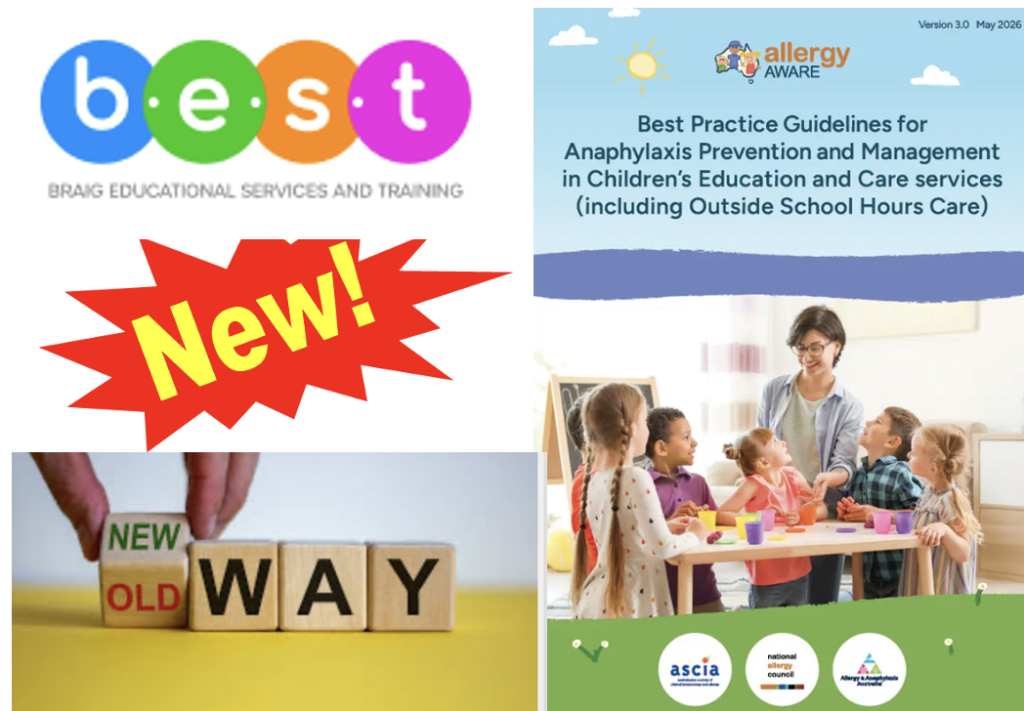
BEST NEW RESOURCE ALERT: Allergy Resource for Childcare: What Educators, Managers & Families Need to Know About the Updated Anaphylaxis Guidelines (May 2026)

A major new resource has been released for the children’s education and care sector: Best Practice Guidelines for Anaphylaxis Prevention and Management in Children’s Education and Care Services (Version 3.0 – May 2026). The updated national guidelines were developed by the National Allergy Council with input from health professionals, education departments, ACECQA, allergy organisations and early childhood providers across Australia. 

These guidelines are designed to help services reduce the risk of anaphylaxis while ensuring children with allergies can fully participate in childcare experiences, excursions and everyday learning.

Importantly, the 2026 update introduces new expectations around adrenaline devices, drills, excursion planning and food allergy management training.

What is New in the 2026 Updat
Creating Safe, Inclusive Spaces: Honouring Every Child During Food Allergy Week

For most of us, food is love. It is shared in laughter, celebration, and everyday moments of care. But for some children and families, food carries a very different feeling—one of vigilance, anxiety, and constant awareness. A simple bite can hold serious risk. A shared snack can mean exclusion. And a moment that should feel joyful can quickly become overwhelming.

During Food Allergy Week (24th–30th May), led by Allergy & Anaphylaxis Australia, we are invited to truly step into the perspective of these children and families. To slow down. To listen. And to ask ourselves—are we doing everything we can to ensure every child feels safe, included, and a genuine sense of belonging?

In early childhood settings, this matters deeply. Food is woven through our day—morning tea, shared celebrations, cooking experiences, cultural connections. These are the moments where children build relationships and identity. Guided by the evidence-based practices of Australasian Society of Clinical Immunology and Allergy (ASCIA), we have the opportunity—and responsibility—to ensure these experiences are not only safe, but inclusive, empowering, and grounded in empathy.

Because at its heart, this work is not just about managing allergies.
It is about protecting children.
It is about building trust with families.
And it is about ensuring that no child ever feels like they don’t belong at the table.